LinkedIn reports 80 conversions. Google Ads reports 62. The CRM contains 39 qualified opportunities, while billing confirms only 14 new customers. Product data shows that just nine of those accounts reached activation.
SaaS attribution is difficult because the conversion is rarely a single transaction. The journey can include anonymous research, advertisements, content, trial activity, product usage, sales calls, CRM stages, and recurring revenue.
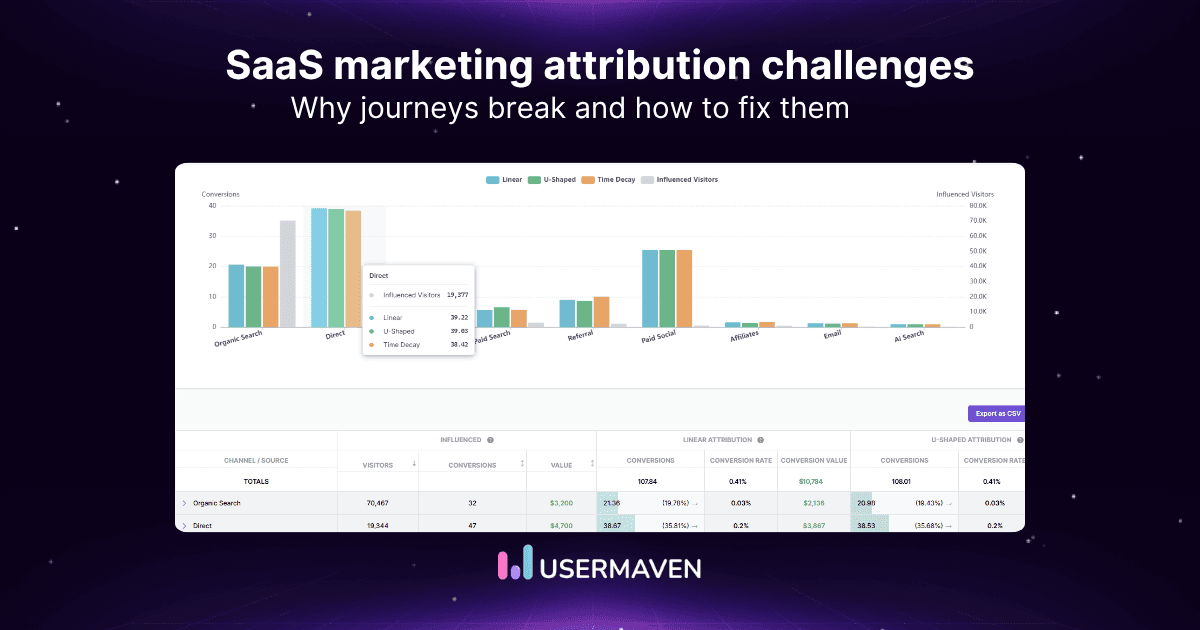
These interactions may also span several months and involve multiple people from the same company. A reliable multi-touch attribution system must connect those activities without treating every signup or platform-reported conversion as equal.
This guide examines 12 major SaaS marketing attribution challenges, how each one affects reporting, and the practical steps needed to fix them.
Key takeaways
SaaS attribution is more complicated than one-time purchase attribution because journeys can include multiple stakeholders, product activity, sales conversations, recurring subscriptions, and long conversion cycles.
Marketing platforms, product analytics, CRMs, and billing systems frequently report different outcomes because each one observes a different stage of the customer lifecycle.
SaaS teams should measure more than leads and signups. Attribution should connect acquisition with activation, qualified pipeline, paid conversion, retention, expansion, and revenue.
Reliable attribution requires consistent conversion definitions, connected customer identities, suitable attribution windows, and models that reflect the company’s go-to-market motion.
Why SaaS marketing attribution is uniquely difficult
A traditional ecommerce journey may end when a customer completes a purchase. SaaS journeys continue after the initial conversion.

A signup might be followed by onboarding, activation, team invitations, product-qualified status, a sales conversation, a paid subscription, renewal, and expansion.
The most meaningful conversion therefore depends on the business model:
Product-led SaaS may prioritize activation and product-qualified leads.
Sales-led SaaS may prioritize opportunities, pipeline, and closed-won revenue.
Hybrid SaaS must connect both product activity and sales involvement.
Enterprise SaaS may need to combine several contacts into one account journey.
This creates several possible attribution endpoints rather than one universal conversion.
| Measurement area | One-time purchase | SaaS |
|---|---|---|
| Buying cycle | Usually shorter | Often extended |
| Decision-makers | Commonly one buyer | Frequently several stakeholders |
| Main conversion | Completed purchase | Signup, activation, opportunity, or subscription |
| Revenue | Single transaction | Recurring and expandable |
| Product activity | Usually follows purchase | Often influences conversion |
| Sales involvement | May be limited | Can be central to the journey |
| Attribution endpoint | Purchase | Revenue, retention, or lifetime value |
12 SaaS marketing attribution challenges and how to fix them
1. Long sales cycles delay revenue feedback
SaaS prospects may interact with a company for weeks or months before becoming customers.
A campaign can generate interest today, but the opportunity might not enter the CRM until next month or close until the following quarter.
This delay makes recent campaigns appear unprofitable. It also encourages teams to optimize around early events such as form submissions rather than qualified pipeline or revenue.
Consider a prospect who discovers the company through paid search in January, attends a webinar in February, requests a demo in March, and becomes a customer in May. A short reporting period may disconnect the January campaign from the final sale.
Google recommends choosing a conversion window that reflects the typical time required for a customer to convert. A window that is shorter than the real SaaS sales cycle can exclude important early interactions.
How to fix it
Measure the average time from first interaction to paid conversion.
Set an attribution window that reflects that timeline.
Connect campaign activity with CRM stages and closed revenue.
Compare acquisition cohorts after enough deals have matured.
Avoid judging recent campaigns before their opportunities have progressed.
2. Multiple stakeholders create fragmented journeys
A SaaS purchase may involve an end user, department manager, technical reviewer, finance lead, procurement team, and executive approver.
Each stakeholder can interact with different channels, content, devices, and sales representatives.
Salesforce notes that the average B2B sales deal can involve six to ten decision-makers. Tracking only the contact who submitted a form can therefore miss most of the account’s research and influence.
For example, a marketing manager might click a LinkedIn advertisement. The head of product may later read a case study, while the CFO visits the pricing page before the deal is approved.
Contact-level attribution can record these people as unrelated leads even though they contributed to the same purchase.
How to fix it
Connect individual contacts with their company or account.
Associate marketing activity with CRM accounts and deals.
Analyze journeys at both contact and account levels.
Preserve activity from every known stakeholder.
Evaluate account engagement instead of relying only on the lead creator.

3. SaaS customer journeys are nonlinear
SaaS prospects rarely move through a simple sequence from awareness to consideration and purchase.
They may move repeatedly between organic search, paid campaigns, review sites, webinars, product pages, email, direct visits, and sales conversations.
A customer may discover a blog through organic search, return through LinkedIn, attend a webinar, start a trial, and convert after an onboarding email.
A single-touch model can make the final email or direct visit appear responsible for a journey that several channels supported.
How to fix it
Capture the full sequence of recorded interactions.
Analyze the complete SaaS customer journey.
Compare common paths for converted and non-converted users.
Use multi-touch reporting for journeys involving several channels.
Evaluate how channels assist one another instead of ranking them in isolation.
4. Anonymous visitors are difficult to connect with known users
Most SaaS journeys begin before the prospect provides an email address or creates an account.
A person may read several articles, visit comparison pages, and return through branded search before finally signing up.
When anonymous activity is not connected with the later user profile, the recorded journey begins too late. The original acquisition source can disappear, and returning visitors may be treated as new users.
This makes bottom-funnel channels appear stronger while content and awareness campaigns lose credit.
How to fix it
Preserve first-party visitor identifiers.
Merge previous activity when the visitor becomes known.
Use consistent user and account IDs across connected systems.
Connect website activity with signup and product events.
Test identity merging across sessions, domains, and devices.
5. Product-led and sales-led touchpoints overlap
Hybrid SaaS companies often combine self-serve product usage with sales-assisted conversion.
A prospect might start a trial, activate an important feature, invite teammates, speak with sales, and then purchase an annual plan.
Marketing analytics may stop at signup. Product analytics records activation, while the CRM begins the journey at the sales conversation.
Each system tells only part of the story.
This separation can make sales appear to create demand independently, even when marketing and product usage generated the opportunity.
How to fix it
Connect acquisition source with product analytics.
Define activation and product-qualified lead events.
Sync meaningful product activity with CRM records.
Separate self-serve and sales-assisted conversions.
Report the path from acquisition through product usage and revenue.
6. Trials and freemium plans blur the real conversion
A free trial signup is not the same as a paying customer.
Many users create accounts but never complete onboarding, activate a key feature, invite teammates, or subscribe.
This makes signup volume a weak measure of campaign quality.
Suppose Campaign A produces 200 trial signups and ten customers. Campaign B creates 80 signups and 24 customers.
Signup attribution favors Campaign A, but paid conversion and revenue clearly favor Campaign B.
How to fix it
Create a conversion hierarchy that reflects the SaaS sales funnel:
Signup
Onboarding completion
Activation
Product-qualified lead
Paid subscription
Retained customer
Expansion
Measure every channel across these stages rather than selecting one universal conversion event.
7. Marketing, product, CRM, and billing data remain siloed
SaaS lifecycle data is normally spread across several systems:
Advertising platforms
Website analytics
Marketing automation
Product analytics
CRM software
Subscription billing
Finance systems
These platforms may use different customer identifiers, account names, event definitions, dates, and revenue values.
The advertising platform may report a demo request. The CRM records an opportunity, while billing creates a subscription under a different customer identifier.
Without a shared connection, the campaign cannot be reliably tied to the customer or revenue.
How to fix it
Establish shared user, account, deal, and transaction identifiers.
Standardize important event and conversion definitions.
Connect CRM and billing outcomes with acquisition data.
Decide which system owns each metric.
Create one reporting layer across the connected lifecycle.
8. Privacy restrictions create missing journey data
Browser restrictions, ad blockers, consent decisions, cookie limitations, and device switching reduce the amount of customer activity that can be observed.
A prospect might click an advertisement on a phone, return through a work laptop with an ad blocker, and convert through another browser.
Some systems may see only the original click. Others may record the final conversion without knowing where the visitor came from.
The result is fragmented identity and incomplete attribution.
How to fix it
Prioritize first-party data collection.
Use server-side measurement where appropriate.
Respect consent while preserving permitted identifiers.
Send verified outcomes from CRM and billing systems.
Use cookieless attribution methods where third-party tracking is unavailable.
Document the measurement gaps that cannot be recovered.
9. Advertising platforms claim overlapping conversions
Google, Meta, LinkedIn, and other advertising platforms measure their own influence.
A customer may click a LinkedIn advertisement, return through Google Ads, open an email, and convert directly. More than one advertising platform can claim the same customer.
Adding the reported conversions together can therefore produce more conversions than the business actually received.
This also inflates platform-reported return on ad spend and makes cross-channel budget decisions unreliable.
How to fix it
Use an independent cross-channel attribution layer.
Compare click-through and view-through conversions separately.
Align conversion definitions, dates, and windows.
Do not add self-reported platform conversions together.
Reconcile ad platform discrepancies against CRM and billing outcomes.
10. Single-touch models oversimplify SaaS journeys
First-click attribution gives the discovery source all the credit. Last-click attribution gives everything to the final recorded interaction.
Both models can answer useful questions, but neither represents the full SaaS journey.
First-click can overvalue awareness channels. Last-click can overvalue branded search, direct visits, retargeting, and sales emails.
Middle-funnel content, webinars, comparison pages, and product interactions may receive no credit even when they helped move the account forward.
How to fix it
Compare several marketing attribution models.
Use first-click reporting to understand demand creation.
Use last-click reporting to understand final demand capture.
Test U-shaped or time-decay models for longer journeys.
Review conversion paths alongside attributed credit.
Avoid treating any one model as objective truth.
11. Marketing conversions do not equal pipeline or revenue
Advertising and analytics platforms often stop at form submissions, signups, or demo requests.
The commercially important outcomes happen later.
A lead may never qualify. A demo may not become an opportunity, and an opportunity may never close.
One campaign might produce 100 leads and one customer. Another generates 30 leads and seven customers. Lead-based reporting favors the wrong campaign.
How to fix it
Import CRM lifecycle stages into attribution reporting.
Track MQLs, SQLs, opportunities, pipeline, and closed-won deals.
Connect deal values with the original campaigns.
Use revenue attribution to compare channels by business impact.
Return qualified outcomes to advertising platforms for optimization.
12. Expansion, renewals, churn, and LTV are ignored
Many attribution systems stop when the customer first pays.
For SaaS companies, the initial subscription may represent only a small portion of the customer’s eventual value.
A channel can generate many customers who cancel quickly. Another may produce fewer customers who remain for years, upgrade, and expand across their organization.
Acquisition-only reporting makes both channels appear more similar than they really are.
How to fix it
Connect acquisition sources with subscription and product data.
Compare retention and churn by channel.
Track expansion and renewal revenue.
Evaluate customer acquisition cost alongside lifetime value.
Use SaaS revenue analytics to separate initial revenue from retained value.
How to build a reliable SaaS attribution system
The twelve challenges cannot be fixed through one model or dashboard. SaaS attribution needs a connected measurement process.
Map the complete SaaS lifecycle
Document the journey from first visit through recurring revenue.
Include:
Anonymous acquisition
Lead capture
Signup or demo
Onboarding
Activation
Product-qualified status
Sales opportunity
Paid conversion
Retention
Expansion
Renewal
This prevents attribution from stopping at the first convenient event.
Define a conversion hierarchy
Give every important event a clear business meaning.
For example:
| Conversion level | Example |
|---|---|
| Marketing engagement | Webinar registration |
| Lead generation | Demo request |
| Product engagement | Key feature activated |
| Qualification | Product-qualified or sales-qualified lead |
| Pipeline | Opportunity created |
| Revenue | Paid subscription |
| Retention | Subscription renewed |
| Expansion | Account upgrade |
Avoid using “conversion” as one undefined metric across every platform.
Standardize campaigns and events
Document the naming rules for:
Campaigns
Events
Conversion goals
User IDs
Account IDs
Deal IDs
Transaction IDs
Consistent definitions make data easier to connect and audit.
Connect the core systems
SaaS attribution should bring together:
Advertising data
Website activity
Product usage
CRM lifecycle stages
Billing outcomes
Revenue
The purpose is not to copy every data point into one place. It is to preserve the links between acquisition, behavior, pipeline, and revenue.
Match the model to the go-to-market motion
Product-led SaaS needs attribution connected with product activation.
Sales-led SaaS needs account, opportunity, and pipeline attribution.
Hybrid SaaS needs both.
Enterprise SaaS must also connect several stakeholders with the same account and deal.
Return downstream outcomes to advertising platforms
Campaign algorithms should not optimize only for form submissions.
Where possible, send later outcomes such as:
Qualified leads
Opportunities
Paid subscriptions
Revenue
High-value customer segments
This helps advertising platforms learn from commercially meaningful conversions.
Build one attribution dashboard
A marketing attribution dashboard should show more than channel conversion totals.
Include:
Marketing spend
Leads
Activated users
Product-qualified leads
Qualified pipeline
Closed revenue
Trial-to-paid conversion
Retention
Audit the system regularly
Attribution quality declines when websites, campaigns, products, and CRM processes change.
Review:
Event firing
Duplicate records
Missing campaign parameters
Identity merging
CRM synchronization
Revenue matching
Unexpected differences between systems
Choosing the right attribution model for SaaS
There is no universal best attribution model for every SaaS company.
The appropriate model depends on the question being answered, the sales cycle, data quality, and go-to-market motion.
| Model | Best use in SaaS | Main limitation |
|---|---|---|
| First-click | Identifying demand-creation channels | Ignores nurturing and closing interactions |
| Last-click | Understanding final demand capture | Overvalues branded and bottom-funnel channels |
| Linear | Recognizing every recorded touchpoint | Treats every interaction as equally valuable |
| Time-decay | Long journeys where recent touches matter more | Can undervalue initial discovery |
| U-shaped | Emphasizing discovery and conversion | Underweights middle-funnel nurturing |
| Data-driven | Mature teams with substantial connected data | Depends on volume and data quality |
| Custom | Businesses with clearly defined milestones | Requires governance and validation |
Most SaaS teams should compare several models rather than searching for one permanent answer.
A practical approach is to use first-click reporting for demand creation, last-click for demand capture, and a multi-touch model for the broader journey.
CRM pipeline and revenue should remain the commercial outcomes against which the models are evaluated.
How Usermaven solves SaaS attribution challenges
Usermaven connects marketing attribution with website behavior, product activity, customer journeys, CRM pipeline, and revenue.
This allows SaaS teams to evaluate channels using signup, activation, opportunity, and revenue data instead of relying only on advertising clicks or form submissions.

Connect acquisition with product behavior
Usermaven combines website and product analytics in the same environment.
Teams can connect campaigns with:
Landing-page behavior
Account creation
Product events
Funnel progression
Feature usage
Activation
Retention
This helps identify which channels generate customers who engage with the product rather than only those who create accounts.
Visualize complete customer journeys
The user journeys feature shows how visitors and customers move across pages, sessions, channels, and product interactions.
Teams can inspect:
Common conversion paths
Drop-off points
Repeated visits
Product journeys
User and account activity
High-value conversion sequences
Compare attribution models using one dataset
Applying several attribution models to one connected dataset makes comparison more meaningful.
Changes in channel credit can be understood without comparing disconnected reports from different advertising platforms.
Connect CRM pipeline and revenue
Usermaven’s Scale plan includes paid-ad attribution, channel and content attribution, CRM revenue and pipeline attribution, multi-touch conversion paths, customer journey attribution, and conversion sync. (usermaven.com)
This connects marketing activity with later outcomes such as:
Qualified leads
Opportunities
Pipeline
Closed revenue
Customer value
Investigate performance with Maven AI
Maven AI helps teams examine attribution, campaigns, funnels, customer journeys, product behavior, and revenue.
Instead of creating a separate report for every question, teams can investigate performance changes across the connected dataset.
Start without an enterprise implementation
Usermaven offers public pricing, self-serve access, and a 14-day free trial without requiring a credit card.
This allows teams to test tracking, customer journeys, product analytics, and attribution using their own data before selecting a paid plan.
Unlock insights that drive growth
*No credit card required
Common SaaS attribution mistakes
SaaS attribution fails when signup, product usage, pipeline, revenue, and retention are measured separately instead of as one connected journey.

Treating signup as the final conversion
A signup proves that a user created an account. It does not prove activation, qualification, payment, or retention.
Campaigns should be compared across the full conversion hierarchy.
Using one model for every decision
First-click, last-click, and multi-touch models answer different questions.
Using one model for awareness, demand capture, pipeline, and revenue can create misleading conclusions.
Using an attribution window shorter than the sales cycle
Short windows remove early interactions before the deal closes.
The attribution window should reflect observed conversion time rather than a default platform setting.
Tracking contacts without connecting accounts
Individual contact tracking fragments buying committees.
Account-level reporting is necessary when several people influence one opportunity.
Separating marketing from product activity
A campaign may generate signups that never activate.
Product behavior provides the context needed to distinguish acquisition volume from customer quality.
Optimizing advertisements for form submissions
Form submissions are easier to collect than qualified pipeline, but they may produce poor optimization signals.
Later funnel events should be connected through revenue attribution and returned to advertising platforms where possible.
Ignoring expansion, renewal, and churn
Acquisition reporting cannot show whether a channel produces valuable long-term customers.
Retention and revenue analytics should be analyzed by source and campaign.
Treating attribution as causality
Attribution distributes credit across recorded interactions.
It does not prove that a campaign created conversions that would not otherwise have happened. Incrementality testing is needed to evaluate causal impact.
Final verdict
SaaS marketing attribution challenges are structural as well as technical.
Teams need a clear conversion hierarchy, connected identities, shared event definitions, appropriate attribution windows, and reporting that continues from acquisition through revenue and retention.
The right SaaS attribution software should connect campaigns with website activity, product usage, customer journeys, CRM pipeline, and recurring revenue.
That connected view allows teams to optimize for customers and business value rather than clicks, leads, or isolated platform claims.
Start a free 14-day Usermaven trial and evaluate attribution using real campaign, product, CRM, and revenue data.
See what's working. Fix what's not. Grow faster.
*No credit card required
FAQs
1. Why is SaaS marketing attribution difficult?
SaaS customer journeys often span several channels, sessions, devices, stakeholders, and months. The conversion may also involve a free trial, product activation, sales opportunity, paid subscription, renewal, or expansion. Different systems observe different parts of that lifecycle.
2. What is the biggest SaaS attribution challenge?
The largest challenge is connecting fragmented data across advertising, website analytics, product activity, CRM records, and billing systems. Without shared identities and conversion definitions, teams cannot reliably connect marketing activity with revenue.
3. Which attribution model works best for SaaS?
No single model works best for every SaaS business. First-click is useful for measuring demand creation, last-click helps evaluate final demand capture, and multi-touch models provide a broader view of longer journeys.
4. How should long SaaS sales cycles be attributed?
The attribution window should reflect the observed time from first interaction to conversion. Campaign activity should also be connected with later CRM stages and closed revenue so early interactions are not lost before the deal matures.
5. How can multiple stakeholders be tracked in one journey?
Contacts should be connected with their company, account, opportunity, or deal. Teams can then analyze both individual journeys and the combined activity of the buying committee.
6. How should free-trial conversions be attributed?
Trial signups should be treated as one stage rather than the final conversion. Attribution should continue through onboarding, activation, product-qualified status, payment, and retention.
7. How can campaigns be connected with CRM revenue?
Use consistent user, account, and deal identifiers across marketing and CRM systems. Campaign data can then be associated with opportunities, pipeline values, closed deals, and revenue.
8. Can GA4 handle SaaS marketing attribution?
GA4 can measure website and app behavior, acquisition, events, and selected conversion paths. SaaS teams may still need CRM, product, account-level, and revenue data that exists outside GA4 to evaluate the full customer lifecycle.
9. How should product-led SaaS attribution be measured?
Product-led attribution should connect the original acquisition source with signup, onboarding, activation, feature adoption, product-qualified status, and paid conversion. Signup volume alone does not show whether a channel generates successful product users.

Written by
Ryan Mitchell
Marketing Analytics Strategist
Ryan Mitchell is a marketing analytics strategist specializing in campaign measurement, customer journeys, and marketing performance. He writes about analytics, reporting, and data-driven marketing strategies, helping SaaS and B2B teams measure what matters across every stage of the customer journey.
All articles by Ryan →