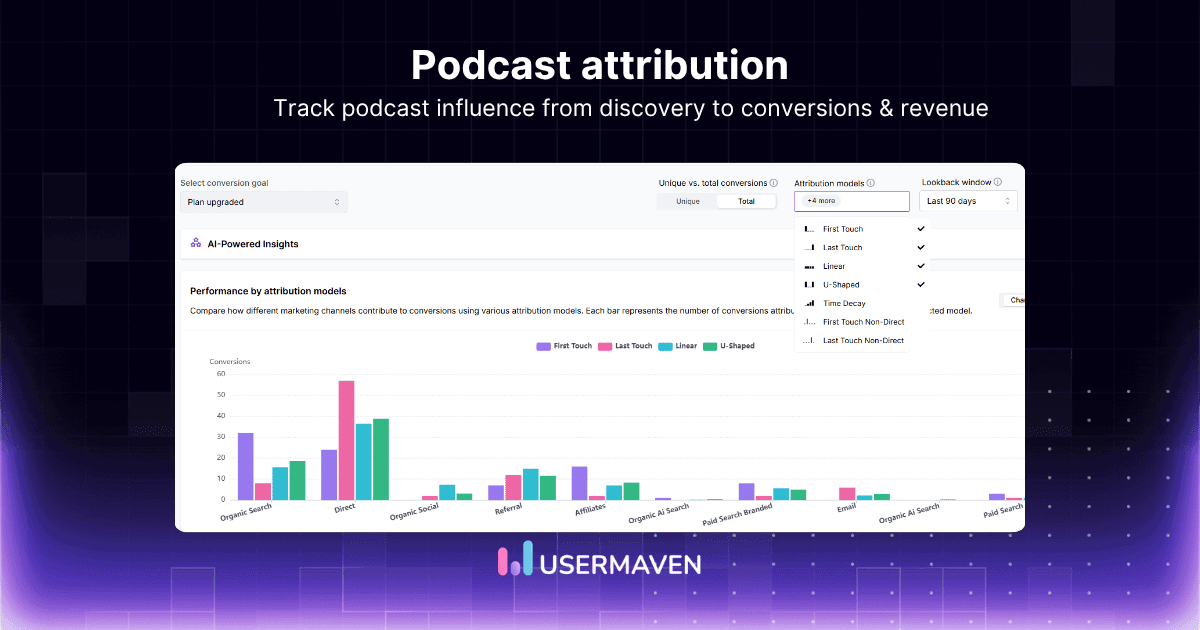
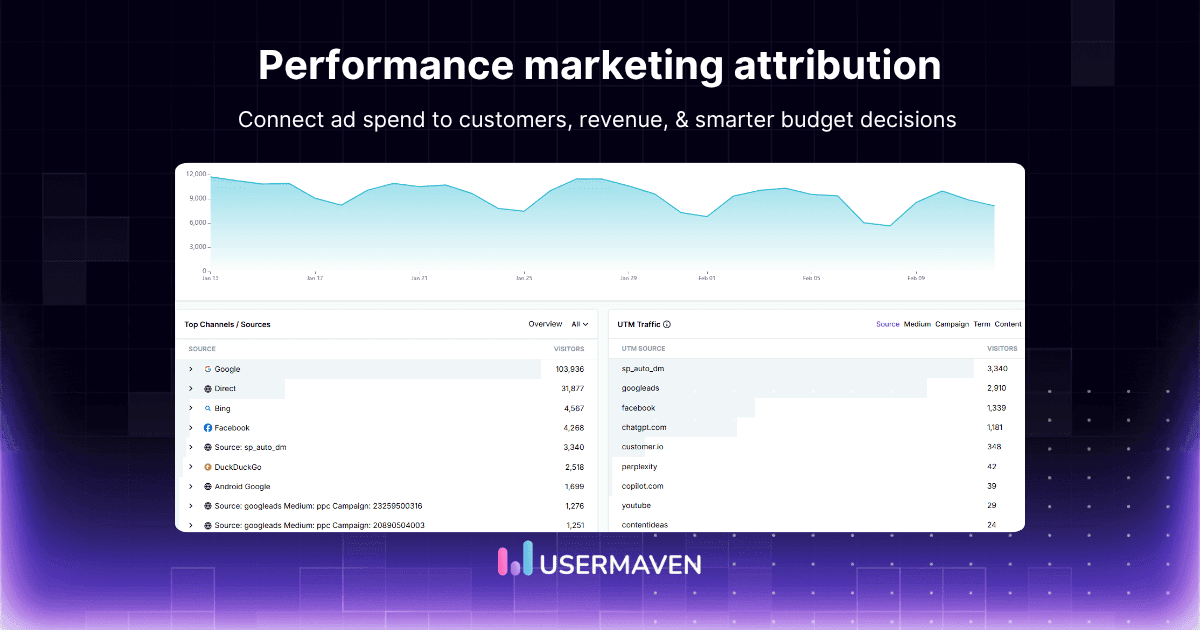
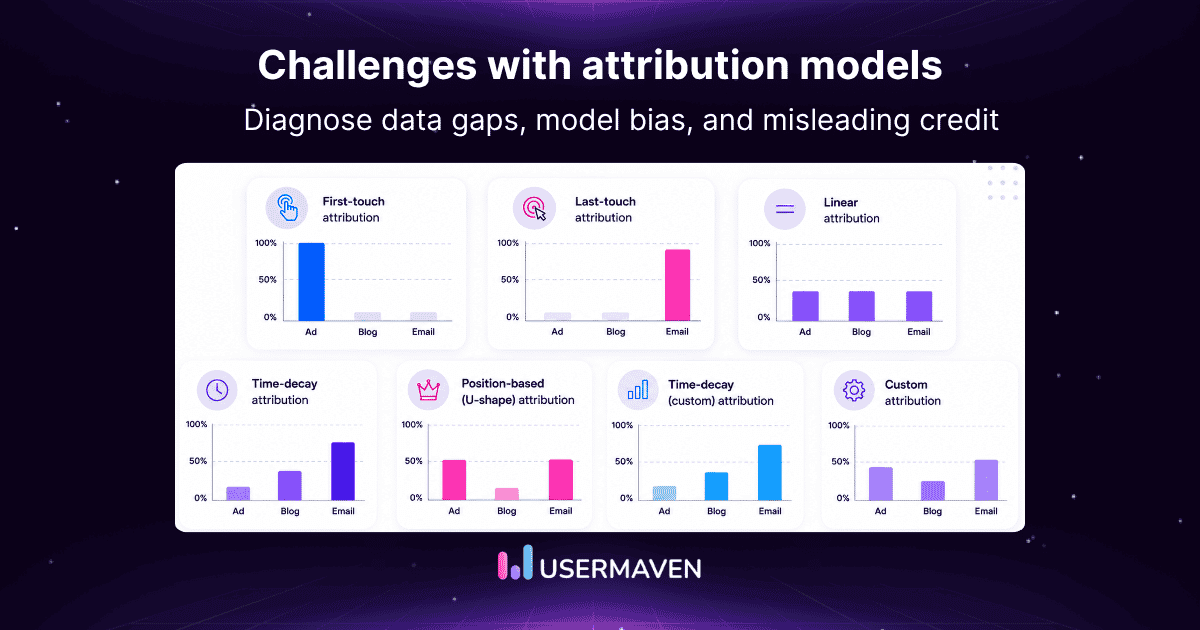
B2B marketing attribution is harder than assigning revenue to the ad or page that came before a conversion. One deal can involve several people, dozens of interactions, a long sales cycle, offline conversations, and a CRM opportunity that appears months after the first website visit.
The challenge is connecting those recorded interactions across people, accounts, channels, pipeline stages, and revenue without pretending every influence is perfectly observable.
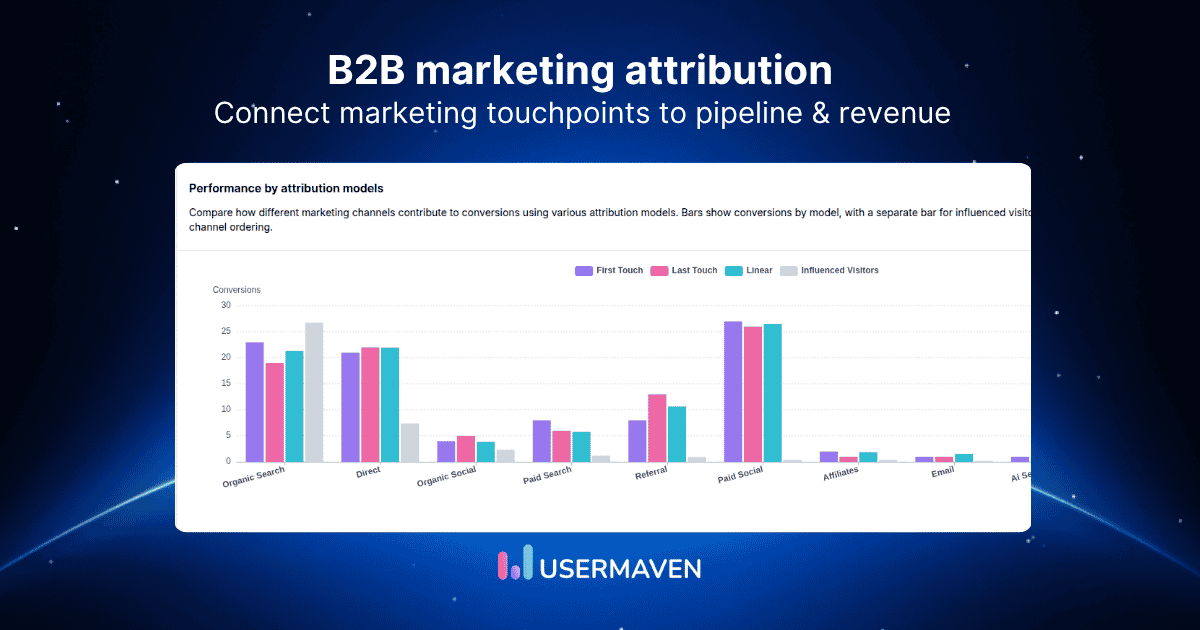
A useful marketing attribution system therefore connects interaction -> person -> account -> opportunity -> revenue -> retention/LTV before it decides how credit should be distributed.
B2B marketing attribution at a glance
B2B marketing attribution is the process of connecting recorded marketing interactions across people, accounts, channels, and sales stages with pipeline and revenue, then applying a defined credit model to understand how those observed interactions contributed to the commercial journey.
Attribution measures recorded contribution. It does not, by itself, prove causal incrementality. A channel can receive credit because it appears in a measured journey without proving that the conversion would not have happened without that channel.
B2B marketing attribution at a glance
| Point | What it means | Why it matters |
|---|---|---|
| Measurement unit | Person + account | B2B buying involves multiple stakeholders |
| Revenue outcome | Opportunity + pipeline + Closed Won | Leads alone are not enough |
| Attribution rule | Model + eligibility + lookback window | Different rules produce different credit |
| Measurement limit | Only observed interactions receive credit | Dark/offline influence remains partly invisible |
| Long-term value | Retention + expansion + LTV | Closed Won may not reveal customer quality |
Key takeaways
- B2B attribution starts with identity: A model cannot fix broken visitor, contact, account, or CRM matching.
- The buying unit is often an account: One opportunity may contain several people who interacted with different channels.
- Credit is not causality: Attribution distributes credit across observed interactions; incrementality asks what actually caused additional outcomes.
- Windows matter as much as models: A sophisticated model cannot recover a touchpoint excluded by the lookback window.
- Pipeline is more useful than leads: B2B measurement should connect campaigns with opportunities, revenue, and qualified pipeline.
- Closed Won is not the end: Retention, expansion, and LTV can change which channel creates the best customers.
- No platform sees everything: Dark social, events, sales conversations, and word of mouth need complementary evidence.
Why B2B attribution is different from B2C
B2C and B2B attribution use many of the same tracking methods and credit models, but the entity being measured is different. A consumer purchase can often be tied to one person and one transaction. A B2B deal is more likely to involve a buying group, sales stages, and a CRM opportunity that accumulates influence over time.
B2C vs B2B attribution
| B2C | B2B |
|---|---|
| Often one buyer | Account / buying committee |
| Shorter path | Longer journey |
| Purchase-centric | Lead -> opportunity -> revenue |
| Mostly digital | More human/offline influence |
| One identity | Multiple stakeholders |
| Lower deal complexity | Sales stages + CRM process |
Buying committees
Imagine Jane, a marketing manager, discovers the company through an organic article. Her VP later clicks a LinkedIn ad. A technical evaluator attends a webinar, while procurement joins only after a sales conversation.
The CRM may ultimately contain one opportunity, but the observed marketing journey belongs to several people. A contact-only report can therefore overstate the importance of whichever individual happened to submit the first form.
Longer buying cycles
B2B journeys often move through awareness, research, internal evaluation, demo, security review, procurement, contract negotiation, and Closed Won. Early demand can be separated from revenue by weeks or months.
That time gap changes how attribution windows, identity resolution, and model choice should be interpreted. A 30-day window can make a six-month buying journey look much simpler than it actually was.
More offline and dark influence
Conferences, podcasts, communities, peer recommendations, analyst conversations, sales calls, partner introductions, and executive relationships can materially influence a deal without producing a clean click.
B2B attribution is therefore strongest when tracked evidence is treated as one measurement layer rather than a claim that every causal influence has been observed.
See Usermaven in action
Book a free demo and discover how powerful analytics can grow your business.
Three levels of B2B attribution
A useful way to mature B2B attribution is to move through three levels. Each level answers a more commercially important question.

Level 1: Interaction attribution
The first level asks: Which recorded marketing touches received credit? The units are ads, pages, emails, organic search visits, referrals, content assets, and other trackable interactions.
This level is useful for campaign optimization, but it can still stop too early. A source can generate many attributed leads without producing strong opportunities or revenue.
The same principle applies to individual assets. Content attribution can show which articles, comparison pages, webinars, and case studies start or assist valuable journeys, but the content signal becomes more useful when it is connected with later pipeline and revenue rather than judged only by page traffic.
Level 2: Account and pipeline attribution
The second level asks: Which activities contributed to qualified accounts, opportunities, and pipeline? The useful metrics move toward pipeline sourced, pipeline influenced, opportunity creation rate, pipeline by source, and win rate.
This is where multi-touch attribution becomes more useful for B2B because several interactions can be preserved instead of compressing the journey into one source field.
Level 3: Customer-value attribution
The third level asks: Which acquisition journeys create customers that retain, expand, and produce higher LTV? This shifts the analysis toward retention by source, expansion revenue, LTV by source, and CAC:LTV.
Moving from interaction credit to customer-value attribution changes the question from what converted? to what creates valuable customers? That distinction is especially important for recurring-revenue businesses.
Contact-level vs account-level attribution
B2B teams often need both contact-level and account-level views. They answer different questions and fail in different ways.
Contact-level attribution
Contact-level attribution asks which interactions influenced one identifiable person. It is useful for lead journeys, content engagement, campaign response, and individual conversion analysis.
For example, Jane may first arrive through organic search, return from an email, visit pricing, and request a demo. A contact journey can preserve that sequence well.
Account-level attribution
Account-level attribution asks which interactions across everyone at the company contributed to one commercial outcome. It is more useful for ABM, buying committees, enterprise sales, and opportunity analysis.
At Acme, Jane’s organic visit, the VP’s LinkedIn click, the evaluator’s webinar attendance, and a later sales meeting can all be relevant to the same opportunity even though no one individual experienced the entire path.
Why individual attribution can miss buying reality
Different stakeholders can enter through different channels. One participant may never submit a form, contact roles can change, and marketing interactions overlap with sales activity.
Account-level attribution solves part of that problem, but it introduces another requirement: identities and company associations must be reliable enough to group the right people together.
Contact-level vs account-level attribution
| Question | Contact level | Account level |
|---|---|---|
| Who engaged? | Individual | Buying group |
| Revenue object | Lead/contact | Opportunity/account |
| Best for | Lead journeys | B2B revenue |
| Main risk | Misses other stakeholders | Requires good account identity |
How B2B marketing attribution works
The measurement architecture comes before the model.

A practical B2B chain looks like this:
| Measurement chain: Campaign -> visitor -> person -> account -> CRM stage -> opportunity -> revenue -> retention/LTV |
Collect marketing interactions
Start with reliable acquisition and behavioral evidence: UTMs, advertising clicks, referrers, landing pages, content, sessions, forms, and meaningful product or website actions.
Structured event tracking helps preserve the actions that matter between the first visit and the later CRM outcome instead of reducing the journey to pageviews.
Resolve identities
An anonymous browser eventually needs to become a known person, and that person may need to be associated with a company. Identity resolution is the bridge between early marketing activity and later CRM revenue.
Contacts Hub provides a profile layer where visits, lead details, source information, and behavioral history can be viewed together after the identity is known.
Connect CRM outcomes
The CRM should contribute the commercial milestones that marketing analytics does not know on its own: lead or contact, company or account, deal or opportunity, stage history, Closed Won status, and revenue.
Without those fields, a campaign can look successful because it created many forms even when few of those forms become qualified pipeline.
Define conversion eligibility
A B2B attribution report must define what outcome is being credited. A demo request, qualified opportunity, Closed Won deal, and expansion are different conversions and should not be treated as interchangeable.
The selected outcome changes which journeys are included, when the journey ends, and what commercial question the report can answer.
Choose the lookback window
The attribution window defines how far back the system can look for eligible interactions. For B2B, the window should reflect the real research and sales cycle rather than an arbitrary default.
A sophisticated attribution model cannot recover touchpoints that fell outside the measurement window. If an important webinar happened 120 days before Closed Won but the report only looks back 90 days, the model never gets the chance to credit it.
Apply the attribution model
Only after the journey, identity, conversion, and window are defined should the credit rule be applied. The model determines how the observed touches share credit; it does not repair missing evidence.
B2B attribution models compared
Different models answer different questions. A team should select the model based on the decision it is trying to make, not because one model is universally more accurate.
B2B attribution models compared
| Model | Best question | Main B2B risk |
|---|---|---|
| First touch | What created awareness? | Ignores nurture |
| Last touch | What closed the recorded journey? | Overcredits demand capture |
| First non-direct | What first known source created demand? | Still ignores later assists |
| Last non-direct | What known channel closed? | Can overcredit late-stage channels |
| Linear | Which touches participated? | Assumes equal influence |
| Time decay | What mattered near conversion? | Undervalues early demand |
| U-shaped | What introduced and converted? | Can underweight the middle |
| Data-driven | What patterns correlate with conversion? | Needs reliable data volume |
| Custom/W-shaped | Which milestones matter to our process? | Can encode subjective assumptions |
First-click attribution
First-click attribution gives full credit to the first recorded interaction. It is useful for studying demand creation and the channels that start measurable relationships, but it ignores the nurture and sales activity that follows.
Last-click attribution
Last-click attribution gives credit to the final recorded interaction before conversion. It helps identify closing activity, but closing credit should not be interpreted as proof that the channel created the demand.
First non-direct attribution
First non-direct attribution credits the earliest known non-direct source in the eligible journey. It can reduce the tendency for direct traffic to absorb returning visits, but it still ignores the later interactions that helped move the account toward revenue.
Last non-direct attribution
Last non-direct attribution credits the latest known non-direct source before conversion. It is useful when direct return visits would otherwise take final credit, but it can still overvalue late-stage demand capture.
Linear attribution
A linear attribution model gives every eligible touch the same share. It is transparent and useful as a participation baseline, but equal credit should not be confused with equal causal influence.
Time-decay attribution
Time-decay attribution gives increasing weight to more recent interactions. It can be useful for long nurture cycles where late-stage activity becomes more diagnostic, but it can understate the channels that created early awareness.
U-shaped attribution
U-shaped attribution emphasizes the beginning of the journey and the conversion milestone. It can fit teams that care strongly about acquisition and lead creation, but it can underweight the middle of a long buying process.
Data-driven attribution
Data-driven attribution uses observed journey patterns rather than a fixed position rule. Its usefulness depends on having enough reliable conversion data and a measurement chain that is complete enough for the model to learn from.
Custom or W-shaped attribution
Custom and W-shaped models assign more weight to milestones that matter to the business, such as first touch, lead creation, opportunity creation, or conversion. They can reflect a B2B process more closely, but they can also encode subjective assumptions if the weighting rules are not tested.
The broader marketing attribution models guide explains the mechanics and trade-offs of the major credit models in more detail.
Model comparison is not model truth
Consider a $50,000 B2B deal with five recorded touches: organic search -> LinkedIn ad -> webinar -> nurture email -> demo retargeting.
One deal, three attribution interpretations
| Model | Credit |
|---|---|
| First touch | Organic search = $50,000 |
| Last touch | Demo retargeting = $50,000 |
| Linear | Organic + LinkedIn + webinar + email + demo = $10,000 each |
Nothing about the buyer’s history changed. Only the credit rule changed.
Attribution model output is an interpretation of observed data, not a different historical reality. This is why executive decisions should rarely depend on one model alone.
Why B2B marketing attribution becomes inaccurate
Most attribution errors are not caused by the credit formula. They begin earlier when the recorded journey is incomplete, duplicated, misclassified, or disconnected from the CRM outcome.
Common B2B attribution accuracy problems
| Problem | What happens | What to check |
|---|---|---|
| Identity fragmentation | One buyer appears multiple times | Visitor/contact matching |
| Multiple stakeholders | Credit stays on one contact | Account associations |
| Offline influence | Important touches disappear | CRM + self-reported data |
| Platform self-attribution | Channels double-claim revenue | Independent attribution layer |
| CRM gaps | Revenue cannot connect correctly | Opportunities/stages/roles |
| Short lookback window | Early demand vanishes | Attribution window |
| Direct traffic | Repeat visits lose original context | Source handling |
| Cross-device behavior | One person becomes multiple users | Identity resolution |
| Model bias | One stage gets structural advantage | Compare models |
A strong B2B attribution workflow audits the measurement chain before changing models. Moving from last touch to multi-touch does not fix broken UTMs, missing contact-to-account relationships, or incomplete opportunity revenue.
Dark funnel does not make attribution useless
Recorded attribution can only assign credit to observed interactions. That boundary should be explicit.
Peer recommendations, podcasts, communities, conferences, analyst conversations, partner introductions, private Slack or WhatsApp discussions, and word of mouth can influence demand without leaving a clean trackable path.
Supplement tracked attribution
Use tracked attribution together with ‘How did you hear about us?’ responses, sales discovery notes, CRM source fields, partner or referral tracking, event attendance, and survey data.
Self-reported evidence should not be treated as a perfect replacement for behavioral data either. Buyers forget, simplify, and remember the most salient influence rather than every touch.
The goal is not perfect attribution. The goal is to make uncertainty visible while improving the measurable portion of the journey.
Attribution belongs inside blended measurement
B2B measurement improves when attribution is used alongside methods that answer different questions. Treating one method as universal truth creates false certainty.

Attribution and complementary measurement methods
| Method | Best question |
|---|---|
| Attribution | Which recorded touches received credit? |
| Incrementality | What outcomes happened because of marketing? |
| MMM | How does aggregate spend relate to outcomes? |
| Self-reported attribution | What invisible influence does the buyer remember? |
| CRM/pipeline analysis | Which marketing connects with qualified revenue? |
Attribution
Attribution is strongest for understanding recorded journeys and comparing how channels participate under a defined credit rule.
Incrementality
Incrementality asks a causal counterfactual: how many conversions, opportunities, or revenue outcomes would not have happened without the marketing activity?
Marketing mix modeling
MMM works at an aggregate level and is useful for budget-level effects when user-level journeys are incomplete or unavailable. It does not replace customer-journey analysis.
Self-reported attribution
Self-reported attribution can reveal podcasts, communities, peers, events, and word of mouth that tracked systems may not capture reliably.
CRM measurement
CRM and pipeline analysis validates whether marketing-created demand progresses into opportunities, wins, and revenue.
Attribution is useful evidence, but it should not be treated as the only evidence.
Unlock insights that drive growth
Confidence levels in B2B attribution
Not every attribution result deserves the same level of confidence. Teams can make better decisions by labeling evidence according to how directly the interaction, identity, CRM outcome, and revenue are connected.
B2B attribution confidence framework
Confidence | Example | Interpretation |
|---|---|---|
| High | Tagged click -> known contact -> verified opportunity -> revenue | Strong recorded connection |
| Medium | Anonymous journey later matched across sessions | Useful but identity-dependent |
| Directional | Podcast, conference, word of mouth, community | Influence exists but credit is incomplete |
High-confidence attribution
A tagged interaction that resolves into a known person, maps to the correct account, connects to a verified opportunity, and carries complete revenue has a strong recorded chain.
Medium-confidence attribution
Anonymous journeys that are stitched later can still be very useful, but the result depends on identity continuity, cookie persistence, login behavior, email matching, and the attribution window.
Directional evidence
Offline and dark-funnel evidence can be directionally important without allowing precise fractional credit.
Attribution does not have to be perfect to be useful, but uncertainty should be visible.
B2B attribution metrics that matter
B2B teams should organize attribution metrics by the decision they support. Traffic and clicks describe activity; attribution and commercial metrics explain what that activity became.
B2B marketing attribution performance should therefore be read as a chain rather than a leaderboard. A channel can lead on traffic, lose on opportunity creation, recover on win rate, and still produce the highest LTV.
The useful question is not simply which channel has the largest attributed number, but where value strengthens or weakens as the journey moves toward revenue.
This is also why period-over-period changes need context. A lower attributed pipeline figure may reflect a shorter reporting window, a new model, slower sales cycles, or incomplete CRM syncing rather than a real fall in marketing quality. Before acting on a performance change, confirm that the conversion definition, lookback window, model, and data availability stayed comparable.
Pipeline metrics
- Pipeline sourced: Opportunity value from customers whose defined source is marketing.
- Pipeline influenced: Opportunity value where marketing participated somewhere in the eligible journey.
- Pipeline by source: Pipeline grouped by channel, campaign, source, or content.
- Opportunity creation rate: Qualified opportunities divided by the relevant lead or account population.
Revenue metrics
- Attributed revenue: Revenue credit assigned under the selected model.
- Revenue by source: Closed revenue grouped by acquisition source or channel.
- Win rate: Won opportunities divided by eligible opportunities.
- Average deal value: Closed revenue divided by won customers or deals.
Efficiency metrics
- CAC: Acquisition cost divided by new customers.
- Cost per opportunity: Marketing spend divided by opportunities created.
- Pipeline ROAS: Attributed pipeline value divided by paid spend.
- Revenue ROAS: Attributed revenue divided by paid spend.
Journey metrics
- Touchpoints per conversion: How many eligible interactions appear before the outcome.
- Time to opportunity: Time from the first recorded interaction to opportunity creation.
- Time to conversion: Time from first eligible interaction to the selected conversion.
- Assisted conversion rate: How frequently a channel participates without receiving final credit.
Customer-value metrics
- Retention by source: Whether customers from one acquisition path stay longer.
- LTV by source: Lifetime value grouped by acquisition source or attributed channel.
- Expansion revenue: Upsell or expansion value by acquisition cohort.
The dedicated marketing attribution metrics guide covers formulas and interpretation in more detail.
Pipeline attribution vs LTV attribution
Pipeline attribution asks who becomes a customer. LTV attribution asks which marketing creates the most valuable customers.
Imagine LinkedIn generates fewer opportunities but those customers sign larger contracts, retain longer, and expand more often. Paid search creates more opportunities and more immediate Closed Won revenue, but the customers churn faster.
If measurement stops at Closed Won, paid search may appear to win. If the business measures customer economics, LinkedIn may create more long-term value.
That is why recurring-revenue teams should connect attribution with retention and calculating SaaS LTV rather than treating the first contract as the final outcome.
For B2B SaaS, the journey continues in product
For B2B SaaS, the commercial journey often continues after the marketing conversion. A signup or demo is only useful if the account activates, adopts the product, reaches value, converts to paid, and remains a customer.
| SaaS journey: Marketing -> signup -> activation -> product usage -> opportunity -> customer -> retention |
This matters for PLG, sales-assisted SaaS, and hybrid motions because product behavior can reveal customer quality before the CRM closes the opportunity.
Useful questions include: Which campaigns create activated accounts? Which sources create users who adopt core features? Which acquisition paths create upgrades? Which channels produce retained customers?
Product analytics adds this post-signup behavior to the acquisition story instead of forcing marketing and product performance into separate measurement systems.
How CRM data completes B2B attribution
CRM data turns anonymous and lead-level behavior into commercial measurement. It supplies the stage progression and revenue record that web analytics alone cannot know.
HubSpot
HubSpot can contribute contacts, companies, deals, lifecycle stages, sales engagements, and Closed Won revenue. HubSpot’s official attribution reporting documentation also separates contact, deal, and revenue attribution, with deal and revenue attribution requiring Marketing Hub Enterprise.
For a deeper platform-specific explanation, see HubSpot revenue attribution.
Salesforce
Salesforce can contribute leads, contacts, accounts, opportunities, stages, revenue, and contact-role context. Its official Campaign Influence documentation shows why campaign-member and opportunity-contact relationships matter to revenue influence.
The Salesforce marketing attribution guide explains the native CRM layers and how pre-CRM behavior changes the picture.
Why CRM structure matters
A perfect clickstream cannot create accurate pipeline attribution when the opportunity, contact roles, stages, or revenue are incomplete.
Marketing and sales should therefore agree on the commercial outcome, stage definitions, association rules, and revenue fields before attribution results are used to reallocate budget.
What 2026 B2B attribution research reveals
Recent B2B research supports the same pattern that appears throughout the measurement workflow: marketers do not have a shortage of dashboards. The harder problem is connecting customer journeys, identities, accounts, CRM outcomes, and revenue well enough to trust the result.
For this secondary-research review, Usermaven examined recent B2B attribution and measurement research published primarily between 2024 and 2026. The studies use different samples, methodologies, geographies, and research populations, so their respondent counts should not be pooled.
The useful signal is the pattern across them: full-funnel measurement remains uncommon, data is still fragmented, and many teams do not trust marketing measurement enough to make confident revenue decisions.
What the research shows
| Research finding | Evidence | What it suggests |
|---|---|---|
| Full revenue attribution remains uncommon | 18% met Anteriad + Ascend2’s definition of Attribution Leaders | Most teams have not connected attribution fully through closed revenue |
| Revenue measurement is still incomplete | 51% strongly agreed measurement accurately reflects revenue impact in Walker Sands’ enterprise B2B study | Reporting activity is easier than proving business impact |
| Measurement often lacks decision trust | 64% said their organization does not trust marketing measurement for decision-making in Forrester research | Having attribution is not the same as having decision-grade attribution |
| Connected data remains difficult | Only 45% were very confident connecting data across teams in Demandbase + Harris research | Fragmentation is an infrastructure problem before it is a model problem |
| Customer-journey visibility remains difficult | 56% of B2B content marketers struggled to track customer journeys, and the same share struggled to attribute content ROI | Marketing influence is difficult to follow across the full journey |
| Observed B2B journeys can be highly complex | Dreamdata’s 2026 customer data describes roughly 88 touchpoints, 10+ people, and about 272 days | Short, contact-level reporting can miss much of the buying process |
Full visibility is still rare
The strongest headline comes from Anteriad and Ascend2’s 2026 B2B Marketing Edge research. Only 18% of respondents qualified as Attribution Leaders under the study’s definition: organizations with full visibility through closed revenue and attribution embedded in performance measurement.
The same research found that 45% of Attribution Leaders significantly exceeded their primary goals compared with 24% of other respondents. That is an association, not proof that attribution caused the performance difference, but it reinforces an important point: mature attribution tends to exist alongside stronger measurement discipline.
Reporting does not equal trust
The deeper problem is confidence in what the reports mean. Walker Sands’ 2026 enterprise B2B research found that only 51% of senior leaders strongly agreed that their marketing measurement accurately reflects revenue impact.
Forrester found an even sharper trust problem: 64% of B2B marketing leaders said their organization does not trust its marketing measurement for decision-making.
A company can produce source reports, campaign dashboards, and attributed revenue without having evidence strong enough to confidently move budget. This is the difference between having attribution and having decision-grade attribution: connected measurement trusted enough to guide a real budget or channel decision.
Fragmentation is the structural gap
The research also points toward infrastructure rather than model choice as the recurring bottleneck. Demandbase and The Harris Poll found that only 45% of B2B marketers were very confident in their ability to connect data across teams.
Content Marketing Institute and MarketingProfs found that 56% of B2B content marketers struggle to track customer journeys, while the same percentage struggle to attribute content ROI.
Those findings fit the architecture problem described earlier in this guide. Attribution becomes fragile when the journey crosses advertising platforms, analytics, content systems, marketing automation, CRM records, sales activity, and revenue without a dependable identity and account layer.
Journeys outlast reporting cycles
Journey complexity makes the problem harder. Dreamdata’s 2026 LinkedIn Ads benchmark analysis describes observed B2B journeys with roughly 88 touchpoints, 10 stakeholders, and about 272 days from first touch to closed revenue.
Those figures come from Dreamdata’s aggregated customer data rather than a representative survey of every B2B organization, so they should not be treated as universal averages. They do, however, illustrate why short reporting windows and one-contact attribution can create a misleadingly simple picture of the buying process.
From activity to decision
Across these studies, the common problem is not the absence of marketing data. It is the distance between activity visibility and decision-grade attribution.
| B2B measurement ladder: Activity -> journey -> identity -> account -> revenue -> decision |
A team can know where traffic came from and still be unable to answer whether those interactions belong to the same person, which people belong to the same account, which account became an opportunity, which opportunity generated revenue, and whether the evidence is reliable enough to change investment.
Reaching the final stage requires more than adding another attribution model. It requires connecting the measurement layers underneath it.
How Usermaven connects the B2B revenue journey
Usermaven does not need to claim that every B2B influence can be observed. Its role is to connect more of the measurable customer journey across acquisition, behavior, CRM outcomes, and revenue.

| Connected journey: Campaign -> website behavior -> known person -> company/account -> CRM deal/opportunity -> revenue -> retention/LTV |
Connect acquisition with behavior
Paid campaigns, organic search, referrals, content, landing pages, and behavioral events can be analyzed before the CRM outcome exists. This preserves the evidence that created or nurtured demand instead of starting the story at the form submission.
Reconstruct customer journeys
User journeys show the ordered path behind aggregate attribution reports, including return visits and meaningful behavior before conversion.
Connect HubSpot and Salesforce
With HubSpot, Usermaven collects its own behavioral data first and enriches identified profiles using HubSpot contact, company, deal, and engagement data. Email matching connects the CRM record with the behavioral history.
With Salesforce, Usermaven reads CRM records such as contacts, accounts, opportunities, and deal information, then enriches tracked profiles so acquisition and behavior can be analyzed beside pipeline outcomes.
Measure pipeline and revenue
Once CRM outcomes are available, teams can compare acquisition sources by opportunity value, win rate, Closed Won revenue, and other commercial outcomes instead of lead volume alone.
This is the role of revenue attribution at the buying-decision level: connecting marketing activity with the financial outcome the business actually cares about.
Continue into retention and LTV
For SaaS, the same measurement layer can continue beyond acquisition into product usage, retention, lifecycle, expansion, and LTV so the business can distinguish customers that merely convert from customers that create durable value.
Validate measurement before changing models
Changing attribution models does not fix broken collection or identity. Validate the measurement chain first.

Collection
Confirm that pageviews, events, campaign parameters, forms, and critical conversion actions are actually arriving. Missing events create false certainty because the model can only credit what exists.
Identity
Check whether anonymous visitors become the correct known people and whether those people map to the correct company or account.
Integrations
Verify that CRM and advertising connections are syncing the fields, costs, opportunities, stages, and revenue required for the report.
Conversion delivery
When conversion data is sent back to ad platforms, verify that the correct events are being delivered and that duplicate or stale conversions are not inflating campaign optimization.
Revenue integrity
Audit opportunity amounts, currencies, Closed Won status, expansion values, and missing revenue records before interpreting attributed revenue.
This measurement-health discipline is more important than switching from last touch to a more complicated model when the underlying evidence is unreliable.
How AI can help B2B marketing attribution
AI is most useful after the measurement chain is reliable. It can reduce the time required to investigate complex journeys, compare models, find anomalies, and connect channel performance with commercial outcomes.
Where AI is useful
- Investigate channel and campaign contribution.
- Compare how attribution credit changes across models.
- Find unusual shifts in conversion, pipeline, CAC, or LTV.
- Inspect account and customer journeys.
- Surface high-LTV acquisition sources.
- Query pipeline and Closed Won revenue.
- Analyze retention and product behavior by acquisition source.
- Create repeatable reports and views.
What AI cannot fix
AI cannot reconstruct data that was never collected. It cannot reliably repair missing UTM parameters, broken CRM associations, duplicated identities, incomplete revenue, unrecorded offline conversations, or invisible word of mouth after the fact.
AI can accelerate attribution analysis, but it cannot manufacture trustworthy measurement data.
Maven AI
Maven AI can help investigate B2B questions such as: Which channels create the most qualified pipeline? Which sources create the highest-LTV customers? What happened before Closed Won? Which acquisition paths retain best?
MCP for connected analysis
Usermaven MCP lets compatible AI tools query authorized marketing attribution, product analytics, funnels, journeys, retention, CRM-linked revenue, CAC, LTV, ARR, and other business metrics.
MCP also supports approval-gated creation of analytics objects such as funnels, journeys, segments, retention reports, dashboards, conversion goals, and attribution views. The important advantage is not generic AI access; it is AI grounded in the same connected behavioral and commercial data used for measurement.
Real-world evidence: B2B attribution in practice
Hyperengage
Hyperengage is a B2B SaaS post-sales intelligence company whose marketing journey spans content, organic search, podcasts, LinkedIn, email, and partnerships. Before Usermaven, the team relied on Google Analytics, CRM data, individual platform dashboards, and manual tracking, which produced fragmented versions of performance.
The Hyperengage case study is especially relevant to B2B attribution because the problem was not a lack of dashboards. It was the inability to connect several channels with qualified pipeline through one customer journey.
Hyperengage B2B attribution evidence
| Evidence | Result | Why it matters |
|---|---|---|
| Attribution coverage | 4 -> 6 channels | More of the journey became measurable |
| Visitor-to-goal rate | 22.19% | Acquisition connected with downstream goals |
| Organic first-touch conversions | 0 -> 8 | Previously hidden contribution surfaced |
| New sources uncovered | 2 | More acquisition paths became visible |
| Budget decision | Shifted toward qualified pipeline | Attribution changed spend decisions |
The useful standard is not whether every interaction receives perfect credit. It is whether better journey visibility changes decisions about qualified pipeline, marketing investment, and the sources worth scaling.
A second example: Buyer intent across journeys
The current Usermaven case-study library also shows Actisense using journey and intent data before the final revenue event. The company has tracked 5,000+ leads, identified 927 high-intent purchase signals, mapped 6 buyer journeys, and reported 5x faster decisions.
That evidence supports a different part of the B2B measurement problem: attribution is not only useful after Closed Won. Connected behavior can also help teams understand which journeys contain stronger buying intent before the opportunity reaches the final stage.
The live Usermaven case studies library should continue to be checked when this article is refreshed so the evidence block remains aligned with the strongest current B2B examples.
How to build a reliable B2B attribution system
1. Define the revenue outcome
Decide whether marketing should optimize for qualified lead, opportunity creation, pipeline, Closed Won revenue, expansion, or another business stage. Avoid letting every team use a different definition of success.
2. Standardize campaign tracking
Use consistent UTMs, channel definitions, campaign names, and source taxonomies so one campaign does not fragment into several reporting values.
A stable source attribution taxonomy also prevents Google, LinkedIn, partners, newsletters, and direct visits from being classified differently across tools. That consistency matters because model comparisons are meaningless when the underlying source labels change from one report to another.
3. Capture first-party behavior
Record the website and product events that indicate meaningful progress, not only pageviews. Examples include pricing visits, case-study views, demo clicks, signups, activation, and high-intent product actions.
4. Resolve identities
Connect anonymous sessions with known people after signup, login, or lead capture, then associate those people with the right company or account.
5. Connect the CRM
Bring in the opportunities or deals, stages, contact relationships, revenue, and Closed Won dates needed to connect marketing evidence with business outcomes.
6. Select realistic attribution windows
Match the lookback period to the actual buying cycle. A six-month enterprise sale should not be judged through a window designed for a short self-serve purchase.
7. Compare more than one attribution model
Use different models to answer discovery, participation, nurture, and closing questions. A single credit rule can hide structural bias.
8. Add self-reported and offline evidence
Capture conference attendance, partner introductions, sales-discovery notes, surveys, and ‘How did you hear about us?’ responses to reduce dark-funnel blind spots.
9. Track pipeline and customer value
Evaluate marketing against opportunity quality, pipeline, revenue, retention, expansion, and LTV rather than stopping at form submissions.
10. Audit measurement confidence
Review collection, identity, CRM associations, integrations, direct traffic, unattributed activity, and revenue integrity on a recurring schedule.
Choosing the right B2B attribution model
There is no universal best B2B attribution model. The best choice depends on the decision being made and the quality of the evidence available.
- For demand creation: First touch.
- For closing channels: Last touch or last non-direct.
- For journey participation: Linear.
- For long nurture cycles: Time decay.
- For awareness + conversion milestones: U-shaped.
- For sufficient reliable conversion volume: Data-driven or algorithmic approaches.
- For executive budget decisions: Compare multiple attribution views and supplement them with incrementality, pipeline, and customer-value evidence.
The strongest B2B setup usually combines a model with a realistic window, reliable identity, CRM outcomes, and a clear understanding of what the model cannot observe.
For recurring reporting, document the selected conversion, attribution window, eligibility rules, model, excluded sources, and CRM requirements next to the dashboard. That prevents a team from comparing two periods that were calculated under different rules and calling the difference a performance trend.
B2B marketing attribution checklist
- Campaigns use consistent source and UTM rules.
- Anonymous visitors can become known contacts.
- Contacts map to companies or accounts.
- CRM opportunities or deals are complete.
- Revenue is available and reconciled.
- The attribution window matches the sales cycle.
- Direct traffic is handled consistently.
- Several models can be compared.
- Dark and offline influence has a collection method.
- Pipeline metrics are tracked.
- Retention and LTV are available where relevant.
- Measurement quality is audited regularly.
- AI is used to analyze data, not replace missing data.
The attribution checklist can be used as an operational QA layer before reports are trusted for budget decisions.
Final verdict
B2B marketing attribution is fundamentally harder because buying journeys span people, accounts, channels, CRM stages, and offline influence. A neat credit model cannot remove that complexity.
The model matters, but the deeper priorities are identity, account resolution, attribution windows, CRM quality, revenue integrity, and visible measurement confidence. Better attribution starts by improving the evidence before changing the formula.
For B2B teams that want to connect acquisition with website behavior, product activity, HubSpot or Salesforce outcomes, pipeline, revenue, retention, and LTV, Usermaven provides one measurement layer across more of the measurable revenue journey.
Ready to see Usermaven in action? Explore the platform or book a demo for a closer look.
FAQs
1. What is B2B marketing attribution?
B2B marketing attribution connects recorded marketing interactions across people, accounts, channels, CRM stages, pipeline, and revenue, then uses an attribution model to decide how those observed interactions receive credit. It measures recorded contribution rather than proving causal incrementality.
2. How do you measure B2B marketing attribution?
Start by defining the commercial outcome, standardizing campaign tracking, capturing first-party behavior, resolving visitor and account identities, connecting CRM opportunities and revenue, setting a realistic lookback window, and then comparing attribution models. Pipeline, revenue, retention, and LTV should be added as the measurement matures.
3. Why is B2B marketing attribution difficult?
B2B journeys involve multiple stakeholders, long buying cycles, several digital channels, sales activity, offline influence, and CRM records that may appear much later than the first interaction. Accurate measurement therefore depends on identity and account resolution as much as the attribution model.
4. Why is B2B marketing attribution inaccurate?
Common causes include fragmented identities, missing UTMs, disconnected CRM records, incomplete opportunity or revenue data, short attribution windows, direct traffic, cross-device behavior, platform self-attribution, and offline influence that was never recorded.
5. What is the best attribution model for B2B marketing?
There is no universal best model. First touch is useful for demand creation, last touch for closing activity, linear for participation, time decay for later nurture, U-shaped for first and conversion milestones, and data-driven approaches when reliable data volume is sufficient. Comparing several models is usually safer than treating one as truth.
6. What is account-level marketing attribution?
Updated

Written by
Adeel Khan
Growth Marketing Expert
Adeel Khan is a full-stack SaaS marketer with 10+ years of experience in content marketing, paid advertising, analytics, and conversion rate optimization. He shares practical insights and strategies drawn from hands-on experience, helping B2B SaaS marketers improve performance and make better marketing decisions.
All articles by Adeel →