If you were to concisely describe how paid users of a service behave, compared to how free users behave, it would be this: the free user clicks around; the paid user gets things done.
And this has nothing to do with the fact that the free user doesn’t need the product. Once a free user converts to a paying one, the product usage skyrockets.
Basically, before they make a payment, a user will test limits.
They might explore features just out of curiosity, but once money’s on the line, things change. Users will start acting with purpose, looking for shortcuts, and any friction they hit will feel way more annoying than it did before.
What they could tolerate as a free user isn’t going to fly once they’re paying. The challenge is that dashboards treat free and paid users the same, but the intent behind their clicks is different, and that’s something to keep in mind.
How user intent shifts once payment is made
In order to build a better product, you need to first know how users behave, and that first payment changes everything. Before that moment, you’re just trying something out.
You’re playing around, clicking on whatever, testing limits, and seeing what the product could do. You don’t have to be efficient because your time still doesn’t have a price tag attached to it.
Once you pay, though, that shifts instantly. Your mindset shifts from testing to execution, and you’re no longer interested in what that particular feature does, but in whether it can help you get results.
Free users are all about discovery; that’s what drives their actions.
They wander and experiment. They’ll use a feature just because it’s there, never mind if they need it or not. But paid users have specific goals in mind, and they want results.
That change has an effect on focus and attention, which becomes more narrow and directed. It also does something in terms of patience.
If there’s friction or steps that are unclear, nobody will tolerate it and wait for fixes. You’ll see all this in daily behavior. Paid users log in because they have something to do, not because there’s a new button added and they want to mess with it just for funsies.
They go through tasks faster because they already know what they need to do, and they expect every session to provide more value because each of them now has a price.
The change in usage patterns after payment
Once a user becomes a paid subscriber, their behavior changes significantly.
Free users tend to spend more time exploring the product, jumping between features and menus. In contrast, paid users have shorter, more focused sessions because they know what they need and get straight to it. This is why a reliable processing infrastructure is essential; paid users expect smooth, uninterrupted performance to complete tasks efficiently.
While free users experiment with various tools, paid users focus on a select set of features that provide the most value, using them more intensively.
This shift leads to faster task completion and repeated workflows that directly solve their problems, indicating stronger product-market fit. Fewer actions, in this case, demonstrate greater efficiency.
Vanity metrics like clicks and pageviews lose significance once payment is involved, as they often reflect exploration rather than meaningful engagement. It’s crucial to separate free and paid user data for accurate insights. Mixing the two can distort the actual performance of the product.
Behavioral patterns that point to long-term retention
You won’t see this as one big moment. Long-term retention almost always builds up slowly, with repeatable behaviors (e.g., loyalty, task completion, consistent usage, focused usage, team expansion, etc.) that get stronger over time.
Paid users who stick around tend to leave behind clear patterns in how they use a product.
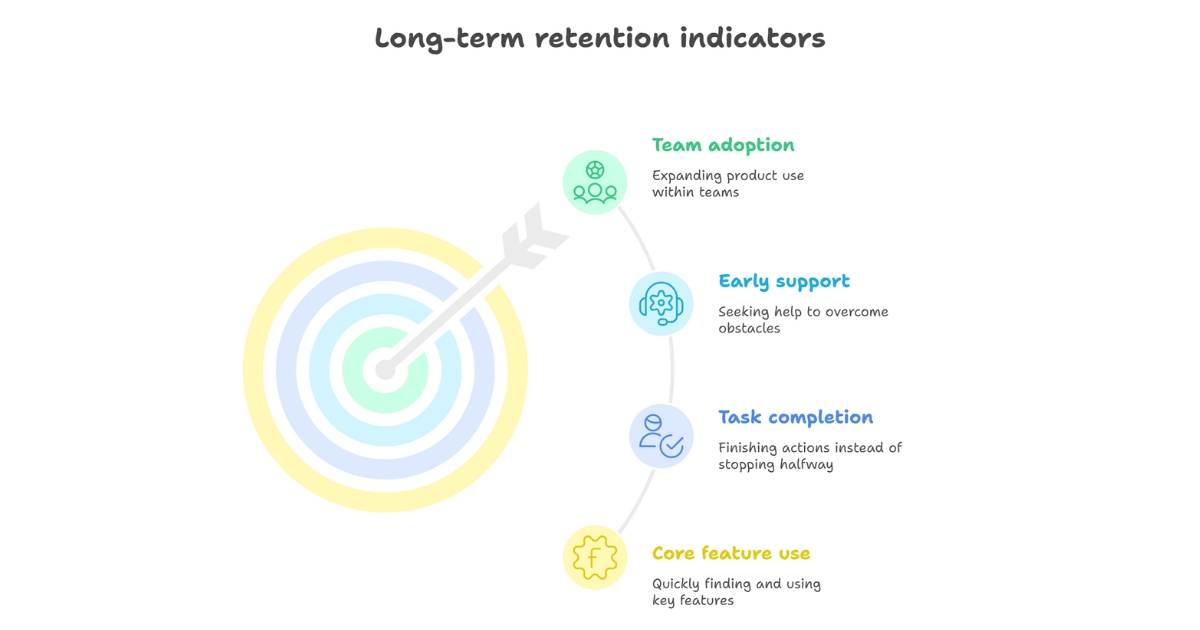
Paid users find their core feature quickly
Paid users find their aha moment early. They know exactly why they’re using a specific product or service.
Updated

Written by
Lauren Brooks
Lifecycle Marketing Strategist
Lauren Brooks is a lifecycle marketing strategist with 4+ years of experience helping SaaS businesses create meaningful customer experiences. She specializes in user engagement, retention, and conversion optimization, helping brands build stronger customer relationships beyond acquisition.
All articles by Lauren →