Your marketing funnel says customers are moving toward conversion. But their actual journey might tell a completely different story.
Someone discovers your brand through a Google search, leaves, returns through an ad, explores your product, and finally books a demo. The funnel shows their progress, but what about everything that happened along the way?
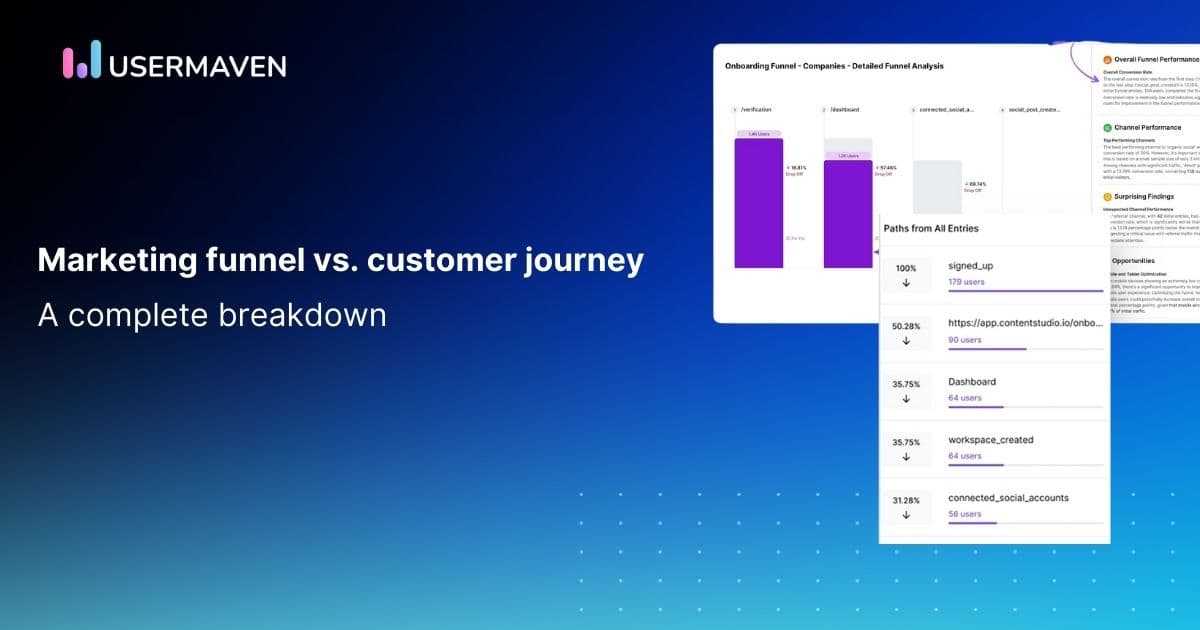
That’s the key difference between a marketing funnel vs. customer journey. One helps you measure progress toward a goal, while the other reveals how customers actually interact with your business.
Understanding both helps you spot conversion gaps, improve the customer journey, and make better marketing decisions.
Turn visitors into paying
customers with funnel analysis
Key takeaways
- Marketing funnels and customer journeys serve different purposes. Funnels measure progress toward specific goals, while journeys show how customers interact with your business.
- Funnels aren’t always linear. Customers can skip stages, return to earlier steps, or take different paths before converting.
- Customer journeys reveal the bigger picture. They help you understand touchpoints, customer behavior, and potential friction across channels.
- Both help improve conversions. Funnel analysis identifies where customers drop off, while journey analysis provides context around those interactions.
- Using both gives you better insights. Combining funnels, customer journeys, and marketing attribution helps connect customer behavior with conversions and revenue.
What is a marketing funnel?
A marketing funnel is a framework that helps businesses understand how potential customers progress from discovering a brand to taking a desired action, such as signing up, requesting a demo, or making a purchase.
It organizes the buying process into stages so marketers can measure conversions, identify drop-offs, and improve performance.
For example, a B2B SaaS company might track how many website visitors explore its pricing page, request a demo, and eventually become customers.
A funnel doesn’t mean everyone follows the same path. It simply helps you measure progress toward a goal. You can also use funnel analysis to measure onboarding, product activation, and retention.
Stages of a marketing funnel
Most marketing funnels include three main stages:
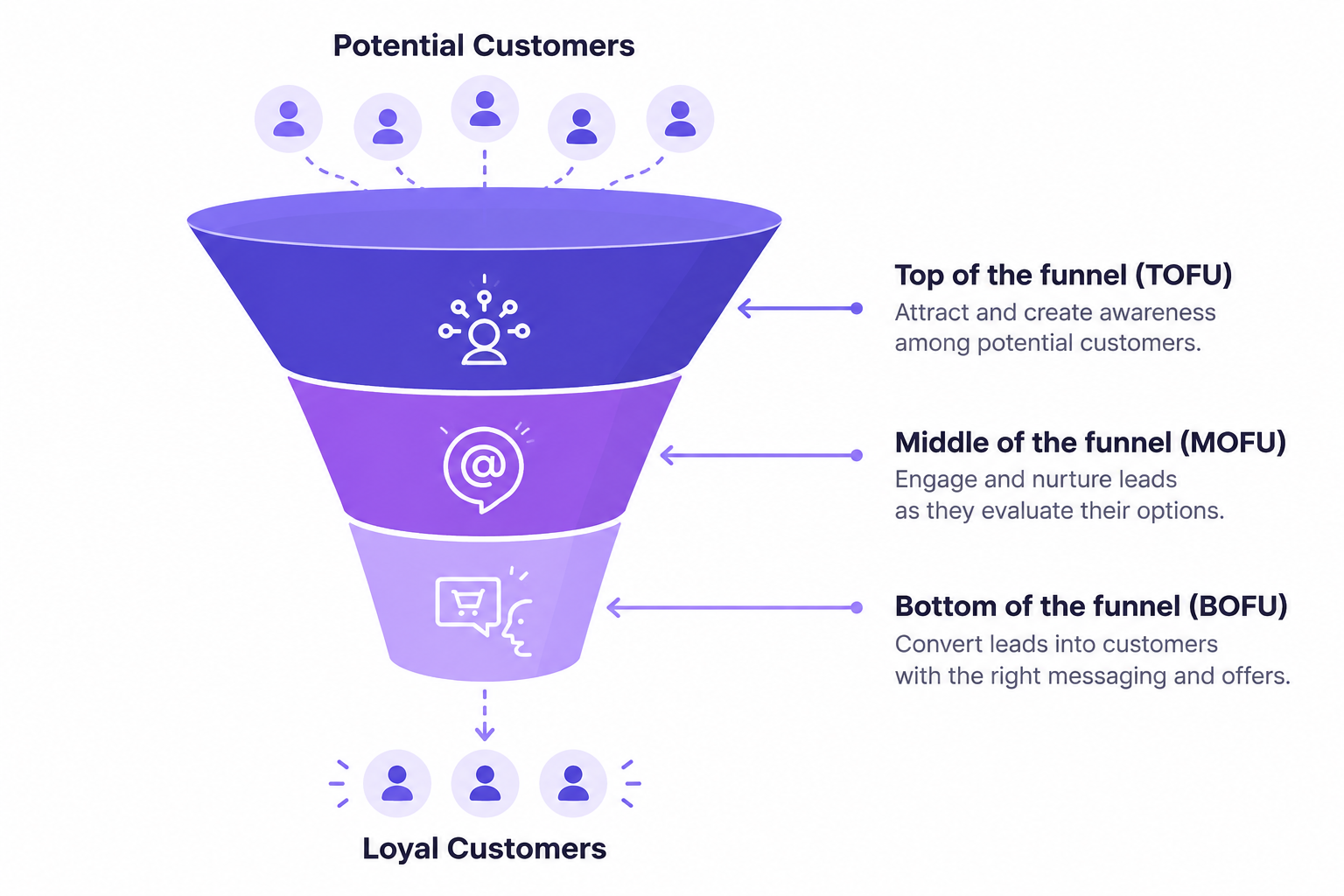
1. Top of the funnel (TOFU) – Awareness
Potential customers discover your business through search engines, social media, paid ads, referrals, or other channels.
The goal is to attract relevant audiences and introduce them to your product or service.
2. Middle of the funnel (MOFU) – Consideration
Prospects explore their options and evaluate whether your solution meets their needs.
Comparison guides, case studies, webinars, and product information can help them make informed decisions.
3. Bottom of the funnel (BOFU) – Conversion
Prospects are ready to take action, such as requesting a demo, starting a trial, or making a purchase.
Clear calls to action, relevant product information, and a simple conversion process can help reduce friction.
Benefits of a marketing funnel
A well-defined funnel helps marketing teams:
- Identify conversion bottlenecks: Find stages where prospects drop off.
- Measure campaign effectiveness: Understand how different audiences progress toward conversion.
- Improve lead nurturing: Deliver relevant content based on buying-stage needs.
- Optimize marketing spend: Focus resources on stages that need improvement.
- Track performance: Compare conversion rates across funnel stages and customer segments.
For a deeper look at building and measuring funnels, explore our digital marketing funnel guide.
Turn visitors into paying
customers with funnel analysis
What is a customer journey?
A customer journey is the complete experience someone has with a business, from their first interaction to becoming a customer and beyond.
It includes the different customer touchpoints people encounter, the questions they ask, and the decisions they make along the way.
For example, someone researching project management software might discover your brand through a blog, read customer reviews, compare alternatives, attend a webinar, and eventually book a demo.
But their experience doesn’t end after purchasing. Onboarding, product usage, support interactions, and renewals are also part of the journey.
Understanding these interactions helps businesses identify customer needs, remove friction, and create better experiences.
Stages of the customer journey
Although every customer takes a different path, a typical journey includes five stages.
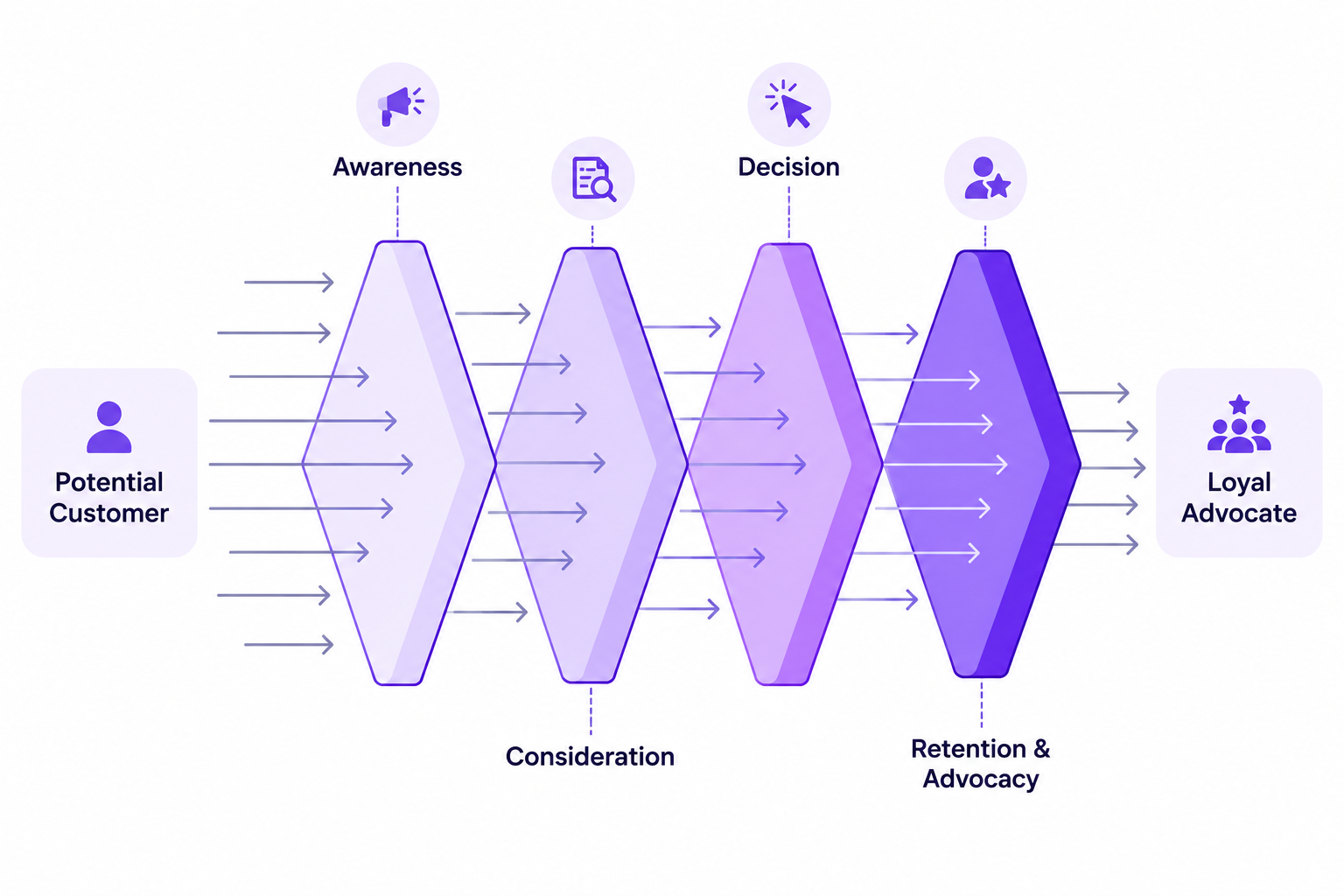
1. Awareness
Customers recognize a problem or discover a product that might help solve it. They may encounter your business through search results, social media, recommendations, or advertising.
2. Consideration
Customers research available solutions, compare features, read reviews, and evaluate which option best fits their needs.
3. Decision
Customers choose whether to move forward. Depending on the business, this might involve a purchase, subscription, or sales conversation.
4. Retention
After becoming customers, people interact with your product, onboarding resources, and support team. Their experience influences whether they continue using your solution.
5. Advocacy
Satisfied customers may recommend your business, leave reviews, or refer others. Advocacy isn’t guaranteed, but positive experiences can encourage it.
Why understanding the customer journey matters
Looking at individual interactions in isolation can make it difficult to understand why customers behave a certain way.
Analyzing the journey helps you:
- Identify friction points: Discover where customers experience confusion, delays, or difficulties.
- Understand buying decisions: Learn which interactions customers encounter before converting.
- Improve customer experiences: Make content, support, and communication more relevant.
- Support retention: Identify opportunities to improve onboarding and ongoing engagement.
- Recognize valuable touchpoints: Understand how different interactions contribute throughout the buying process.
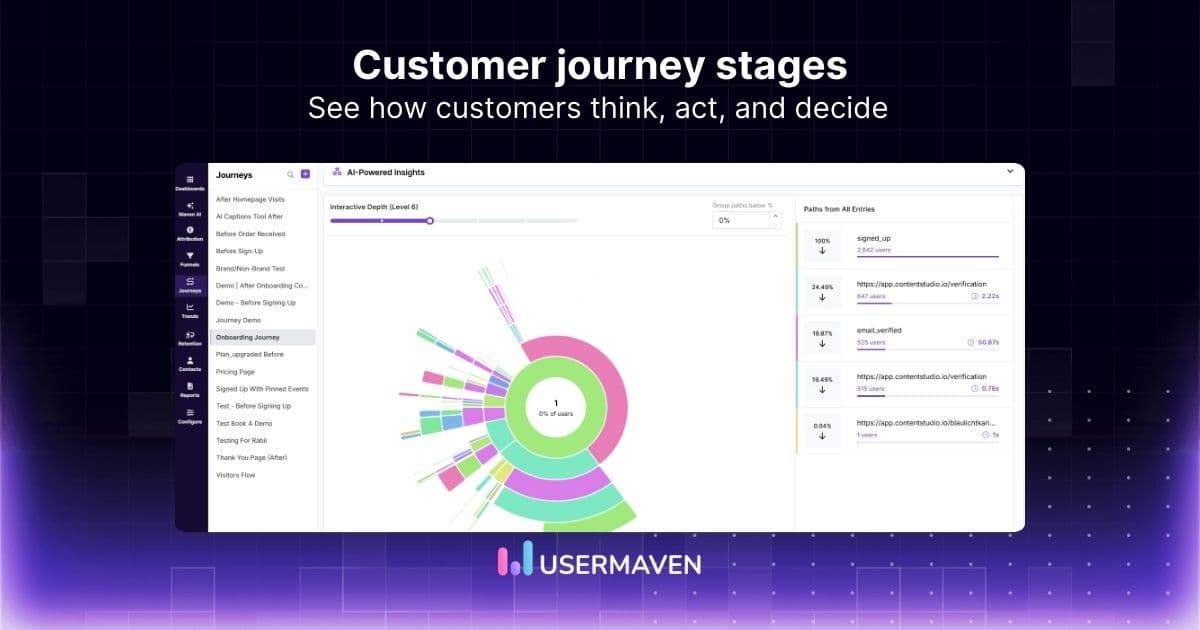
A customer journey map can help visualize these interactions, while user journey analytics helps you examine recorded behavior and identify patterns across journeys.
Visualize & optimize
user journeys with Usermaven
Marketing funnel vs. customer journey
The main difference between a marketing funnel and a customer journey is what each helps you understand.
A marketing funnel measures how people progress toward a specific goal. A customer journey explores the interactions, decisions, and experiences that shape that progress.
Here’s how they compare:
| Aspect | Marketing funnel | Customer journey |
|---|---|---|
| Main focus | Progress toward a defined goal | Customer interactions and experiences |
| Perspective | Business performance | Customer behavior and needs |
| Structure | Organized into measurable stages | Often involves multiple paths and touchpoints |
| Scope | A specific conversion or lifecycle process | The broader customer relationship |
| Key questions | Where are people dropping off? | What happens before, during, and after each interaction? |
| Common metrics | Stage conversion rates, drop-off rates, completion rates | Engagement patterns, journey duration, retention, touchpoint interactions |
| Common tools | Funnel reports, conversion tracking | Journey mapping, behavioral analytics |
| Best use | Finding conversion bottlenecks | Understanding customer behavior and improving experiences |
1. How they represent customer behavior
A funnel organizes activity into defined stages, making it easier to measure how many people complete each step.
A customer journey provides more context about the interactions surrounding those stages, including repeated visits, channel changes, and delays between actions.
For example, a prospect might visit your website three times before requesting a demo. A funnel can measure whether they complete that goal, while user journey analysis helps explain the path they followed.
Neither approach assumes that every customer behaves the same way.
2. What they help you measure
Funnels are particularly useful for understanding conversion rates and identifying stages where people abandon a process.
Customer journey analysis helps explain the context behind those outcomes.
For example, if demo requests decline, a funnel might reveal that fewer visitors are completing the booking form. Journey analysis can help you investigate what visitors did before reaching that form.
Together, these insights can guide a more informed conversion rate optimization strategy.
3. How they evaluate marketing touchpoints
A funnel can show how people move from initial interest to a conversion, but it doesn’t necessarily explain how different marketing channels influenced their decisions.
Customer journeys provide visibility into recorded interactions across channels, such as paid search, organic search, email, and referrals.
With different attribution models, marketers can evaluate how credit for conversions is distributed across those interactions under different attribution models.
This is particularly useful when customers engage with several channels before converting.
4. How they support long-term customer relationships
Marketing funnels aren’t limited to lead generation or sales. Businesses can also build funnels for onboarding, activation, and retention.
Customer journeys help provide context around these lifecycle stages by showing how customers interact with a product or service over time.
For example, a SaaS company might use an onboarding funnel to measure activation rates and customer retention analytics to investigate engagement patterns after signup.
Using both approaches helps teams evaluate individual conversion goals without losing sight of the broader customer experience.
Visualize & optimize
user journeys with Usermaven
Marketing funnel vs. customer journey example
Imagine a B2B SaaS company running Google Ads, publishing blog content, and promoting its product on LinkedIn.
A potential customer interacts with several of these channels before booking a demo and eventually purchasing a subscription.
Here’s how the same buying process looks through a marketing funnel and a customer journey.
| Customer interaction | Marketing funnel view | Customer journey view |
|---|---|---|
| Discovers a blog through Google | Awareness | Finds information about a problem |
| Returns through a LinkedIn ad | Consideration | Reconnects with the brand through another channel |
| Reads a product comparison | Consideration | Evaluates features and alternatives |
| Books a demo | Conversion | Moves from research to a sales conversation |
| Purchases a subscription | Customer acquisition | Begins onboarding and product adoption |
| Starts using the product | Activation | Experiences the product and evaluates its value |
What does the marketing funnel reveal?
The funnel helps the company measure how many prospects move from one defined stage to another.
For example, if 500 visitors explore the product page but only 20 request a demo, the demo-request conversion rate is 4%.
This gives the team a starting point for investigating potential friction in its lead generation process, landing pages, or demo booking experience.
However, the conversion rate alone doesn’t explain why visitors leave.
What does the customer journey reveal?
The customer journey adds context by showing the interactions prospects have before and after those conversion steps.
For example, the company might discover that many demo requests involve multiple visits, comparisons with competitors, and interactions with different marketing channels.
A SaaS customer journey analysis can help identify common patterns, while customer journey analytics can reveal where recorded interactions become disconnected or prospects abandon their research.
Why use both together?
The funnel tells you where conversion performance needs attention, while the journey helps you investigate the behavior surrounding those results.
For a B2B SaaS company, this becomes especially useful when connecting marketing activity with sales outcomes.
For example, pipeline attribution can help teams evaluate which recorded marketing interactions contribute to qualified opportunities and revenue, rather than measuring demo requests alone.
Together, these approaches help marketers understand conversion performance, investigate customer behavior, and make better decisions about improving the buying experience.
How to use marketing funnels and customer journeys together
Marketing funnels and customer journeys become more useful when you analyze them together. One helps you measure performance at specific stages, while the other provides context for improving the customer experience.
Here’s how to put both into practice.
1. Set clear conversion goals
Start by identifying the actions that matter to your business, such as demo requests, free trial signups, purchases, or product activation.
Then build a funnel around those actions to measure how people progress between stages.
For example, a SaaS company might track website visits, trial signups, onboarding completion, and paid subscriptions.
Choosing meaningful marketing KPIs helps you focus on outcomes rather than vanity metrics that don’t necessarily reflect business growth.
2. Map the interactions around each funnel stage
Once you’ve identified your conversion goals, explore how customers reach them.
Look at the content they consume, channels they visit, questions they ask, and interactions that happen before or after important actions.
A well-planned customer journey strategy can help you identify gaps between these experiences and create more relevant interactions throughout the buying process.
3. Investigate where customers drop off
Use funnel reports to identify stages with unusually high abandonment or declining conversion rates.
Then examine the surrounding customer behavior to understand possible reasons.
For example, if visitors frequently leave before completing a signup form, investigate whether the form is too complicated, the value proposition is unclear, or the page creates unnecessary friction.
Combining these insights with website conversion optimization can help you prioritize improvements based on observed behavior rather than assumptions.
4. Connect marketing touchpoints with business outcomes
A conversion doesn’t always happen after one interaction. Prospects may discover your business through organic search, return through paid campaigns, and convert after receiving an email.
Use marketing attribution to evaluate how different recorded touchpoints contribute to conversions under your chosen attribution model.
For B2B companies, connecting these interactions with CRM outcomes can also help evaluate which marketing activities contribute to qualified leads, opportunities, and revenue.
This is particularly useful when developing a B2B marketing attribution strategy that accounts for longer sales cycles and multiple decision-makers.
5. Review and improve continuously
Customer behavior changes as your campaigns, products, and audiences evolve.
Regularly review funnel performance, journey patterns, and conversion outcomes to identify new opportunities.
For example, customer segmentation can help you compare how different audiences interact with your business, while retention analytics can help you investigate what happens after acquisition.
Use these findings to improve the experience at each stage rather than treating your funnel or journey map as a one-time exercise.
How Usermaven helps you connect funnels and customer journeys
Knowing where customers drop off is useful. But understanding what they did before leaving, which channels brought them there, and whether they eventually converted gives you a much clearer picture.
Usermaven is an AI-powered marketing attribution platform that helps you analyze customer behavior, measure funnel performance, and connect marketing interactions with conversions, pipeline, and revenue.
Here’s how you can use both views together.
Find conversion gaps and investigate what caused them
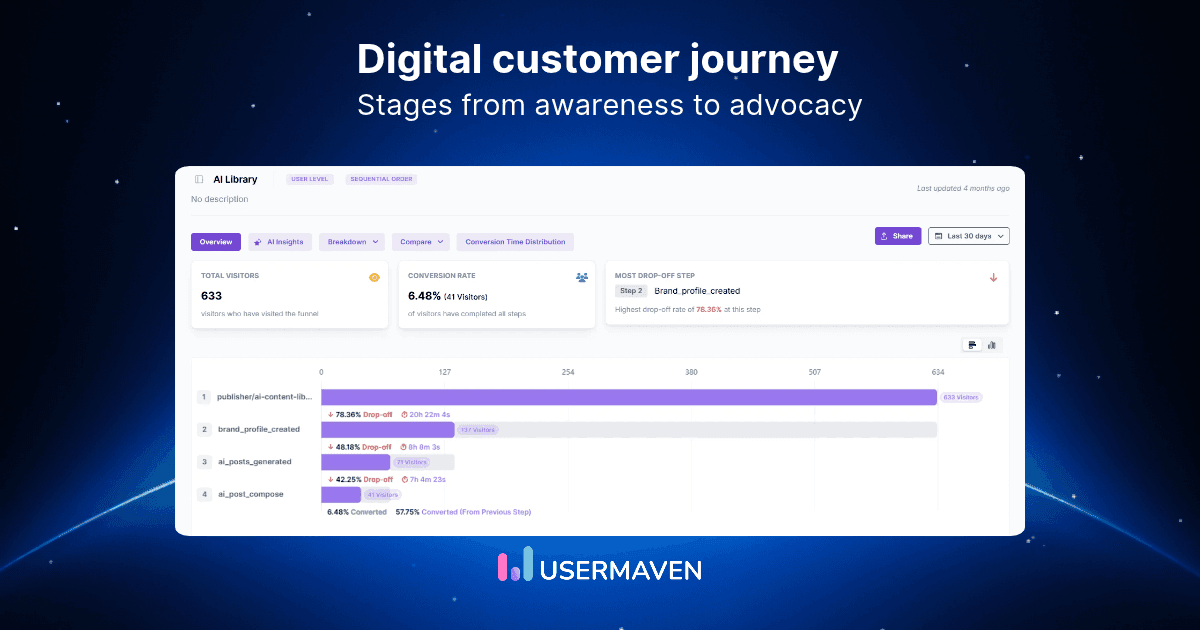
With funnel analysis, you can measure how visitors progress through important steps, such as visiting a pricing page, requesting a demo, or signing up.
When you notice a drop-off, user journey analytics helps you explore recorded customer interactions and identify patterns worth investigating.
For example, if visitors reach your pricing page but rarely request a demo, you can examine their journeys to understand what they explored before leaving.
Understand which marketing channels contribute to conversions
A prospect might discover your business through organic search, return through a Google ad, and convert after interacting with another campaign.
Usermaven’s multi-touch attribution helps you compare how different attribution models assign conversion credit across recorded marketing touchpoints.
This helps you evaluate campaigns beyond their immediate clicks or last-touch conversions.
Connect funnel conversions with pipeline and revenue
Not every signup or demo request becomes a paying customer.
By connecting marketing activity with CRM outcomes through integrations such as HubSpot and Salesforce, Usermaven helps you evaluate which campaigns contribute to qualified opportunities and revenue.
This is particularly useful for B2B SaaS teams that want to understand whether funnel improvements are producing valuable customers, not just more conversions.
Ask deeper questions with Maven AI
Maven AI helps you investigate performance using natural-language questions.
For example, you could ask which acquisition channels bring visitors who complete your signup funnel or how conversion patterns differ between customer segments.
Instead of treating funnels and customer journeys as separate reports, you can use their insights together to understand customer behavior and make more informed marketing decisions.
Book a demo to explore how Usermaven connects customer journeys, funnel performance, and revenue.
Turn visitors into paying
customers with funnel analysis
Final thoughts
The marketing funnel vs. customer journey debate isn’t about choosing one over the other. Both help you understand different parts of the customer experience.
The real value comes from using them together to identify conversion gaps, understand customer behavior, and improve the path from first interaction to long-term customer relationships.
With marketing attribution software like Usermaven, you can connect funnel performance and customer journeys with conversions, pipeline, and revenue to make more informed marketing decisions.
FAQs
1. Can a customer journey start before entering the marketing funnel?
Yes, customers often interact with a brand – through word of mouth, social media, or organic search – before officially entering a funnel.
2. Do marketing funnels apply to existing customers or just new ones?
While funnels focus on new customer acquisition, they can also be used for retention and upselling strategies within existing customer journeys.
3. How do emotions factor into the customer journey compared to a marketing funnel?
Customer journeys capture emotional triggers and decision-making moments, while funnels focus on structured, outcome-driven stages.
4. Can a customer skip stages in a marketing funnel?
Yes, real-world behavior isn’t always linear—some customers jump straight to a purchase or re-enter at different stages.
5. Do marketing funnels work the same way for B2B and B2C businesses?
Not always – B2B funnels are often longer and require multiple decision-makers, while B2C funnels tend to be shorter and more impulse-driven.
6. What role does post-purchase behavior play in funnels vs. journeys?
Funnels typically end at conversion, while customer journeys extend beyond, including retention, advocacy, and repeat purchases.
7. How does personalization impact marketing funnels vs. customer journeys?
Personalization enhances both—funnels use it for targeted messaging, while customer journeys adapt experiences based on individual behaviors.

Written by
Lauren Brooks
Lifecycle Marketing Strategist
Lauren Brooks is a lifecycle marketing strategist with 4+ years of experience helping SaaS businesses create meaningful customer experiences. She specializes in user engagement, retention, and conversion optimization, helping brands build stronger customer relationships beyond acquisition.
All articles by Lauren →