A customer might discover your company through a search result, read a comparison article, leave without buying, and return through an email days later. In another session, they may book a demo or complete checkout. The path rarely follows a straight line.
That sequence is the digital customer journey. The challenge is not only delivering a good experience, but understanding which online interactions happened, where customers struggled, and which marketing touchpoints preceded meaningful outcomes. Marketing attribution software can add conversion and revenue context to that evidence.
This guide explains the five stages of a digital customer journey, the touchpoints involved, how journeys differ across industries, and how to measure and improve them without mistaking incomplete tracking for a complete customer story.
Digital customer journey at a glance
A digital customer journey is the sequence of online interactions and experiences a person has with a business, from discovery and evaluation through purchase, continued use, and advocacy. It can span search engines, ads, websites, email, applications, and digital support channels.
| Question | Quick answer |
|---|---|
| What is a digital customer journey? | A customer’s online interactions with a brand over time. |
| What are its five stages? | Awareness, consideration, purchase, retention, and advocacy. |
| Does everyone follow the stages in order? | No. People may pause, return, repeat, or skip steps. |
| What are typical touchpoints? | Search, social, ads, content, email, product, checkout, and support. |
| How can businesses measure it? | Journey paths, events, funnels, conversion outcomes, and attribution reporting. |
| What is the objective? | Find friction, improve experiences, and connect activities with outcomes. |
Key takeaways
- Five stages offer a shared vocabulary: Awareness, consideration, purchase, retention, and advocacy describe common goals, not a fixed route.
- The observed path matters: A neat journey map may differ from what visitors actually do online.
- Journey, funnel, and attribution are distinct: One describes behavior, one measures progression, and one allocates conversion credit.
- Measure what matters at each stage: A visit, a qualified lead, an activated user, and a repeat purchase represent different outcomes.
- Data can be incomplete: Missing events, identities, campaign tags, and offline activities create blind spots.
- Better decisions require multiple forms of evidence: Pair behavioral analytics with customer feedback and downstream revenue where possible.
What is a digital customer journey?
A digital customer journey follows the interactions that shape a person’s relationship with a company through online channels. It begins before a visit to the company website and can continue long after a purchase, as customers use the product, seek help, and recommend it.
The journey includes both observable actions, such as a pricing-page visit or completed checkout, and less visible experiences, such as reading a review on another site. The business may only record some of those events, so the measured path is a partial representation of the lived experience.
It is also different from a one-time sales funnel. Someone may explore features, return to educational content, compare alternatives, and revisit pricing before taking the next step. Their priorities can change between sessions.
How is a digital journey different from a traditional customer journey?
A digital journey emphasizes interactions through online channels, including websites, social platforms, email, apps, and digital assistance. Traditional journeys can also include retail visits, phone conversations, print advertising, or in-person meetings.
In practice, many customer relationships mix both. A customer may research online before speaking to sales or visiting a store, so many teams plan these settings together as one omnichannel customer journey.
Digital interactions may be easier to record than offline ones, but they are not automatically complete. Privacy choices, disconnected systems, and external platforms can limit what a business can observe.
What are the 5 stages of the digital customer journey?
The five-stage model is a useful way to organize the customer lifecycle. It helps marketers, product teams, sales, and support agree on what customers are trying to accomplish and which signals suggest progress.
Customers do not necessarily progress neatly from stage one to five. They may compare options after an initial purchase or return to research following a disappointing experience, so the stages of the customer journey work better as a flexible framework than a fixed path.
1. Awareness: Discovering the brand
Awareness begins when someone first encounters a potential solution. That discovery can come from organic search, paid advertising, social content, a referral, or an identifiable visit originating from an AI assistant.
A marketer can inspect the source of tracked visits, relevant landing pages, and whether visitors engage with the content they reached. However, a recorded first visit is not always the person’s true first encounter with the brand.
What to improve: Make search and campaign messaging consistent with the landing page. Evaluate whether the page helps visitors understand the problem and continue to a relevant next step instead of relying on traffic volume alone.
2. Consideration: Evaluating the options
In consideration, people investigate whether a product fits their needs. They may read feature pages, compare providers, study case studies, attend webinars, watch demonstrations, or return to the pricing page several times.
Useful signals include progression from educational pages to product content, return visits, demo requests, and engagement with high-intent resources. Repeated pageviews are worth investigating, but do not prove strong purchase intent or confusion on their own.
What to improve: Address common objections, make comparisons clear, explain implementation requirements, and remove missing information that causes avoidable uncertainty. Combine behavioral signals with user feedback when trying to understand why people hesitate.
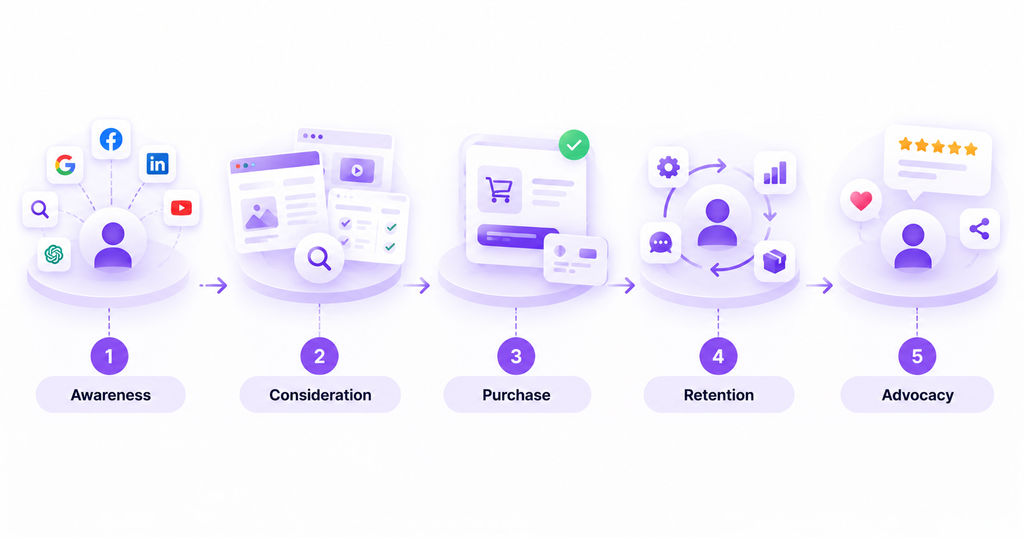
3. Purchase: Completing a conversion
The purchase stage includes buying a product, subscribing, signing a contract, or completing another defined commercial goal. In B2B marketing, a demo or qualified opportunity may be an important milestone without being the final sale.
Teams can analyze defined conversion events, checkout progression, completed orders, lead qualification, and time to convert. They should keep completed purchases separate from softer signals such as starting checkout or viewing a quote.
What to improve: Review forms, payment steps, mobile usability, unexpected costs, and sales handoffs. If the funnel shows a large drop-off, inspect relevant paths before assuming the cause is price or page design.
4. Retention: Continuing the relationship
After conversion, the customer starts judging whether the purchase was worthwhile. Ecommerce businesses may focus on delivery, repeat orders, returns, and support. SaaS companies may focus on onboarding, activation, meaningful feature use, and renewal.
Retention metrics depend on the business model. Suitable measures include repeat-purchase rate, active usage, time to first meaningful action, renewal, or churn. A login alone may not represent customer value.
What to improve: Identify customers who have not reached the intended outcome, improve onboarding and self-service support, and compare post-acquisition behavior across meaningful segments. Keep customer experience and long-term value in view.
5. Advocacy: Recommending the brand
Advocacy is when customers voluntarily support or recommend a business. It can include referrals, testimonials, public reviews, participation in communities, or agreeing to become a customer reference.
Track observable referral or review actions where possible, and connect them to appropriate customer programs. Avoid labeling every repeat buyer or highly active user an advocate, because satisfaction and public recommendation are not interchangeable.
What to improve: Ask for feedback at suitable moments, make referral pathways straightforward, and support existing customers before requesting endorsements. Genuine advocacy follows a valuable experience rather than a perfectly designed marketing sequence.
| Journey stage | Typical digital touchpoints | Useful signals or metrics | Main question |
|---|---|---|---|
| Awareness | Search, social, ads, educational content | Qualified source traffic, relevant landing-page engagement | Are we attracting the right visitors? |
| Consideration | Product pages, demos, reviews, email | Meaningful page progression, return visits, demo activity | Are people getting answers? |
| Purchase | Pricing, forms, checkout, sales handoff | Completed conversions, funnel conversion, time to convert | Where does conversion stall? |
| Retention | Onboarding, product, support, lifecycle emails | Activation, repeat purchase, retention, churn | Do customers keep receiving value? |
| Advocacy | Referrals, reviews, communities | Recorded referrals, review contributions | Are customers willing to recommend us? |
Digital customer journey vs journey map vs funnel
These terms are related, but treating them as synonyms causes reporting problems. A customer journey is the experience and sequence of interactions; a journey map is a representation of that experience, often informed by research and assumptions.
A funnel measures how groups progress through selected milestones. Marketing attribution assigns credit across eligible recorded marketing interactions for a defined conversion. None of these views alone describes everything the customer experienced.
| Concept | What it explains | What it cannot establish on its own |
|---|---|---|
| Digital customer journey | The customer’s interactions and experience across online touchpoints | Everything that happened outside recorded systems |
| Journey map | A visual representation of actions, expectations, and friction | That every represented step reflects real observed behavior |
| Funnel | Aggregate progression through selected steps | Full paths, detours, or customer motivation |
| Marketing attribution | How an attribution model distributes conversion credit | The causal impact of each marketing channel |
Nielsen Norman Group describes journey mapping as visualizing the process a person follows to reach a goal. A map may combine observed actions with thoughts and emotions gathered from research, so it is not simply a dashboard screenshot.
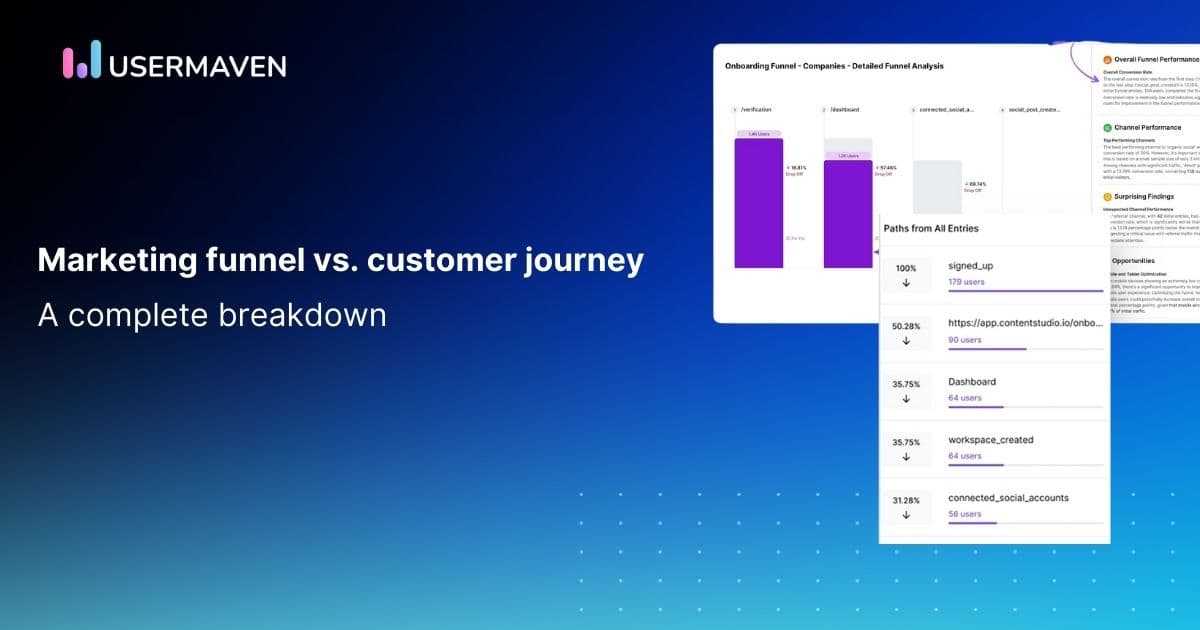
Teams that want a step-by-step process can follow a customer journey mapping guide to build their maps. To see how many customers move through each stage in aggregate, a customer journey funnel view adds the measurement side.
Key digital customer journey touchpoints
A touchpoint is a point of interaction between a customer and a company or its content. Some are direct, such as a product-page visit. Others, such as a third-party review, may shape a decision without entering the company’s analytics.
A useful inventory connects each touchpoint to a customer question and a measurable event, where available. The objective is not to log every possible click, but to capture interactions that help explain meaningful behavior.
| Touchpoint | What a business may learn |
|---|---|
| Search results and AI referrals | Which identifiable sources bring visitors to owned properties |
| Paid campaigns | Which tagged visits and subsequent conversions follow campaigns |
| Educational and product content | Which pages visitors reach and what they explore next |
| Email messages | Which tagged return sessions follow campaigns |
| Mobile app or SaaS product | Whether identified users complete activation or key tasks |
| CRM and sales systems | Whether leads progress to opportunities and deals |
| Support and communities | Where customers seek help, if those systems are connected |
Not every interaction should be interpreted as a stage transition. Someone can click an email during consideration or retention, and the action means different things depending on the broader context.
A fuller inventory of customer journey touchpoints can help teams find gaps across channels.
Digital customer journey examples by industry
The stage labels can stay the same while the behaviors, timelines, and success measures change. This is why a general journey template should be adapted to the company’s business model rather than applied mechanically.
Ecommerce customer journey
An ecommerce customer might discover a category through paid social, compare products, browse delivery information, make a purchase, then receive post-order support or return to buy again. The key transitions involve moving from product research to checkout and from a first order to continued customer value.
Relevant analysis includes recorded acquisition sources, product-to-checkout progression, completed orders, and repeat-purchase patterns. An abandoned cart reveals incomplete progression, but additional evidence is needed to identify the reason.
B2B SaaS customer journey
A B2B SaaS journey often spans educational content, comparison research, a demo, a trial, onboarding, account activity, an opportunity, and eventual revenue. The person using the product may not be the person approving the purchase.
That creates two analytical levels: behavior by individual user and progress by buying account. A team should avoid treating several employees from one company as a single person, or a single product signup as a closed-won deal.
SaaS products add stages such as trial, activation, adoption, and renewal, which our SaaS customer journey guide covers in more depth.
Content-led or subscription business
A content-led business may acquire users through search, useful articles, newsletters, or recognizable AI referrals. Some readers sign up for free resources, return repeatedly, and eventually subscribe or upgrade.
The useful question is not merely which article received the most visits. It is which recorded content paths precede meaningful signups, paid conversions, or sustained engagement, while recognizing that some influences remain outside the measurement system.
Across industries, the same principle applies: define the outcome first, then choose touchpoints and signals that help you understand the path toward it.
How to understand and improve the digital customer journey
The goal of digital journey optimization is not to push every visitor to the next stage immediately. It is to help people accomplish the job they came to do and identify where preventable friction affects that progress.
1. Define the customer and the outcome
Start with a specific audience and an outcome the business values. A new shopper completing a first order, a SaaS trial user activating a key feature, and a B2B buyer requesting a qualified demo need different journey definitions.
Document what success looks like without assuming a single path. The customer may move between stages, and some valid journeys involve several decision makers.
2. Identify meaningful interactions
Select touchpoints related to the intended outcome: acquisition source, content views, relevant events, checkout or lead submissions, onboarding actions, and downstream customer outcomes. Establish consistent names and usable identifiers before building complex reports.
The dedicated guide on how to track customer journey explains more of the implementation work. Here, the priority is choosing a small set of meaningful signals that support decisions.
3. Compare expected journeys with observed behavior
Use the journey map as a hypothesis and the available event data as evidence. Look for common paths, unexpected loops, and behavior before or after a meaningful milestone. Segment when different audiences are likely to act differently.
The Gainsight guide to digital journeys also emphasizes shared stage signals and ongoing review rather than treating the journey map as a one-time deliverable.
4. Investigate friction, not just exits
A steep funnel drop-off identifies a location worth investigating, not its cause. A visitor may abandon because information is missing, technical performance is poor, the offer is unsuitable, or they simply are not ready.
Inspect relevant paths, devices, entry sources, and qualitative feedback before prescribing a fix. For example, repeated returns to a pricing page may represent careful evaluation rather than a broken experience.
5. Improve, measure, and revisit
Prioritize changes according to likely customer benefit and commercial importance. Remove unnecessary form fields, clarify product information, improve onboarding instructions, or repair a confusing transition between channels when evidence supports it.
After a change, compare outcomes over a sensible period and consider experiments when causal confidence matters. Review the journey as products, acquisition mix, and customer expectations evolve, and fold those reviews into your wider customer journey strategy.
How to measure a digital customer journey
Measurement becomes useful when teams can explain which business question each report answers. A single dashboard of visits and conversion rates is rarely enough to understand a long digital customer journey.
Measure acquisition and early engagement
Start with the recorded channels and landing pages associated with relevant visits. Review whether campaign parameters are present and whether visitors engage with content related to their needs.
Traffic alone is a weak indicator of commercial quality. Compare subsequent meaningful actions, such as reaching a solution page, requesting a demo, or beginning a trial, while respecting the limitations of the captured events.
Analyze paths and funnel progression
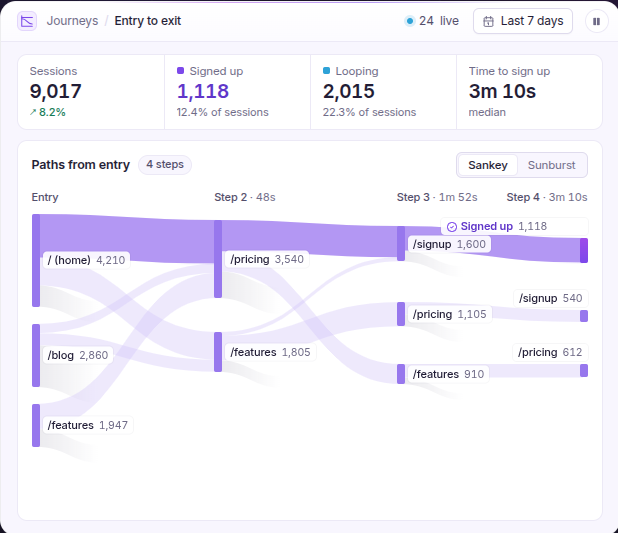
Journey visualization shows the sequence of recorded interactions before or after an important action. Funnels count how many eligible people complete a defined sequence of milestones. Together, they help distinguish a problem in navigation from a problem in progression.
A funnel may show that few users move from signup to activation. Journey paths help identify whether those users explored onboarding material, revisited settings, or stopped before performing the key action.
Connect recorded activity with conversions and revenue
Marketing attribution provides a complementary perspective by distributing conversion credit across eligible, recorded marketing touches under a selected model. CRM and billing data can add opportunity, customer, or revenue outcomes where reliable identifiers and integrations exist.
Compare channels against downstream outcomes rather than declaring the channel with the highest traffic to be the winner. Remember that attribution describes allocated credit; incrementality tests are needed to estimate what would have happened without a channel.
Compare segments and changes over time
Segment journeys by meaningful attributes, such as acquisition source, device, new versus returning status, customer type, or account where appropriate. Look for material differences and check whether the sample size supports a credible interpretation.
Keep qualitative evidence in the process. A survey or interview can help reveal motivations that clickstream data alone cannot establish. Our dedicated customer journey analytics guide explores these measurement approaches in greater depth.
| Evidence source | Useful for understanding | Cannot prove on its own |
|---|---|---|
| Website or product events | Recorded pages, actions, and sequences | Why a visitor chose an action |
| Journey report | Observable paths and returns | Every interaction outside the tracked environment |
| Funnel report | Progression between milestones | What caused a drop-off |
| Survey or interview | Reported expectations and frustration | Complete behavior across sessions |
| Attribution report | Credit under a selected attribution model | Incremental causal impact |
| CRM or revenue system | Downstream leads, deals, and commercial value | Every marketing influence on the buyer |
Why digital customer journey data can be incomplete
Customer journey analytics depends on the information captured and connected to the correct person or account. When that foundation breaks, reports can understate early discovery, misclassify acquisition sources, or separate pre-signup and post-signup actions.
Common gaps include missing event tracking, inconsistent campaign tags, browser or device boundaries, incomplete identity stitching, disconnected checkout domains, and CRM outcomes without a reliable link to website activity. Some off-platform interactions may never be available to the business.
That does not make journey analysis useless. It means reporting should describe its coverage and uncertainty. A coherent-looking flow is not proof that it contains the customer’s entire lived experience.
Before making large attribution or budget decisions, review data quality. Usermaven’s Measurement Trust Center checks areas including campaign tracking, customer matching, connected platforms, conversion feedback, and data confidence.
Core principle: A customer journey report explains the activity available to the measurement system, not necessarily every interaction the customer experienced.
How Usermaven connects digital journeys with marketing attribution
Usermaven is primarily a marketing attribution platform that connects recorded acquisition activity with conversions, pipeline, and revenue. Its full-funnel revenue attribution workflows bring marketing and commercial outcomes into context. Its user journeys, funnels, product analytics, and contact views support the investigation of what happens before and after those outcomes.
That combination matters because knowing which pages a visitor viewed is useful, but marketers also need to know how acquisition sources relate to qualified customers and business value. Each report has a distinct job in that analysis.
See behavior before and after important interactions
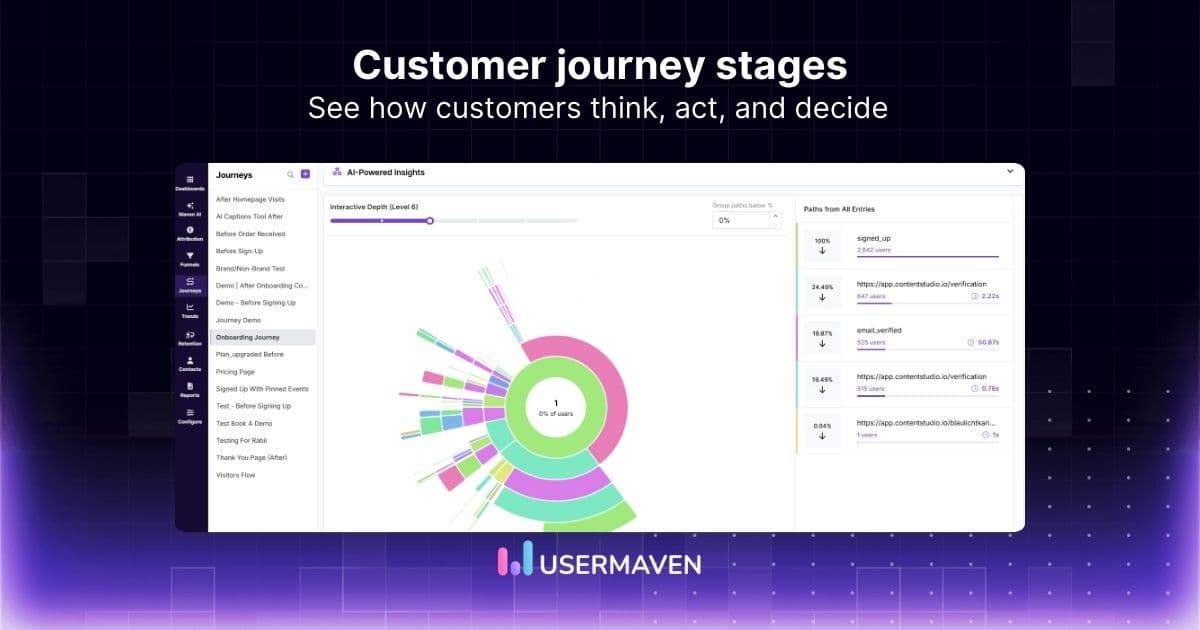
With Usermaven’s customer journey analytics software, teams can investigate recorded paths centered on a page, event, or pinned event. The Before view shows activity preceding the anchor; the After view shows what follows.
User Journeys supports session-level analysis and user-level analysis across sessions where the visitor is correctly identified. URL grouping, exclusions, and path summaries help make complex journeys easier to interpret. These capabilities are described in the official User Journeys documentation.
Measure where customers progress or drop off
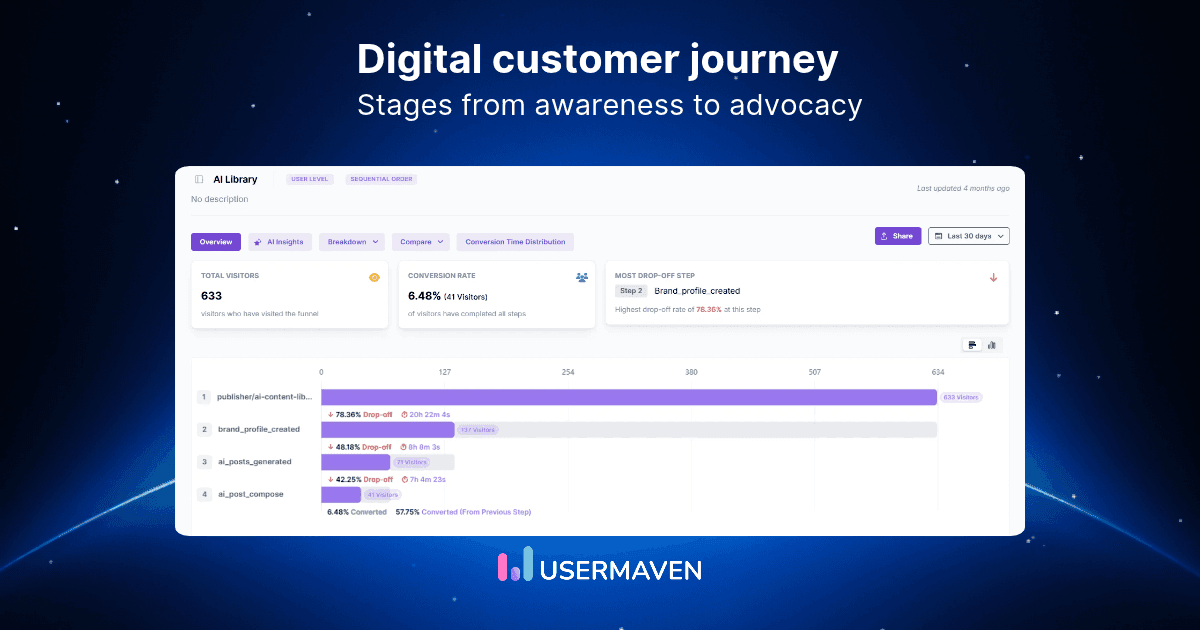
Journeys show path sequences, but a team also needs to know how many users complete important milestones. Usermaven’s funnel analytics software lets teams analyze step-by-step conversion and abandonment for a defined flow.
Use funnels to locate stages with lower progression, then return to journeys to examine the actions people took around those stages. A funnel comparison can indicate where to investigate; it does not explain the cause without additional evidence.
Add marketing channel and revenue context
Usermaven attribution reports analyze recorded channels, sources, and conversion paths leading to a selected goal. Comparing supported attribution models shows how channel credit changes when the rules change, instead of treating one model’s output as absolute truth.
Where connected CRM and revenue data are available, the measurement can extend beyond website conversions into leads, opportunities, and customer outcomes. This makes it possible to compare acquisition channels using the business results the team actually values.
Explore people, companies, and external conversion activity
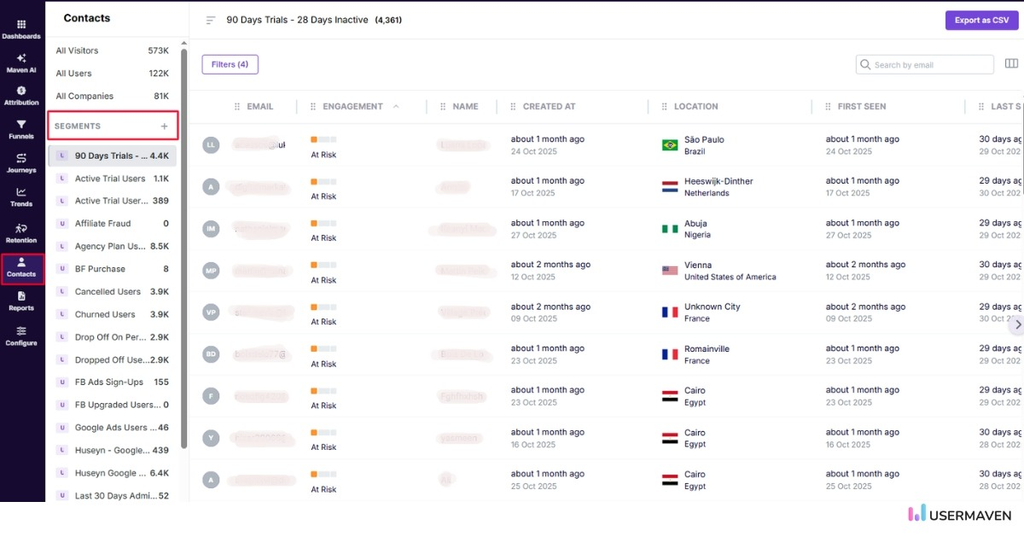
Usermaven Contacts Hub helps teams investigate recorded visitor, user, and company activity. Real-time Contact Profiles and enhanced company activity timelines were announced in September 2026, supporting more timely review of engagement and account-level activity.
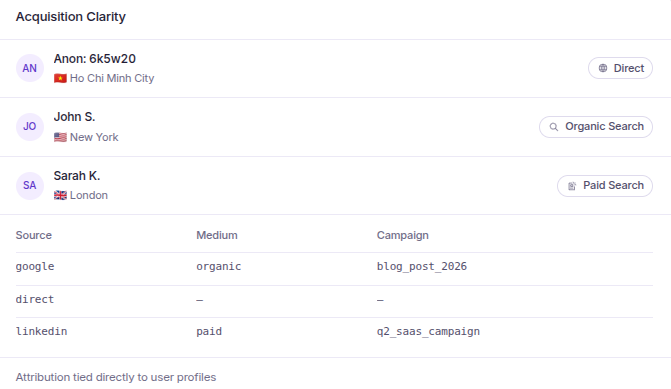
The platform can also bring relevant payment, subscription, CRM, and other external events into analysis through Event Sources. Those events still require usable identifiers to associate them with the appropriate people. Imported activity does not magically repair every missing anonymous-to-known connection.
Investigate patterns with Maven AI
Maven AI supports asking analytical questions about the data available within Usermaven. Its September 2026 Agents release added scheduled analyses that can surface changes such as user-journey drop-offs and feature-adoption shifts.
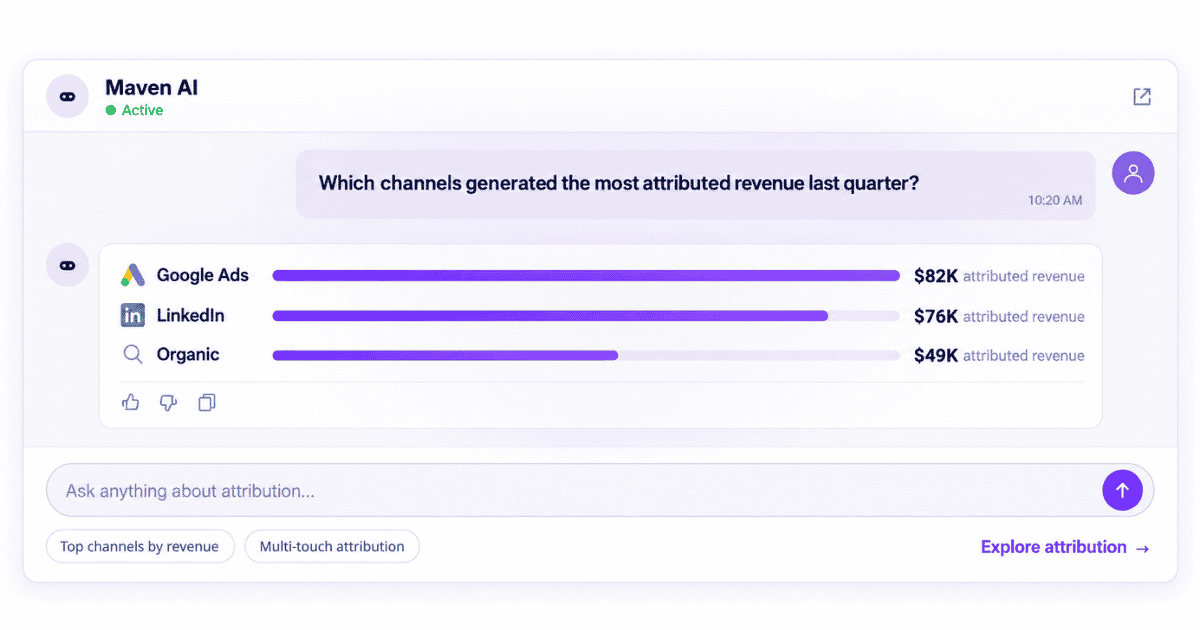
AI can make investigation faster, but it does not establish why customers behave a certain way or reconstruct events that were never recorded. Teams still need to validate interpretation and decide which actions are justified.
Real customer example: Actisense
Actisense makes connectivity solutions for marine electronics, a category where prospective buyers commonly research technical material and compare options before purchasing. Its published Usermaven case study describes a shift from aggregate website statistics toward more visible buyer research paths.
| Metric published in the Actisense case study | Reported value |
|---|---|
| Research-stage visitors tracked | 5,150 |
| High-intent purchase signals | 927 |
| Research interactions | 756 |
| Mapped journeys | 6 |
Those figures come from the Actisense case study. They describe measured interactions and signals, not 927 completed purchases or an experimental uplift caused by Usermaven.
The case illustrates an important point: journey analysis becomes more useful when teams can distinguish general traffic from recorded research behavior and investigate what precedes stronger purchase-intent signals.
Common digital customer journey mistakes
| Mistake | Better approach |
|---|---|
| Assuming everyone follows the five stages in order | Analyze returns, loops, and alternative paths. |
| Treating an ideal journey map as observed fact | Check the map against behavior and customer research. |
| Evaluating campaigns only by traffic | Connect visits with meaningful conversion and customer outcomes. |
| Interpreting every funnel exit as frustration | Investigate journeys, context, and qualitative evidence. |
| Ignoring activity after the first sale | Include activation, retention, support, and repeat value. |
| Assuming all touchpoints have been captured | Audit tracking, identities, and connected systems. |
| Calling attribution credit causal proof | Use suitable experiments for incrementality questions. |
The common thread is overconfidence in a single perspective. Journey maps, behavioral reports, and attribution models each answer a useful question, but none should be treated as a complete explanation of the customer’s motivation.
Digital customer journey optimization checklist
- Outcome: Is the customer goal clearly defined for the relevant segment?
- Stages: Are stage definitions meaningful for this business model?
- Touchpoints: Have important owned and external interactions been identified?
- Tracking: Are priority pages, events, and conversions captured consistently?
- Identity: Are sessions and CRM outcomes linked when reliable identifiers exist?
- Journey: Have actual paths and recurring detours been reviewed?
- Funnel: Is progression measured across the right milestones?
- Attribution: Are channel contributions interpreted under a stated model?
- Feedback: Have behavioral findings been tested against customer input?
- Review: Is there a regular process to reassess changes and outcomes?
Final verdict
The digital customer journey is bigger than a five-stage diagram. Awareness, consideration, purchase, retention, and advocacy provide a helpful framework, but customers move through digital experiences in different orders and on different timescales.
To improve those experiences, teams need to connect the interactions they can reliably observe, investigate friction without jumping to conclusions, and review whether changes lead to meaningful customer outcomes.
Usermaven brings marketing attribution, journey analysis, funnels, and connected business data into one measurement workflow. To explore how these capabilities fit your acquisition and revenue goals, book a Usermaven demo.
FAQs
What is a digital customer journey?
A digital customer journey is the sequence of online interactions and experiences someone has with a business, from discovery through purchase and continued engagement. It includes touchpoints such as search, ads, websites, apps, email, and support.
What are the five stages of a digital customer journey?
A common framework uses awareness, consideration, purchase, retention, and advocacy. These are useful organizing stages, not a mandatory step-by-step route for every customer.
Is a digital customer journey always linear?
No. People may research, leave, return through a new channel, revisit earlier questions, or skip some interactions entirely. A journey diagram is a simplified representation of those possible paths.
What is the difference between a digital customer journey and a journey map?
The customer journey is what someone experiences. A journey map represents that experience visually, often combining observed actions with research about expectations, questions, and emotions.
What are digital customer journey touchpoints?
Touchpoints are moments when customers interact with a brand or its content online. Examples include search-result visits, product pages, email links, checkout, product features, and digital support conversations.
How can a business improve its digital customer journey?
Define a meaningful outcome, capture relevant interactions, compare observed paths with expectations, identify friction, and validate improvements. Combine behavioral analytics with customer feedback instead of assuming a click reveals motivation.

Written by
Adeel Khan
Growth Marketing Expert
Adeel Khan is a full-stack SaaS marketer with 10+ years of experience in content marketing, paid advertising, analytics, and conversion rate optimization. He shares practical insights and strategies drawn from hands-on experience, helping B2B SaaS marketers improve performance and make better marketing decisions.
All articles by Adeel →