Google, Meta, TikTok, and other ad platforms can all claim credit for the same ecommerce order, even though the store records only one actual purchase.
That is why ecommerce teams need an independent ecommerce attribution layer that connects paid media with customer journeys, orders, revenue, and customer value.
This guide compares ten ad attribution software options for ecommerce by paid-channel coverage, tracking accuracy, revenue connection, customer value, pricing, and ecommerce fit.
Key takeaways
- Platform ROAS is not a neutral revenue record: Google, Meta, TikTok, and other networks can claim overlapping conversions using different rules.
- Orders need deduplication: One ecommerce purchase should not become several independently counted business outcomes.
- New-customer value matters: Returning-customer revenue can make an acquisition campaign look stronger than its actual ability to bring new buyers.
- Product-level visibility improves decisions: Teams should know which ads and channels create product, category, and order outcomes rather than revenue totals alone.
- First-party tracking matters: Clean campaign identifiers, customer identities, and server-side event delivery can reduce avoidable measurement gaps.
- LTV can change the winning campaign: Lower first-order ROAS can still create better economics when a campaign attracts customers who return and spend more over time.
What is ad attribution software for ecommerce?
Ad attribution software for ecommerce connects paid advertising interactions with customer journeys, products, orders, revenue, and customer value.
It applies consistent rules across channels, extending attribution in advertising into store, product, order, and customer-value data instead of relying only on each ad network’s self-reported conversion total.
Basic ad tracking records campaign clicks and conversion events. Ecommerce attribution goes further by reconciling those interactions with store data such as order IDs, customer status, purchase value, products, refunds, and repeat revenue.
A useful setup can combine Google Ads, Meta Ads, TikTok Ads, Microsoft Ads, Shopify or WooCommerce, checkout data, customer IDs, product data, order values, and repeat purchases. The goal is a defensible view of which paid interactions contributed to real store outcomes.
Best ecommerce ad attribution software compared
The table summarizes the ecommerce problem each platform is best positioned to solve. Homepage links are reserved for the detailed numbered profiles below.
| Platform | Best for | Ecommerce strength | Main outcome |
|---|---|---|---|
| Usermaven | Customer journey + attribution | Ads + behavior + revenue | Revenue |
| Triple Whale | Shopify / DTC | Store + paid media | Orders / LTV |
| Northbeam | Scaled DTC | Attribution + advanced measurement | Revenue / efficiency |
| Cometly | Paid-media ecommerce | Server-side + conversion sync | Revenue / ROAS |
| Rockerbox | Omnichannel brands | MTA + MMM + incrementality | Incremental growth |
| Hyros | High-ticket ecommerce | Long journey + paid ads | Sales / revenue |
| SegmentStream | Modeled measurement | Behavioral attribution + automation | Revenue |
| RedTrack | Performance ecommerce | CAPI + media buying | ROAS / LTV |
| Attribution App | Lean ecommerce teams | Auditable user-level MTA | Revenue / CAC |
| LayerFive | Full-funnel ecommerce | Identity + MTA + MMM | Revenue / profit |
Ad attribution software for ecommerce
Ecommerce platforms differ in whether they specialize in Shopify operations, high-volume paid media, multi-touch journeys, modeled measurement, conversion feedback, or broader customer analytics.
1. Usermaven: Best for customer journey attribution

Overview
Usermaven is an AI-powered marketing attribution platform that connects paid acquisition with website behavior, product activity, customer journeys, ecommerce conversions, revenue, funnels, segments, and conversion feedback in one environment.
Best for
Ecommerce brands that want paid-media attribution plus behavioral context, Shopify or WooCommerce businesses, multi-channel acquisition teams, and companies that want to understand what shoppers do before and after the order.
Ecommerce use case
A typical journey can run from ad to landing page, product view, cart, checkout, purchase, and later repeat activity. The same customer-level context helps teams investigate which paths lead to high-value orders instead of treating the purchase as an isolated event.
Pricing
Growth covers website, product, and ecommerce analytics, while Scale is $199 per month at the 250,000-event tier and adds paid-ad attribution, conversion paths, CRM/deals attribution, conversion sync, Maven AI, and longer data history. A 14-day free trial is available.
Key ecommerce attribution capabilities
- Google Ads, Meta Ads, LinkedIn Ads, and Microsoft Ads connections
- Paid-ad, channel, content, landing-page, and revenue attribution
- Multi-touch conversion paths and customer journey analysis
- Website and product behavior, funnels, retention, and segments
- Ecommerce conversion and revenue analysis
- Conversion sync to supported advertising platforms
- Measurement Trust Center for collection, identity, integrations, delivery, and reliability
- Maven AI and MCP-based analysis workflows
Customer journey context
customer journey analytics software can make the sequence behind aggregate ROAS inspectable. Teams can review return sessions, product interactions, cart activity, checkout behavior, and conversion paths at customer level.
Product and funnel behavior
When acquisition quality depends on what shoppers do before purchase, product analytics software and funnel analytics software add useful context around product interest, cart progression, checkout drop-off, and conversion.
Maven AI
Maven AI can help answer questions such as which paid campaigns create the highest-value customers, which paths precede large orders, and which acquisition sources are common among repeat buyers.
Why it stands out
Usermaven is strongest when an ecommerce team wants to connect the advertising story with what customers actually do on-site. The combination of attribution and behavioral analytics makes it easier to investigate why one campaign produces better shoppers, journeys, and downstream outcomes.
Verdict
Usermaven is a strong overall fit for ecommerce teams that want customer behavior and journey context around paid attribution instead of relying on an ecommerce media dashboard alone.
2. Triple Whale: Best for Shopify and DTC

Overview
Triple Whale is an ecommerce intelligence platform built around Shopify and DTC operations. Its current stack combines first-party measurement, multi-touch attribution, business intelligence, customer segments, AI through Moby, and activation workflows.
Best for
Shopify and DTC brands, creative-heavy paid acquisition teams, operators that want store and advertising data together, and brands that prefer an ecommerce-native measurement environment.
Ecommerce use case
Connect Meta, Google, TikTok, and other paid activity with Shopify orders, customer segments, product performance, and revenue. The platform is particularly natural when ecommerce operations and paid media live in the same growth workflow.
Pricing
Triple Whale pricing is based on a combination of annual GMV and the selected package. Current paid packages include Foundation, Automate, and Enterprise; higher tiers add more automation, Compass measurement, and enterprise controls. triple whale pricing gives additional buying context.
Key ecommerce attribution capabilities
- Triple Pixel first-party measurement
- Multi-touch ecommerce attribution
- Business intelligence and custom dashboards
- Customer segments and product/store analytics
- Moby AI across ecommerce data
- Optional retention, conversion, and activation capabilities
- Compass measurement across attribution, MMM, and incrementality on Enterprise
Why it stands out
Triple Whale has unusually strong ecommerce-native context. It is designed for store operators and performance teams that want orders, customer data, creative performance, and paid-media measurement in one system rather than a general-purpose analytics stack.
Verdict
Triple Whale is one of the clearest fits for Shopify-centric DTC. Teams that also need broader web, SaaS, or CRM journey context can compare the Triple Whale alternative page.
3. Northbeam: Best for scaled DTC measurement

Overview
Northbeam is a marketing intelligence platform for ecommerce brands that combines first-party multi-touch attribution, view-through measurement, creative analytics, direct ad-platform optimization, and optional advanced measurement methods.
Best for
Seven-figure and larger DTC brands, high paid-media spend, multi-channel growth teams, and ecommerce businesses that need independent first-party attribution at greater operating scale.
Ecommerce use case
Use Northbeam when paid media spans several major channels and the business needs one independent attribution layer for revenue, new customers, creatives, and view-through effects before making large budget changes.
Pricing
Northbeam currently lists Starter at $1,500 per month and Professional at $3,500 per month, while Enterprise is custom. A Growth path is also available through qualifying agency partnerships for brands spending below the larger direct tiers.
Key ecommerce attribution capabilities
- Independent first-party multi-touch attribution
- Clicks + Deterministic Views measurement
- Creative analytics and omnichannel dashboards
- Northbeam Apex ad-platform optimization
- Direct integration with major ecommerce platforms
- Optional incrementality and MMM on higher plans
- Unlimited users and integrations on Professional
Why it stands out
Northbeam is designed for ecommerce brands making large media-allocation decisions. It adds more measurement depth than basic attribution by supporting view-through analysis, first-party data, advanced optimization, and optional incrementality or MMM.
Verdict
Northbeam is a strong choice for scaled DTC teams that have outgrown simple last-click and platform ROAS reporting and can justify a higher measurement budget.
4. Cometly: Best for paid-media ecommerce
Overview
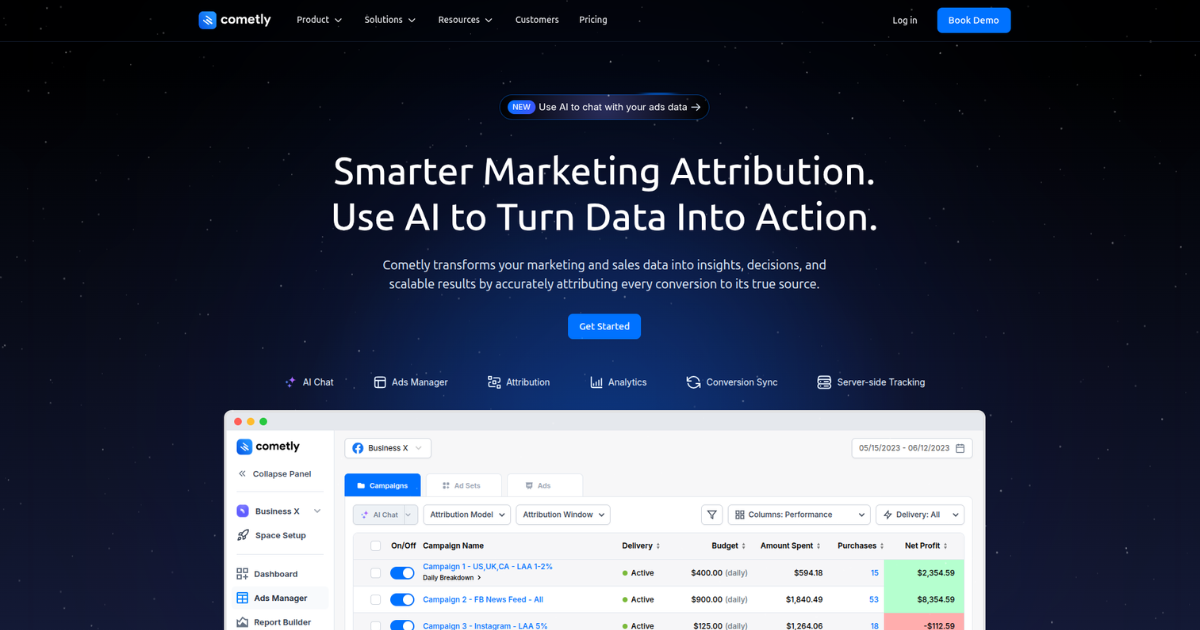
Cometly is a marketing attribution platform with server-side tracking, multi-touch attribution, conversion APIs, ad-platform integrations, CRM and warehouse sync, audiences, dashboards, and AI-assisted analysis.
Best for
Paid-media-heavy ecommerce teams, performance marketers, agencies, and brands that want attribution data to feed directly back into ad-platform optimization.
Ecommerce use case
Connect paid clicks and website conversions with revenue, then send cleaner conversion signals back through supported Conversion APIs. The workflow is strongest when improving paid-media optimization is as important as explaining past performance.
Pricing
Cometly uses quote-based pricing sized around pageviews and the customer stack. Its current pricing page does not offer a free trial because onboarding includes attribution, CRM, and ad-platform setup. Cometly pricing provides additional context.
Key ecommerce attribution capabilities
- Server-side tracking and first-party pixel
- Multi-touch attribution
- Major advertising-platform integrations
- Conversion API feedback
- CRM and warehouse synchronization
- Audiences and customizable dashboards
- AI Ads Manager and agent workflows
Why it stands out
Cometly sits close to the paid-media optimization loop. That makes it attractive when attribution is expected to change campaign decisions and feed useful conversion signals back into ad networks rather than remain a passive reporting layer.
Verdict
Cometly is a strong fit for ecommerce teams whose main problem is cross-channel paid-media attribution and conversion feedback.
5. Rockerbox: Best for omnichannel ecommerce

Overview
Rockerbox is a unified marketing measurement platform that combines a centralized marketing data foundation with multi-touch attribution, marketing mix modeling, and incrementality testing.
Best for
Larger ecommerce and DTC brands, omnichannel portfolios, teams measuring both digital and offline channels, and companies that want multiple measurement methods from a consistent data foundation.
Ecommerce use case
Rockerbox is useful when the question has expanded beyond which click got credit. Teams can use MTA for tactical optimization, MMM for broader budget planning, and incrementality testing for causal questions while keeping the underlying marketing data consistent.
Pricing
Rockerbox uses a demo-led commercial process rather than publishing a simple self-serve price. Implementation scope can vary by methodology, channel coverage, data readiness, warehouse requirements, and support needs.
Key ecommerce attribution capabilities
- Unified marketing data foundation
- Multi-touch attribution
- Marketing mix modeling
- Incrementality testing
- First-party data focus and cross-channel measurement
- Shopify and broader ecommerce integrations
- Warehouse exports and analytics-ready datasets
Why it stands out
Rockerbox is built around measurement triangulation. Its main advantage is the ability to answer different questions with MTA, MMM, and incrementality rather than forcing every ecommerce decision through a single attribution model.
Verdict
Rockerbox is best suited to mature ecommerce brands with a diverse media mix and enough data, spend, and analytical maturity to use more than one measurement method.
6. Hyros: Best for high-ticket ecommerce

Overview
Hyros is an ad tracking and attribution platform focused on paid-media accuracy, cross-session journeys, revenue, calls, and optimization feedback. Its ecommerce positioning emphasizes orders, repeat buyers, and profitable scaling.
Best for
High-AOV ecommerce, direct-response stores, complex upsell or subscription funnels, brands with longer consideration periods, and teams that rely heavily on paid acquisition.
Ecommerce use case
Hyros is useful when a buyer may interact with several paid campaigns, return across sessions or devices, and purchase later. That makes it more relevant to high-ticket and complex ecommerce funnels than a short single-session purchase flow.
Pricing
Hyros Business pricing starts at about $230 per month on an annual plan, while monthly paid-traffic pricing starts higher and scales with tracked revenue or account size. Hyros pricing provides a fuller breakdown.
Key ecommerce attribution capabilities
- Paid-ad tracking across major platforms
- Cross-session and cross-device journey connection
- Multi-touch attribution
- Revenue and repeat-buyer visibility
- Call tracking where relevant
- Conversion feedback and AI optimization
- Longer-funnel direct-response measurement
Why it stands out
Hyros is closely aligned with direct-response measurement and high-consideration ecommerce. It is especially useful when the purchase path is longer, more paid-media driven, or includes calls and complex funnel steps.
Verdict
Hyros is a strong specialist for high-ticket ecommerce brands that need detailed paid-media tracking over longer customer journeys.
7. SegmentStream: Best for modeled ecommerce measurement
Overview
SegmentStream is an AI-native marketing measurement platform that combines attribution modeling, behavioral measurement, incrementality, optimization workflows, and MCP-based access to marketing data.
Best for
Ecommerce, DTC, subscription, and online-only businesses that want modeled measurement when browser-level observation is incomplete, plus teams interested in automated budget optimization.
Ecommerce use case
SegmentStream can evaluate paid acquisition using behavioral and modeled signals rather than only fixed-position attribution rules. This is useful when privacy constraints and fragmented journeys limit what deterministic clickstream data can explain.
Pricing
SegmentStream currently lists Online plans from $800 per month for fully digital conversion journeys and Full Funnel plans from about $1,200 per month for broader measurement needs. Enterprise pricing is customized.
Key ecommerce attribution capabilities
- Advanced marketing attribution models
- Behavioral multi-touch attribution
- Incrementality testing
- Automated budget optimization
- Ecommerce, DTC, subscription, and online-service support
- AI agent and MCP workflows
- Cross-channel performance analysis
Why it stands out
SegmentStream differentiates itself by leaning into modeled measurement and automation rather than simply rebuilding a deterministic conversion path. That can be valuable when ecommerce teams know the observable user journey is incomplete.
Verdict
SegmentStream is a strong option for brands that want modeled attribution and automated optimization rather than relying only on fixed-rule MTA.
8. RedTrack: Best for performance ecommerce
Overview
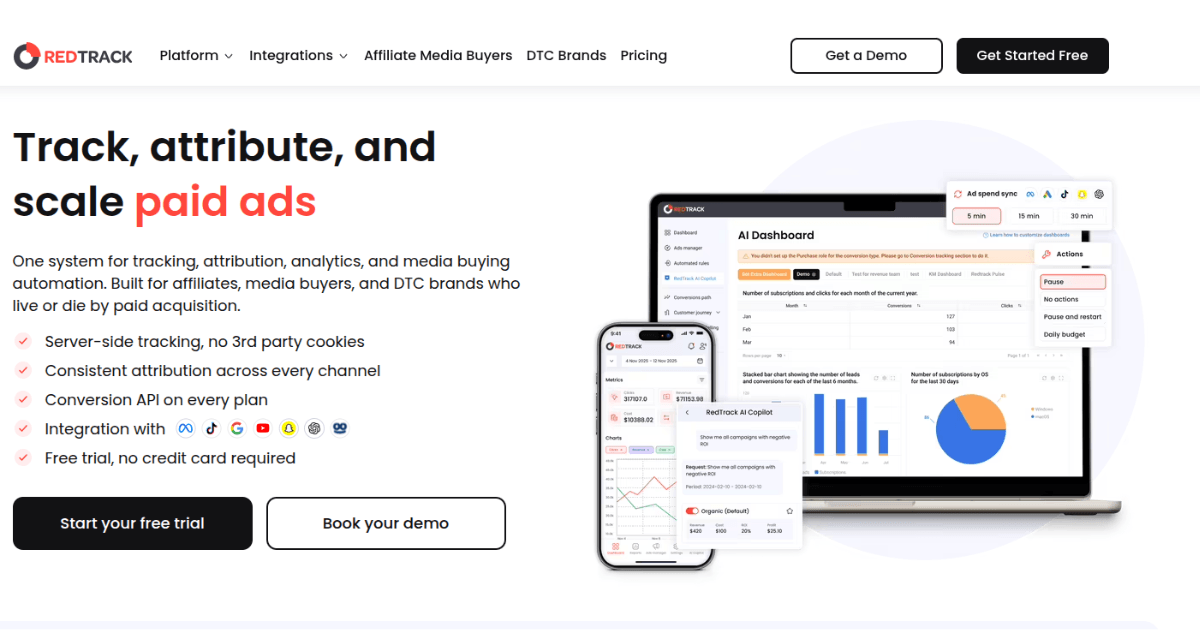
RedTrack is a performance marketing platform for tracking, attribution, analytics, Conversion APIs, ad-spend synchronization, and media buying automation. Its ecommerce positioning directly connects paid acquisition with customer value and LTV.
Best for
DTC brands, performance marketers, media buyers, agencies, Shopify and WooCommerce stores, and teams that want attribution integrated with daily campaign operations.
Ecommerce use case
Connect ad-level spend across platforms with purchases, customer cohorts, and LTV, then return conversion signals to ad networks. RedTrack also supports Shopify and WooCommerce connections for automated sales attribution.
Pricing
RedTrack currently lists Builder from $69 per month on the displayed ecommerce/DTC pricing view, with higher tiers and add-ons scaling by revenue or ad-spend needs. A 14-day free trial is available, while Relay provides free CAPI without full attribution.
Key ecommerce attribution capabilities
- Ad-level tracking and ad-spend synchronization
- Cross-channel attribution and model comparison
- Shopify and WooCommerce integrations
- Server-side Conversion APIs for major networks
- Customer segmentation, cohort analysis, and LTV reporting
- Conversion path and customer journey reports
- Ads Manager and automation rules on supported configurations
Why it stands out
RedTrack sits very close to performance media buying. Attribution, conversion APIs, spend sync, LTV analysis, and automation are designed to support active campaign decisions instead of functioning as a separate strategic analytics layer.
Verdict
RedTrack is a strong fit for ecommerce teams that live inside paid acquisition and want measurement to feed directly into campaign optimization.
9. Attribution App: Best for auditable ecommerce MTA
Overview
Attribution App is a multi-touch attribution platform centered on user-level cost data, deterministic journeys, customizable attribution models, raw data export, and auditable links between ad spend, visits, conversions, and revenue.
Best for
Lean ecommerce teams, Shopify or BigCommerce brands, data-conscious marketers, and companies that want transparent user-level attribution without moving immediately into a large enterprise measurement stack.
Ecommerce use case
The ecommerce setup can follow the customer from first ad click to first purchase and repeat revenue. Its Shopify integration is designed to separate first-time purchaser costs from returning-customer revenue, which is useful for acquisition analysis.
Pricing
Attribution App states that ecommerce plans start at $19 per month. Larger or more customized implementations can use a sales-led pricing process, while data export and other advanced capabilities may be packaged separately.
Key ecommerce attribution capabilities
- Five customizable multi-touch attribution models
- User-level ad cost and deterministic journey data
- Shopify and BigCommerce ecommerce integrations
- First-time vs returning-customer revenue analysis
- Conversion API add-on
- Raw visit-level and user-level data export
- Connections to major ad platforms and payment systems
Why it stands out
Attribution App emphasizes auditability. A marketer can trace reported CAC, ROAS, conversion counts, and credit assignments back to the visits, spend, and revenue events that produced the metric.
Verdict
Attribution App is a useful option for ecommerce teams that want transparent multi-touch measurement and a low entry price without giving up user-level auditability.
10. LayerFive: Best for full-funnel ecommerce measurement
Overview
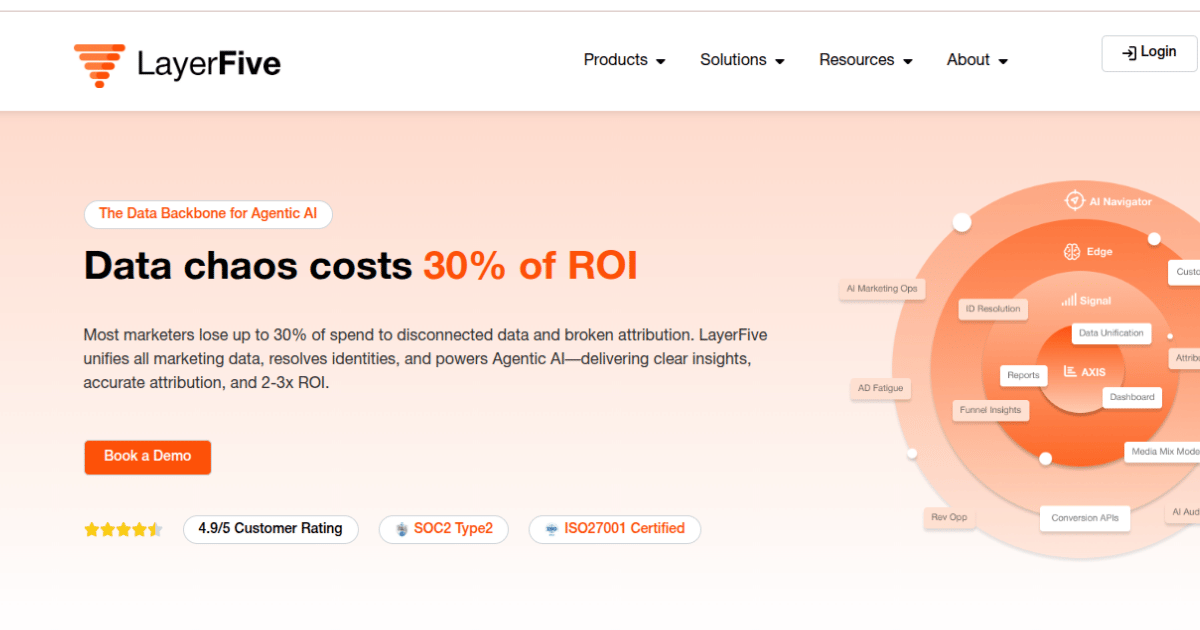
LayerFive is an agentic-AI marketing data and attribution platform that combines unified data, identity resolution, multi-touch attribution, funnel analytics, MMM, predictive audiences, and activation for ecommerce and other growth teams.
Best for
Shopify brands, growing DTC companies, teams that want identity resolution as part of the attribution layer, and ecommerce organizations combining journey analytics with MMM and audience activation.
Ecommerce use case
LayerFive can connect paid-media data with first-party website identity, customer journeys, funnel behavior, revenue, and predictive audiences. Its ecommerce offering is designed to unify measurement and activation rather than stop at reporting.
Pricing
LayerFive publishes entry pricing from $49 per month for Axis unified reporting and from $99 per month for Signal attribution and analytics. Signal includes L5 Pixel, multi-touch attribution, cohort and funnel analysis, and media mix modeling.
Key ecommerce attribution capabilities
- First-party identity resolution
- Unified marketing data and reporting
- Multi-touch attribution
- Funnel and cohort analysis
- Media mix modeling and halo-effect analysis
- Predictive audiences and multi-channel activation
- Agentic AI and MCP access
Why it stands out
LayerFive is positioned as a broader measurement and activation stack. The combination of identity resolution, attribution, MMM, predictive audiences, and AI can appeal to brands trying to consolidate several marketing-data tools.
Verdict
LayerFive is a relevant full-funnel option for ecommerce teams that want identity, attribution, advanced measurement, and activation in a connected platform.
How we evaluated ecommerce attribution software
Each tool was evaluated against the same ecommerce measurement problems rather than ranked only by feature count. The goal is to understand whether a platform can connect paid acquisition with the store outcomes that matter for budget allocation and ecommerce performance analytics.
- Ecommerce platform integration depth
- Paid-ad channel coverage and spend connection
- Order and purchase deduplication
- First-party identity and cross-session continuity
- Server-side measurement options
- Product-level attribution and product mix visibility
- New vs. returning customer analysis
- Revenue, refunds, and customer value context
- LTV and repeat-purchase visibility
- Attribution model flexibility
- Conversion feedback to advertising platforms
- MMM and incrementality where relevant
- Pricing, setup effort, and implementation complexity
Why ecommerce ad attribution is different
Several platforms can claim one sale
A shopper can see a Meta ad, click a Google Shopping result, return through email, and purchase. Meta and Google may both claim the order under their own windows and rules, while the store still has one actual transaction.
Order value is not standardized
Two purchases are not automatically equal. Different products, discounts, bundles, shipping economics, and customer types can create very different commercial value even when both events are counted as one conversion.
Refunds change real revenue
Attributed gross revenue can overstate business impact when cancellations, refunds, or returns arrive later. Ecommerce teams should know which revenue field the attribution platform uses and whether downstream adjustments can be reconciled.
New and returning customers have different meaning
A repeat buyer can make a campaign look efficient even when the advertising did not acquire a new customer. Separating first-time and returning-customer revenue helps growth teams judge acquisition quality more clearly.
Product mix matters
A channel can attract customers who buy premium products, bundles, subscriptions, or higher-margin categories. Product-level and customer-level context can therefore change how the same ROAS number should be interpreted.
Best platform by ecommerce model
Match the platform to the way the business acquires customers and makes measurement decisions. A Shopify DTC brand, a high-ticket store, and an omnichannel enterprise do not need identical attribution depth.
| Ecommerce model | Main measurement problem | Strong options |
|---|---|---|
| Shopify / DTC | Store + paid media | Triple Whale, Usermaven |
| Scaled DTC | Advanced media measurement | Northbeam, Rockerbox |
| Paid-media heavy | Conversion feedback | Cometly, RedTrack |
| High-ticket ecommerce | Long consideration cycle | Hyros, Usermaven |
| Omnichannel enterprise | MTA + MMM + incrementality | Rockerbox, Northbeam |
| Modeled / privacy constrained | Incomplete deterministic data | SegmentStream |
| Journey-focused ecommerce | Behavior + revenue context | Usermaven, LayerFive |
| Lean ecommerce team | Auditable multi-touch | Attribution App |
Why platform ROAS can mislead ecommerce teams
Suppose Meta reports $120,000 in attributed revenue and Google reports $85,000, while the store records only $150,000 in total revenue. Adding the platform totals produces $205,000 because each network can claim overlapping credit under different attribution rules.
The IAB cross-channel measurement playbook recommends integrating data from multiple sources into a unified view so marketers can understand how channels contribute to overall outcomes. That is the core reason independent attribution should reconcile channel claims rather than simply add them together. IAB cross-channel measurement playbook.
When totals do not reconcile, start with ad platform discrepancies: compare the conversion definition, attribution window, identity logic, view-through rules, and revenue date before deciding that one implementation is broken.
A useful single source of truth should treat store or payment data as the record of actual transactions while attribution software explains which marketing interactions contributed to those outcomes.
New-customer attribution vs. total ROAS
Total ROAS can hide whether a campaign is acquiring new buyers or monetizing customers who were already likely to return. Ecommerce acquisition teams should separate customer acquisition from repeat-purchase revenue and compare it with average customer acquisition cost whenever that distinction materially affects growth decisions.
| Campaign | Platform ROAS | New customers | Repeat-buyer share | Long-term value |
|---|---|---|---|---|
| Campaign A | 5.0x | 20 | High | Moderate |
| Campaign B | 3.8x | 70 | Lower | High |
Campaign A looks stronger if platform ROAS is the only metric. Campaign B can be the better acquisition investment if it creates more first-time customers who later reorder, because the economics extend beyond the first attributed purchase.
Product-level attribution
Ecommerce attribution should not always stop at channel and order totals. An ad can introduce one product while the shopper later buys another, or a campaign can consistently attract customers into a high-value category even when that product was not the original click target.
Useful questions include which campaigns introduce premium products, which ads assist bundle purchases, which landing pages influence high-AOV categories, and whether particular sources create customers with a stronger product mix over time.
This is where product analytics software can complement attribution by showing the product interactions that happen before the order rather than reducing the journey to source and revenue alone.
First-order revenue vs. customer LTV
First-order ROAS is useful for immediate acquisition efficiency, but it can understate channels that bring customers who purchase repeatedly. Subscriptions, replenishment products, loyalty programs, and cross-sell behavior make customer value a longer-term measurement problem.
Shopify defines customer lifetime value as the total value or profit generated across the customer relationship and emphasizes that acquisition decisions should account for how much valuable customers are worth over time. Shopify customer lifetime value analysis.
That does not mean every attribution platform should be treated as a profit calculator. Teams should verify whether the tool reports gross order revenue, net revenue, retained revenue, LTV, or margin-adjusted value before using the number for financial decisions.
Attribution windows for ecommerce
An attribution window defines how long an earlier interaction remains eligible for credit. A low-consideration DTC purchase may convert quickly, while furniture, premium electronics, luxury goods, or other high-ticket categories can require much longer research.
Teams should separate ad-platform click and view windows from their own first-party customer history. Two platforms can show different revenue totals even when both are functioning correctly because one gives view-through credit or retains interactions for longer.
First-party and server-side tracking for ecommerce ads
Reliable ecommerce attribution starts with clean acquisition and purchase data. Campaign IDs, UTMs, click IDs, customer IDs, order IDs, product events, and conversion timestamps need consistent definitions before any attribution model can produce defensible results.
Appropriate server side tracking can improve event delivery and data control, while standardized UTM parameters help preserve campaign context across paid and owned channels.
Server-side delivery does not solve consent, duplicate purchase events, poor identity rules, or missing order data by itself. Teams should explicitly test browser and server-event deduplication and make sure one checkout cannot produce several business conversions.
Attribution vs. MMM vs. incrementality
Attribution
Attribution explains how observed marketing touchpoints are associated with a conversion or order. multi touch attribution is useful when several eligible interactions contribute to the same purchase, but it can only work with the interactions and identities the system can observe or model.
Marketing mix modeling
MMM works at a more aggregated level and estimates how marketing investment contributes to outcomes over time, accounting for broader patterns such as seasonality, promotions, and channel spend. It is often more useful for budget planning than user-level path inspection.
Incrementality
Incrementality asks the causal question: how many purchases happened because the advertising ran? Larger ecommerce brands increasingly combine attribution with MMM or experiments because no single method answers tactical journeys, long-term budgeting, and causality equally well.
From attribution to ecommerce optimization
Track the order accurately
Start with consistent order IDs, customer IDs, revenue fields, campaign data, and deduplication. Attribution cannot correct a purchase record that is already duplicated or inconsistent before the model runs.
Identify valuable customers
Separate first-time buyers, repeat customers, high-AOV shoppers, subscribers, and other meaningful groups. The goal is to optimize acquisition around customer quality rather than every purchase equally.
Build high-value segments
A customer segmentation platform can group buyers by behavior, product interest, purchase history, or value so the same measurement data can support more targeted lifecycle and acquisition decisions.
Return stronger conversion feedback
Where supported, send verified purchase or customer outcomes back to the ad network so optimization is trained on cleaner business events rather than browser-only signals or duplicated platform claims.
Where AI supports ecommerce attribution
Ask journey and revenue questions
AI can reduce the time required to investigate which campaigns create high-value buyers, which paths appear before large orders, and which acquisition sources are overrepresented among repeat customers or specific product categories.
Detect anomalies
AI can also help surface sudden conversion drops, unusual channel changes, broken event delivery, or unexpected differences between cohorts. Those findings still need to be validated against tracking quality and business context.
Keep human judgment in the loop
Teams still need to define the purchase event, revenue source of truth, attribution window, model, customer-value metric, and the difference between attribution and incrementality. AI can accelerate analysis, but it cannot decide those business definitions automatically.
How Usermaven supports ecommerce ad attribution
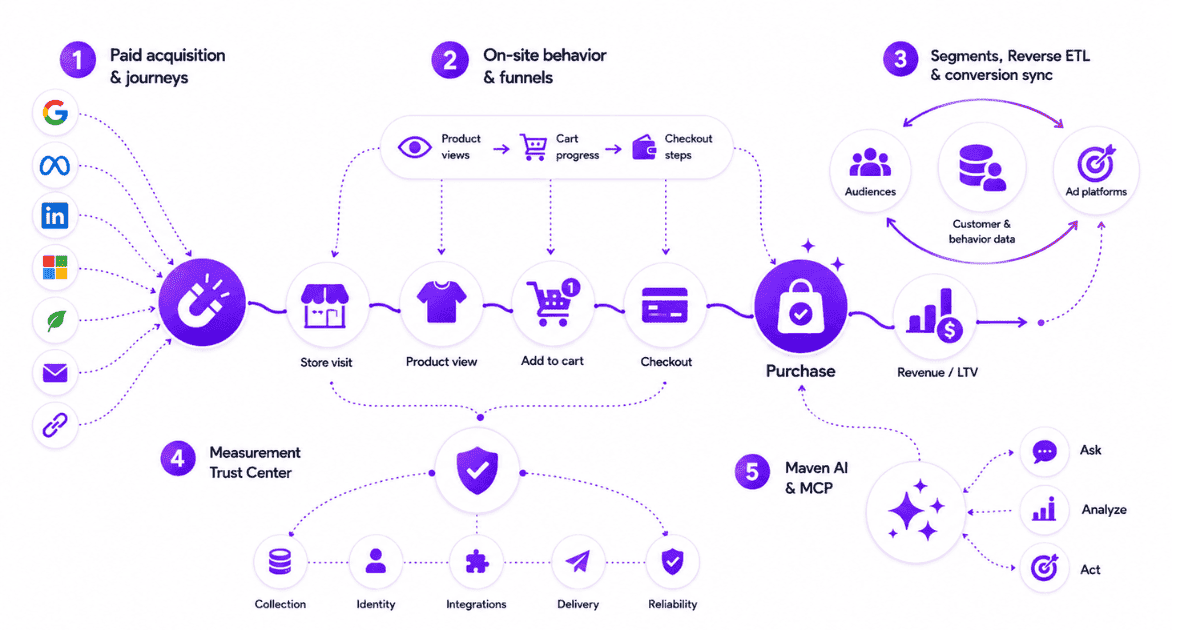
Usermaven connects paid acquisition with website behavior, product activity, customer journeys, ecommerce conversions, revenue, funnels, segments, and AI-assisted analysis. That makes it useful when the team wants more context around why some advertising creates better customers and journeys.
Paid acquisition and customer journeys
Google, Meta, LinkedIn, Microsoft/Bing, organic, referral, email, and other acquisition sources can be compared within the same customer journey. Conversion paths help show which channels assist the purchase instead of forcing every decision through the last touch.
On-site behavior and funnels
Website and product events provide the behavioral layer between the ad click and the order. Teams can analyze product views, cart progress, checkout steps, repeat visits, and other events alongside the source that brought the shopper in.
Segments, Reverse ETL, and conversion sync
High-value audiences can be created from customer and behavioral data and synced to connected destinations through Reverse ETL. Verified downstream outcomes can also be returned to supported advertising platforms through conversion syncs.
Measurement Trust Center
The Measurement Trust Center checks collection, identity, integrations, delivery, and reliability before teams use attribution to move budget. That is especially relevant when ecommerce tracking spans several ad networks, website events, checkout data, and purchase records.
Maven AI and MCP
Maven AI can investigate attribution, funnels, journeys, retention, and revenue in natural language, while MCP access can expose the same analytics tools to compatible AI clients and approved external workflows.
Unlock insights that drive growth
How to choose ecommerce attribution software
Every stack is different. Here’s how to choose wisely.
1. Define the revenue source of truth
Decide which store, payment, or order record represents actual revenue. Ad-platform conversion values should not automatically become the financial source of truth when several networks can claim the same purchase.
2. List every material paid channel
Document Google, Meta, TikTok, Microsoft/Bing, Pinterest, affiliates, influencers, or other channels that materially affect paid acquisition. A platform cannot provide a neutral cross-channel view if important spend is missing.
3. Check ecommerce integration depth
Verify that the integration includes the fields you need: orders, products, customers, revenue, discounts, subscriptions, refunds, and repeat purchases. A generic purchase event may be too shallow for advanced ecommerce decisions.
4. Test purchase deduplication
Place a real order through a known campaign path and verify that browser, server, checkout, and payment events reconcile to one purchase. Duplicate purchase events can make every downstream attribution model look more accurate than it is.
5. Check new-customer visibility
If customer acquisition is the growth goal, confirm whether the platform can distinguish new buyers from returning customers and whether CAC, NC-ROAS, or first-purchase revenue can be analyzed separately.
6. Evaluate product-level attribution
Brands with many products or categories should verify whether they can compare acquisition against specific products, bundles, categories, and customer product mix rather than only total order revenue.
7. Match the attribution window
Use historical purchase timing to decide how long earlier interactions should remain eligible for credit. Premium and high-consideration products usually require more persistence than impulse purchases.
8. Check first-party and server-side options
Review how campaign IDs, customer IDs, cookies, server events, consent, and deduplication work together. Server-side collection should improve delivery without creating duplicate business outcomes or bypassing consent requirements.
9. Evaluate LTV support
Repeat-purchase, subscription, and replenishment businesses should verify whether acquisition can be connected with later customer value. First-order ROAS alone may reward channels that acquire low-quality one-time buyers.
10. Test conversion feedback
Confirm which verified events can be sent back to each ad platform, how event matching is handled, and whether the platform can distinguish the conversion signals that matter most for optimization.
11. Compare attribution with MMM and incrementality needs
If the brand has substantial spend across many channels, decide whether user-level attribution is enough. Larger teams may need MMM or experiments for budget allocation and causal questions that path-based attribution cannot answer alone.
12. Audit real orders before switching
Use an attribution checklist to trace several real customers from first paid touch to order, revenue, and repeat purchase. Parallel testing can reveal identity breaks, duplicate orders, and definition mismatches before a new dashboard becomes the source for budget decisions.
How much does ecommerce attribution software cost?
Pricing can depend on store GMV, ad spend, pageviews, orders, tracked revenue, events, stores, users, advanced measurement methods, and implementation scope.
The broader marketing attribution software cost guide explains why the billing model can matter as much as the starting price.
This comparison spans low-cost ecommerce plans, mid-market self-service software, and enterprise measurement platforms costing thousands per month.
The best price comparison is the tier that includes the required attribution, ecommerce integration, identity, and activation capabilities at the brand’s expected scale.
Also include implementation, data engineering, onboarding, warehouse exports, additional measurement vendors, and the analyst time spent reconciling several dashboards. A higher software price can still reduce total measurement cost if it replaces enough disconnected work.
Final verdict
There is no universal best ecommerce attribution platform because Shopify DTC, scaled omnichannel, high-ticket, and performance-driven brands make different decisions from different data.
The strongest option is the one that matches the actual customer journey and revenue model.
Usermaven is the strongest fit here when the team wants ad attribution connected with customer journeys and behavioral analytics.
Before migrating budget decisions, run the shortlisted platform against real orders, known customer journeys, and the revenue record the business already trusts.
Then compare whether the tool explains not only which ads produced purchases, but which campaigns created customers worth acquiring again.
Ready to see Usermaven in action? Explore the platform or book a demo for a closer look.
See Usermaven in action
Book a free demo and discover how powerful analytics can grow your business.
FAQs
1. What is ad attribution software for ecommerce?
Ad attribution software for ecommerce connects paid advertising interactions with customer journeys, orders, products, revenue, and customer value. It applies attribution rules across channels so teams can compare paid-media contribution without relying only on each ad platform’s self-reported totals.
2. What is the best ad attribution software for ecommerce?
The best platform depends on the ecommerce model. Usermaven is strong for customer-journey and behavioral context, Triple Whale for Shopify/DTC, Northbeam for scaled DTC, Cometly and RedTrack for paid-media optimization, Rockerbox for omnichannel measurement, and Hyros for high-ticket ecommerce.
3. How does ecommerce ad attribution work?
The software captures campaign interactions, connects them with customer and store identities, records purchases and revenue, deduplicates business outcomes, and then applies an attribution model to decide how eligible marketing touchpoints receive credit.
4. Why do Meta and Google both claim the same purchase?
Each platform uses its own attribution window, identity rules, model, and eligible interactions. One shopper can interact with both networks before buying, so both platforms may legitimately claim the same order inside their own reporting systems.
5. What is the best attribution software for Shopify?
Triple Whale is one of the most ecommerce-native Shopify options. Usermaven is useful when Shopify attribution needs broader website behavior and customer-journey context, while Northbeam, Rockerbox, RedTrack, Attribution App, and LayerFive serve different Shopify measurement needs.
Updated

Written by
Junaid Ahmed
Content Writer & Digital Marketer
Junaid Ahmed is a content and copywriter with 3+ years of experience creating research-driven content across SaaS, B2B, ecommerce, and digital marketing. He specializes in turning complex topics into clear, practical content that helps marketers better understand their challenges, evaluate solutions, and make informed decisions. His work spans educational content, industry insights, and actionable marketing guides.
All articles by Junaid →