Agencies often manage Google, Meta, LinkedIn, and other paid channels across multiple clients, yet every platform can report a different version of conversion performance.
An ad tracking software setup captures clicks and conversions, but agencies also need consistent attribution across client accounts, channels, CRM data, and revenue.
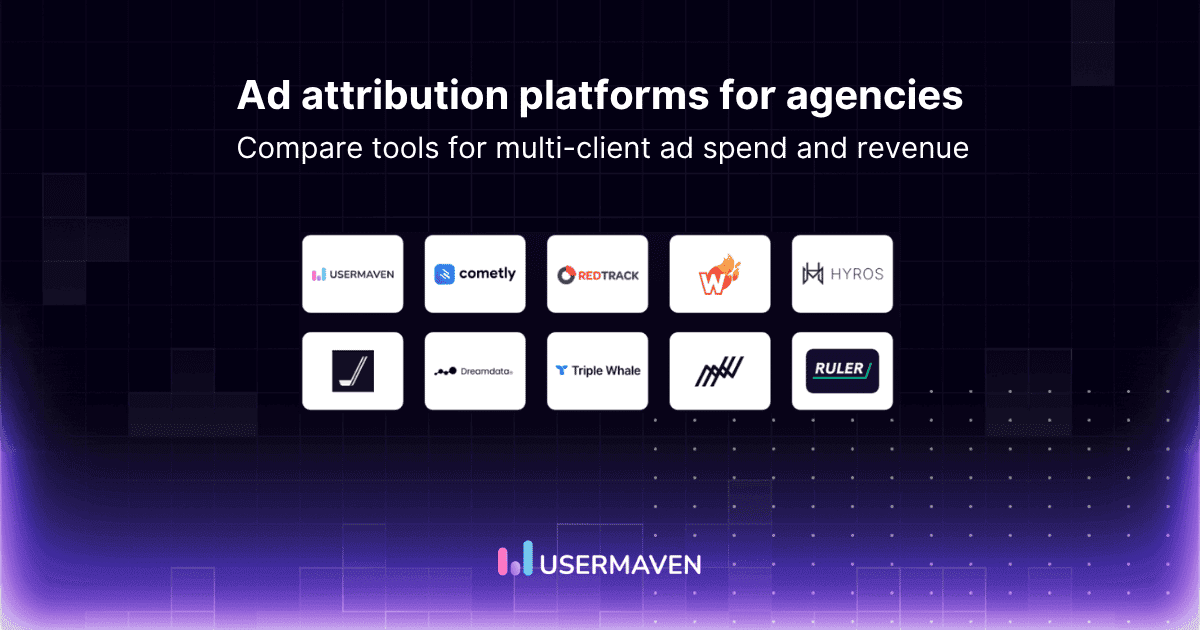
This guide compares ten ad attribution platforms by multi-client management, channel coverage, attribution depth, revenue connection, reporting, activation, pricing, and agency fit.
Key takeaways
- Multi-client operation matters: Agency attribution software must stay manageable as client accounts, domains, channels, and conversion definitions multiply.
- Ad platforms can overclaim differently: Google, Meta, LinkedIn, and other networks can credit the same conversion under different identities, windows, and rules.
- Client type changes the best platform: B2B, ecommerce, direct-response, and lead-generation clients need different downstream data and attribution workflows.
- Tracking quality comes first: Missing UTMs, browser loss, duplicate events, and weak identity resolution damage attribution before any model is applied.
- Revenue proof matters: Agencies increasingly need to connect ad spend with qualified pipeline, purchases, closed revenue, retention, or LTV rather than clicks alone.
- Activation is becoming part of attribution: Modern workflows can move verified audiences and outcomes back into downstream tools and ad platforms after measurement.
What is an ad attribution platform for agencies?
An ad attribution platform for agencies connects advertising interactions across client accounts and assigns conversion or revenue credit through a consistent measurement framework. It is built to explain which campaigns and channels contributed to a business outcome, not only to display what each ad network reported.
A capable platform can combine Google, Meta, LinkedIn, Microsoft Ads, TikTok, website activity, ecommerce orders, calls, CRM stages, and revenue. Agencies with longer journeys often need multi touch attribution so several interactions can be evaluated before the final conversion.
The distinction matters because ad tracking records observable interactions, while attribution interprets how those interactions should receive credit. Agency software usually needs both functions working together across separate client environments.
Table 1: Best ad attribution platforms for agencies
This comparison focuses on how each platform fits common agency operating models rather than treating every attribution product as interchangeable.
| Platform | Best for | Agency strength | Main measurement focus |
| Usermaven | Mixed SaaS/B2B portfolios | Multi-workspace + attribution + analytics | Ads → behavior → CRM → revenue |
| Cometly | Paid-media agencies | Cross-platform paid attribution | Ads → pipeline / revenue |
| RedTrack | Performance agencies | Multi-client tracking + white label | Ads → conversions / ROAS |
| Wicked Reports | Ecommerce agencies | First-party customer attribution | Ads → new-customer revenue / LTV |
| Hyros | Direct-response agencies | Paid funnel tracking | Ads → calls / leads / sales |
| HockeyStack | B2B agencies | Account-level revenue analysis | Ads → accounts → pipeline |
| Dreamdata | B2B revenue agencies | Buying-committee attribution | Ads → accounts → revenue |
| Triple Whale | Shopify / DTC agencies | Ecommerce measurement | Ads → orders / profit |
| Northbeam | High-spend ecommerce agencies | Advanced media measurement | Ads → ecommerce revenue |
| Ruler Analytics | Lead-gen agencies | Online + offline attribution | Ads → leads / calls → revenue |
Ad attribution platforms for agencies
The platforms below are reviewed through the realities of agency work: multiple client accounts, different business models, cross-channel ad spend, and downstream revenue reporting. Each profile focuses on where the platform fits best so agencies can shortlist tools around their client roster rather than feature count alone.
1. Usermaven: Best overall for mixed agency portfolios

Overview
Usermaven is an AI-powered marketing attribution and analytics platform for agencies that need to connect paid channels with website behavior, product activity, customer journeys, CRM pipeline, revenue, retention, and client reporting in one environment.
It is especially useful for mixed portfolios where one client is SaaS, another is B2B sales-led, and another needs website or ecommerce measurement alongside paid-ad attribution.
Best for
SaaS agencies, B2B agencies, performance teams, and mixed client portfolios that need acquisition reporting connected with downstream behavior and commercial outcomes.
Agency use case
Use separate workspaces for client data, apply consistent attribution across paid and organic channels, and give account teams a shared view of campaigns, journeys, product behavior, CRM stages, and revenue.
Pricing
Scale is $199 per month at the 250,000-event tier and includes unlimited users, five workspaces, seven years of data history, paid-ad attribution, CRM revenue attribution, multi-touch conversion paths, conversion sync, Maven AI, Salesforce, and Reverse ETL. White-label analytics starts at $49 per month and scales with workspace count.
Key agency attribution capabilities
- Google, Meta, LinkedIn, and Microsoft Ads tracking
- Paid-ad, channel, landing-page, CRM, pipeline, and revenue attribution
- Multi-touch conversion paths and customer journey attribution
- Website, product, ecommerce, funnel, retention, and account context
- Multi-workspace support plus branded dashboards, tracking domains, and white-labeled emails
- Conversion sync back to advertising platforms
- Measurement Trust Center for tracking health and data readiness
Salesforce and CRM depth
Salesforce is now a supported CRM connection in read-only mode for the first release. It can sync Accounts, Contacts, Leads, Opportunities, stage history, and contact roles, with per-org field mapping and sandbox support for agencies serving different Salesforce schemas.
Audience activation and AI workflow
Reverse ETL can sync Usermaven audiences into connected destinations such as HubSpot and Customer.io. That lets agencies move from measuring a segment to activating it without exporting lists manually.
Maven AI supports natural-language analysis across attribution, journeys, funnels, and behavioral data. AI-generated funnel, retention, and journey previews can be saved as reports, while MCP access and external MCP connectors extend approved workflows into connected systems.
Why it stands out
Attribution reporting is connected to the broader lifecycle instead of ending at the lead. User journeys give teams the path behind aggregate results, while website and product analytics help explain whether acquired users actually activate, adopt, retain, and expand.
Verdict
Usermaven is the strongest overall fit for agencies that need a flexible attribution layer across several client business models without separating campaign attribution, behavioral analytics, CRM outcomes, activation, and client reporting into unrelated tools.
2. Cometly: Best for paid-media-heavy agencies
Overview
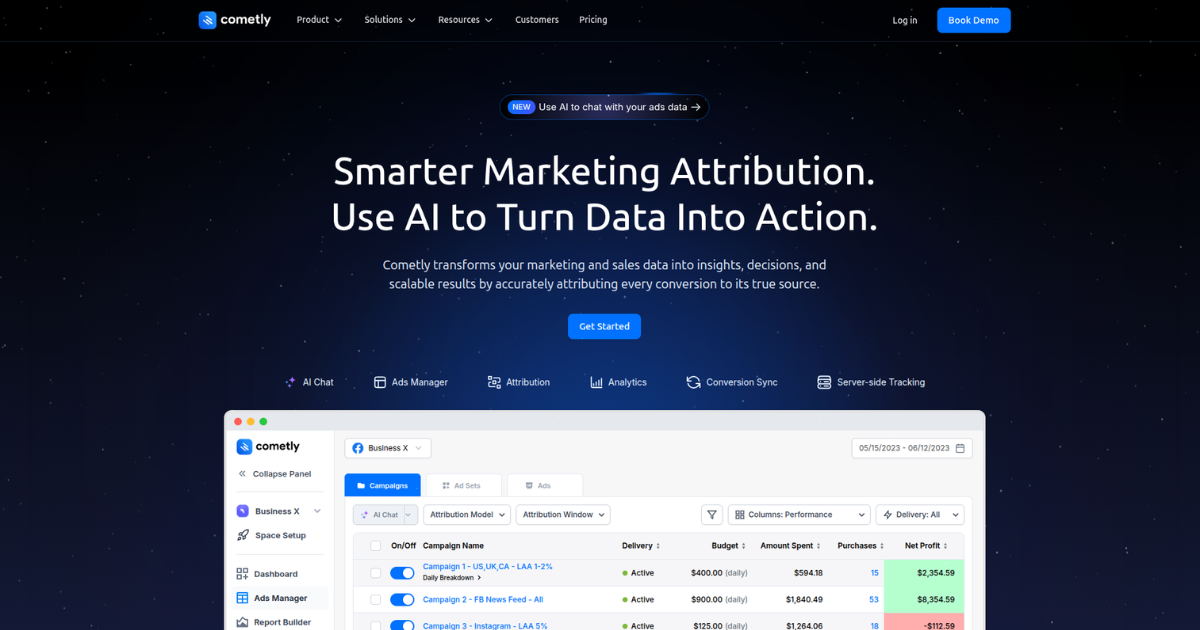
Cometly is a marketing attribution platform built around connecting paid advertising with CRM stages, pipeline, revenue, and conversion feedback. Its current positioning is especially strong for B2B SaaS and performance teams running substantial paid acquisition.
Best for
Performance marketing agencies, lead-generation teams, and B2B agencies whose core service is paid social and paid search optimization.
Agency use case
Standardize server-side tracking and paid-media-to-pipeline reporting across clients that need a clearer connection between ad spend, opportunities, and closed revenue.
Pricing
Cometly uses quote-based pricing sized around pageviews and the connected stack rather than publishing one universal self-serve price. The Cometly pricing guide provides additional buying context.
Key agency attribution capabilities
- Paid-platform integrations across major ad networks
- Server-side tracking and conversion APIs
- Multi-touch attribution and customer journeys
- CRM and pipeline synchronization
- Revenue connection and downstream conversion feedback
- AI-assisted attribution analysis and reporting
Why it stands out
Cometly keeps the operating model centered on paid-media-to-pipeline measurement. That makes the product easy to position inside agencies where client retention depends on proving which campaigns create qualified commercial outcomes.
Verdict
Cometly is a strong shortlist option for paid-media-heavy agencies. The Cometly alternative page provides a direct comparison with Usermaven for agencies that also need website, product, journey, and retention analytics.
3. RedTrack: Best for performance marketing agencies
Overview
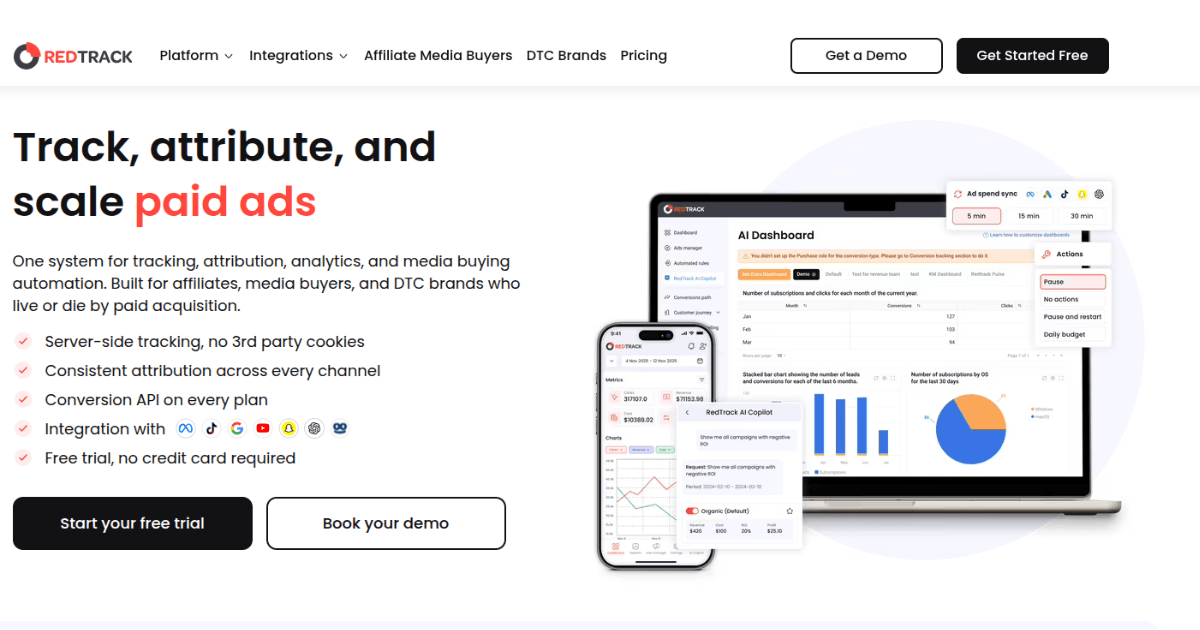
RedTrack is a performance marketing tracking and attribution platform with an agency-specific proposition built around one repeatable measurement system across multiple client accounts. It combines attribution, ad-spend data, conversion APIs, reporting, and campaign operations.
Best for
Performance agencies, media buyers, affiliate teams, ecommerce advertisers, and agencies managing high campaign volume across several ad networks.
Agency use case
Run a repeatable tracking framework across many client accounts while maintaining consistent ROAS reporting, fresh ad-spend data, and client-facing performance views.
Pricing
RedTrack currently lists agency bundles from $139 per month, with higher bundles adding faster ad-spend sync, Ads Manager access, AI dashboards, support, and larger-scale media-buying capabilities. Pricing rises with spend, data freshness, and add-ons.
Key agency attribution capabilities
- Unlimited stores/websites and users on agency bundles
- Conversion API support for Meta, TikTok, Google, and other networks
- Cross-channel attribution and revenue/ROAS reporting
- White-label and partner-facing reporting options
- Ad-spend synchronization at several refresh frequencies
- Campaign management and performance automation options
- MCP access for AI-enabled media-buying workflows
Why it stands out
RedTrack is unusually agency-specific. Its product packaging and use-case positioning recognize that agencies need the same tracking logic to work repeatedly across client accounts instead of rebuilding the stack for each onboarding.
Verdict
RedTrack is a strong specialist for agencies whose day-to-day work centers on performance marketing, campaign tracking, conversion APIs, and ROAS optimization across many active paid-media accounts.
4. Wicked Reports: Best for ecommerce agencies focused on new-customer revenue
Overview
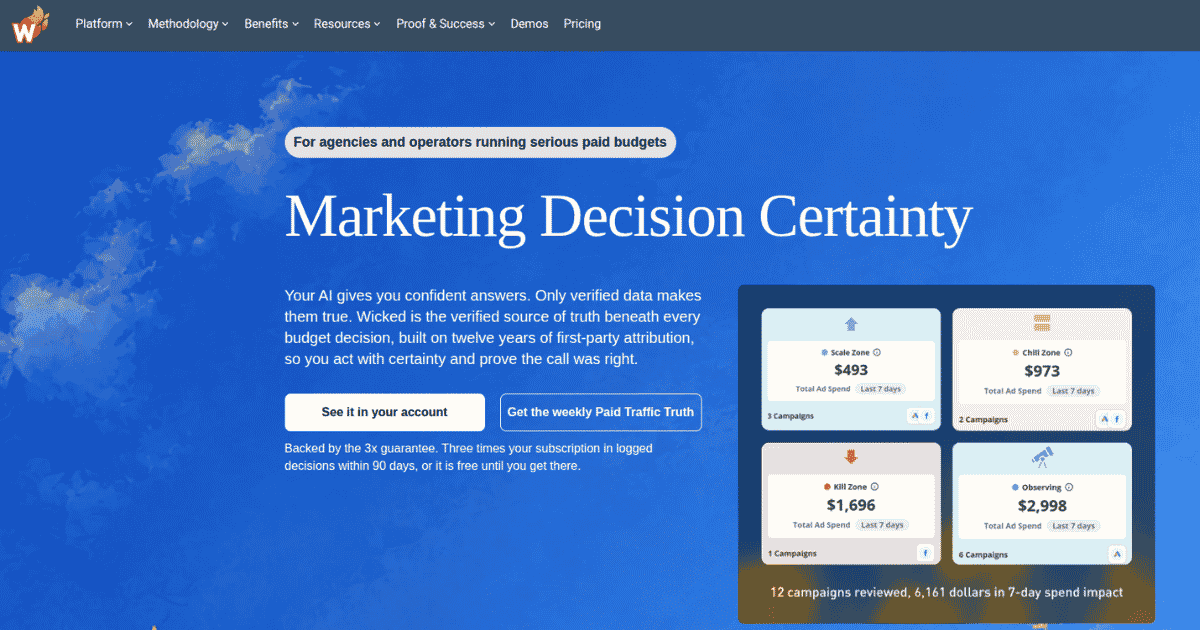
Wicked Reports is a first-party attribution platform centered on marketing decision certainty, customer-level attribution, new-customer acquisition, and lifetime value. Its positioning is particularly relevant to ecommerce and subscription businesses running serious paid budgets.
Best for
Ecommerce agencies, subscription brands, repeat-purchase businesses, and teams that need to distinguish new-customer revenue from total platform-reported ROAS.
Agency use case
Evaluate which campaigns acquire valuable new customers and how those customers generate revenue over time, instead of treating every purchase as equivalent.
Pricing
Wicked Reports uses revenue-aligned pricing for ecommerce and subscription businesses. Current plan selection is based on annual revenue and required attribution scope rather than one flat price for every account.
Key agency attribution capabilities
- First-party customer-level attribution
- New-customer and repeat-customer measurement
- Revenue and customer lifetime value analysis
- Multi-touch marketing attribution
- Paid-channel integrations for ecommerce acquisition
- Longer customer journey and subscription context
Why it stands out
Wicked Reports focuses measurement on the customer economics behind paid acquisition. That is valuable for agencies that need to explain whether an ad channel is generating profitable new customers rather than only creating attributed orders.
Verdict
Wicked Reports is best suited to ecommerce and subscription agencies where new-customer acquisition quality, repeat revenue, and LTV are more important than CRM opportunity stages.
5. Hyros: Best for direct-response agencies

Overview
Hyros is an AI-powered ad tracking and attribution platform built for paid-traffic businesses. It is closely associated with direct-response funnels, ecommerce, B2B calls, and environments where ad-to-sale visibility drives daily budget decisions.
Best for
Direct-response agencies, high-ticket services, coaching and education funnels, ecommerce advertisers, and teams where calls or sales-assisted conversions are central to paid acquisition.
Agency use case
Trace paid clicks through leads, calls, purchases, and recurring revenue across several client accounts, then use the resulting conversion signals to guide budget allocation.
Pricing
Hyros currently advertises entry pricing from $69 per month for up to $5,000 in tracked monthly revenue, with higher tiers scaling by tracked revenue. The Hyros pricing guide gives additional context for evaluating the model.
Key agency attribution capabilities
- Paid-ad tracking across major advertising networks
- Multi-client attribution reporting for agency portfolios
- Funnel, lead, call, sales, and recurring-revenue tracking
- Multi-touch attribution and customer journeys
- Server-side measurement and conversion feedback
- Agency reporting views centered on tracked revenue and ROAS
Why it stands out
Hyros has a strong direct-response identity and now explicitly frames multi-client attribution reporting as an agency workflow. That makes it especially relevant when client value is judged almost entirely through paid traffic and revenue.
Verdict
Hyros belongs on the shortlist for direct-response agencies. Teams comparing that specialization with a broader analytics and attribution environment can review the Hyros alternative comparison.
6. HockeyStack: Best for complex B2B agency clients
Overview
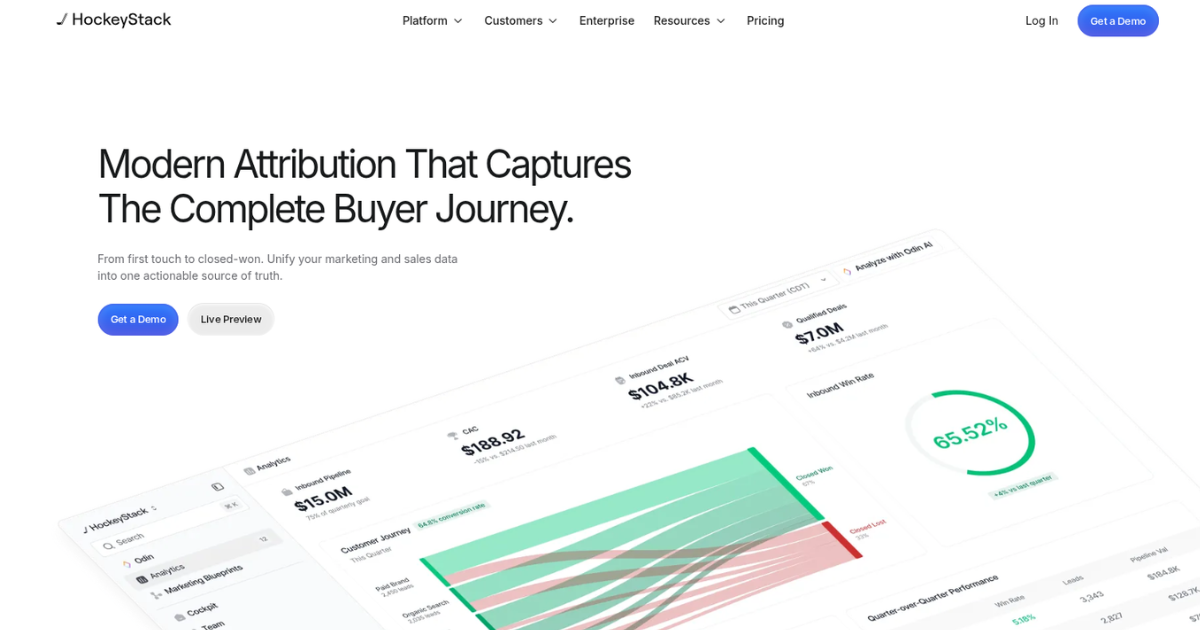
HockeyStack is a B2B revenue and GTM intelligence platform that evaluates account-level buyer journeys across marketing, sales, CRM, product, and other go-to-market data.
Best for
Agencies serving B2B SaaS, enterprise software, account-based marketing programs, and clients with long sales cycles or multi-stakeholder buying committees.
Agency use case
Model how paid activity contributes to accounts, opportunities, pipeline, and revenue rather than stopping at individual leads. This is especially useful for agencies working deeply in b2b marketing attribution.
Pricing
HockeyStack uses a demo-led custom pricing process. The hockeystack pricing guide provides more context on its sales-led buying model.
Key agency attribution capabilities
- Account-level buyer journeys and buying-committee context
- Multi-touch attribution and model comparison
- Marketing, sales, CRM, product, intent, and web data
- Pipeline and revenue reporting
- Account scoring, lift views, and GTM analysis
- AI-assisted analysis across complex B2B journeys
Why it stands out
HockeyStack is designed around the B2B account rather than an isolated web conversion. That makes it useful when an agency must prove influence across a buying committee before an opportunity reaches closed-won status.
Verdict
HockeyStack is a strong fit for specialized B2B revenue intelligence. The HockeyStack alternative page compares that depth with Usermaven’s self-serve attribution, behavioral analytics, and multi-workspace model.
7. Dreamdata: Best for B2B buying-committee attribution
Overview
Dreamdata is a B2B attribution and activation platform built around account journeys, buying committees, campaign ROI, pipeline, revenue, audience creation, and conversion feedback. It also has an agency-specific partner proposition.
Best for
B2B SaaS agencies, ABM specialists, revenue marketing agencies, and client portfolios where several contacts and channels influence the same opportunity.
Agency use case
Map anonymous and known interactions to accounts, measure which activities influence pipeline and revenue, then activate audiences from the same B2B journey data.
Pricing
Dreamdata offers a free plan for foundational B2B attribution and activation. Larger organizations use customized pricing for broader attribution, activation, AI, reporting, and data-control requirements.
Key agency attribution capabilities
- Anonymous-to-known B2B journey tracking
- Contact-to-account mapping and account timelines
- Multi-touch and customizable attribution models
- Pipeline and revenue attribution
- Audience building and activation
- Conversion feedback and account-level intent workflows
Why it stands out
Dreamdata combines attribution with B2B activation. That is useful for agencies that want to move from proving which accounts are influenced to building and syncing audiences around those same signals.
Verdict
Dreamdata is a strong specialist for B2B account attribution. Teams that also need broader website and product analytics can use the Dreamdata alternative page for a more direct comparison.
8. Triple Whale: Best for Shopify-focused agencies

Overview
Triple Whale is an ecommerce analytics and attribution platform built around store revenue, ad spend, orders, customer value, product performance, and first-party ecommerce data.
Best for
Shopify and DTC agencies that want paid attribution connected directly with orders, products, customer cohorts, profitability, and repeat-purchase economics.
Agency use case
Pull ecommerce and media data into one environment so account teams can compare advertising through store economics instead of relying only on native ad-platform ROAS.
Pricing
Triple Whale prices paid plans based on annual revenue and the package selected. The triple whale pricing guide provides additional context for agencies planning across different client sizes.
Key agency attribution capabilities
- First-party ecommerce tracking through Triple Pixel
- Multi-touch attribution and Total Impact Attribution
- Paid-media spend, order, and new-customer measurement
- Creative, product, customer, and profitability analytics
- Post-purchase survey inputs to complement tracked touchpoints
- Unlimited users and multi-store support on paid plans
Why it stands out
Triple Whale keeps attribution centered on ecommerce economics. Agencies with Shopify-heavy client portfolios can also review the broader ecommerce attribution workflow when deciding how much store, customer, and channel detail they need.
Verdict
Triple Whale is one of the strongest specialist options for Shopify/DTC agencies. The Triple Whale alternative comparison is useful when broader CRM, SaaS, or product analytics coverage is also required.
9. Northbeam: Best for high-spend ecommerce agencies

Overview
Northbeam is an ecommerce media measurement platform that combines first-party multi-touch attribution, deterministic views, creative analytics, correlation analysis, and optional media mix modeling for larger advertisers.
Best for
Agencies serving established DTC and ecommerce brands with substantial paid-media budgets, dedicated performance teams, and a need for advanced media measurement or planning.
Agency use case
Help larger clients move from platform ROAS toward an independent ecommerce measurement layer that can support daily campaign decisions and broader media planning.
Pricing
Northbeam Starter begins at $1,500 per month. Professional and Enterprise use custom pricing for higher-spend advertisers, and Northbeam states that qualifying seven-figure brands may receive lower pricing through its Agency Partner Program.
Key agency attribution capabilities
- First-party multi-touch attribution
- Clicks plus deterministic view-through measurement
- Creative and product analytics
- Correlation analysis and channel-level performance views
- Optional media mix modeling for broader planning
- Agency partner support and multi-store options
Why it stands out
Northbeam gives scaled ecommerce agencies a path from campaign-level attribution into broader media strategy. It is strongest when clients have enough spend and data volume to justify more advanced measurement infrastructure.
Verdict
Northbeam is a strong specialist for high-spend ecommerce accounts. The Northbeam alternative page compares that specialization with a broader SaaS, B2B, and product-oriented attribution environment.
10. Ruler Analytics: Best for lead-generation agencies
Overview
Ruler Analytics is a marketing measurement platform that connects online acquisition with forms, phone calls, live chat, CRM opportunities, offline conversions, pipeline, and revenue.
Best for
Lead-generation agencies, professional services, appointment businesses, high-value sales, and clients whose sales process often continues by phone or inside a CRM.
Agency use case
Close the loop between campaign activity and offline sales by matching leads with their earlier marketing history. Agencies comparing this workflow can also review lead attribution software before pushing revenue outcomes back into reporting and advertising systems.
Pricing
Ruler’s Small plan starts at $400 per month for up to 10,000 monthly visits, and agency partner rates are available. The Ruler analytics pricing guide provides additional context on higher traffic tiers.
Key agency attribution capabilities
- First-party tracking and conversion tags
- Form, call, live-chat, ecommerce, and offsite conversion capture
- Google, Microsoft, Meta, TikTok, LinkedIn, and other ad integrations
- CRM integrations including Salesforce, HubSpot, Dynamics, and Pipedrive
- Multi-touch, data-driven, and impression attribution
- Revenue feedback to marketing systems and optional MMM on advanced plans
Why it stands out
Ruler is particularly useful when the client journey leaves the website before the sale closes. Calls, forms, CRM stages, and closed revenue can be tied back to the campaigns and keywords that influenced them.
Verdict
Ruler Analytics is a strong choice for online-to-offline attribution. The Ruler Analytics alternative comparison is useful when agencies are deciding between lead-centric attribution and a broader website, product, and SaaS workflow.
How we evaluated agency ad attribution platforms
Each platform is reviewed against the same agency buying criteria. The goal is to compare operational fit, measurement depth, and client workflow rather than rank tools only by feature count or brand awareness.
- Multi-client management and workspace separation
- Paid-channel coverage across major ad networks
- First-party, server-side, UTM, click-ID, and deduplication support
- Attribution model flexibility and journey visibility
- CRM, ecommerce, pipeline, revenue, and LTV connection
- Client-facing dashboards, white-label options, and auditability
- Audience activation and conversion feedback capabilities
- AI-assisted analysis and reporting workflow
- Pricing scalability as client count, traffic, spend, or revenue grows
Table 2: Best platform by agency client type
Here’s a quick breakdown by client type and need.Match your client’s priority to the right platform below.
| Agency / client type | Primary requirement | Strong options |
| Mixed SaaS + B2B | Ads + website + CRM + revenue | Usermaven |
| Paid media | Cross-channel ads + conversion feedback | Cometly, RedTrack |
| Direct response | Funnel + call + sale attribution | Hyros |
| B2B / ABM | Account + pipeline + revenue | Usermaven, HockeyStack, Dreamdata |
| Shopify / DTC | Orders + ROAS + LTV | Triple Whale, Northbeam, Wicked Reports |
| Lead generation | Forms + calls + offline revenue | Ruler Analytics |
Why agencies need a different ad attribution setup
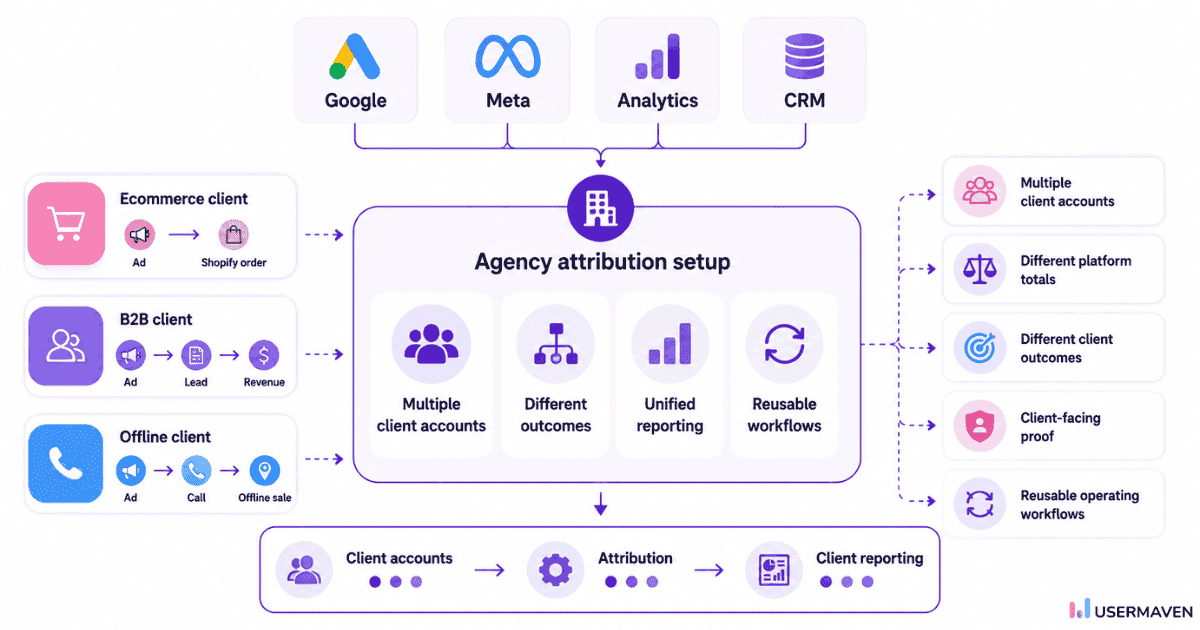
Agencies juggle multiple clients, platforms, and reporting standards at once. A single dashboard rarely captures that complexity accurately.
Multiple client accounts
An in-house team usually measures one business. An agency may need separate workspaces, domains, conversion definitions, CRMs, ecommerce stores, access controls, and attribution settings for every client without mixing data.
Different platform totals
One client can see Meta, Google, analytics, and CRM reporting four different totals for the same period. Understanding ad platform discrepancies is therefore an operational agency skill, not an edge case.
Different client outcomes
A Shopify client may measure orders and new-customer revenue. A B2B client may care about opportunities and pipeline, while a lead-generation client may close revenue through calls or sales-assisted workflows.
Client-facing proof
Agencies must explain attribution to founders, CMOs, ecommerce managers, and revenue teams that may question ROAS or campaign credit. Auditable customer journeys and consistent definitions make those conversations easier.
Reusable operating workflows
A strong agency setup should make onboarding the next client easier. Repeatable tracking, workspace templates, reporting logic, and validation steps reduce the need to rebuild measurement from scratch for every new account.
Native ad dashboards vs. agency attribution platforms
Each platform reports its own numbers in isolation, ignoring cross-channel overlap. Agencies need a unified view to see what’s actually driving results.
Native advertising platforms
Google, Meta, LinkedIn, TikTok, and other native systems are essential for bidding, creative optimization, audience decisions, and platform-specific campaign management. Their attribution logic is still limited to the identities, windows, and eligible interactions available inside each ecosystem.
This is why marketing attribution discrepancies between tools can persist even when every implementation is working correctly. The agency needs a documented way to reconcile those differences for the client.
Independent agency attribution
Independent attribution creates a common reporting framework across channels, client websites, CRM systems, ecommerce stores, and revenue. It can serve as a single source of truth for comparison without claiming perfect omniscience: agencies can evaluate channels using the same definitions instead of adding overlapping native totals together.
What makes an agency ad attribution platform reliable?
Reliability comes down to a few core capabilities every agency should expect. Here’s what actually matters.
1. Separate client environments
Each client should have clearly separated data, reporting, access, and attribution settings. Workspace organization becomes more important as the agency adds domains, currencies, teams, and conversion definitions.
2. Strong first-party tracking
A durable first party data layer helps preserve campaign and customer information that ad-platform dashboards cannot independently reconcile across the wider journey.
3. Server-side measurement
server side tracking can improve delivery, deduplication, and control over first-party events when implemented with the correct consent and data-governance rules. It should support privacy-aware measurement, not be treated as a privacy bypass.
4. Cross-platform consistency
Having cross-platform ad tracking matters because clients rarely spend through only one network. The agency needs a consistent comparison layer across Google, Meta, LinkedIn, Microsoft Ads, TikTok, and other material channels.
5. Attribution model transparency
Teams should know which attribution window applies, which touchpoints are eligible, and how credit is distributed. A sophisticated model is not useful if an account manager cannot explain the result to a client.
6. CRM and revenue connection
For SaaS, B2B, and lead-generation clients, attribution should progress from ad to lead to opportunity to customer and revenue attribution. Otherwise an agency can optimize lead volume while missing customer quality.
7. Client-ready reporting
Agencies need reports that clients can understand and trust. For a broader look at client-facing workflows, see marketing agency reporting tools.
8. Pricing that scales with the roster
Compare the cost at five, ten, and twenty clients rather than only the entry price. The marketing attribution software cost guide explains common pricing models such as traffic, events, tracked revenue, GMV, ad spend, and enterprise custom agreements.
How privacy changes agency ad attribution
Privacy changes reduce the number of touchpoints an agency can observe directly. Consent rejection, browser protections, ad blockers, cookie restrictions, and mobile identifier limits can make customer journeys less complete even when the campaign itself is configured correctly.
WebKit documents that Safari’s tracking prevention includes full third-party cookie blocking and other limits on cross-site tracking. That is why privacy-aware attribution increasingly depends on consented first-party signals, identity connection, server-side delivery where appropriate, and transparent modeling.
Agencies should separate unavoidable signal loss from preventable implementation failures. The guide to attribution software for agencies is useful when white-label delivery and agency operations are the primary concern, while this article stays focused on paid-ad attribution across client accounts.
Why Google, Meta, and CRM numbers disagree
A client may assume one system is broken when Google, Meta, analytics, and the CRM report different conversion totals. In practice, those systems can disagree because they use different identities, windows, dates, modeled conversions, view-through rules, and conversion definitions.
Google’s official documentation explains how attribution models determine which ad interactions receive credit for a conversion. Reviewing the Google Ads attribution models helps agencies separate platform-specific credit logic from neutral cross-channel reporting.
The agency’s job is not to force every system to match. It is to define which system is authoritative for each decision, document the reason for differences, and reconcile platform optimization data with the client’s actual business outcomes.
How agencies should audit client attribution
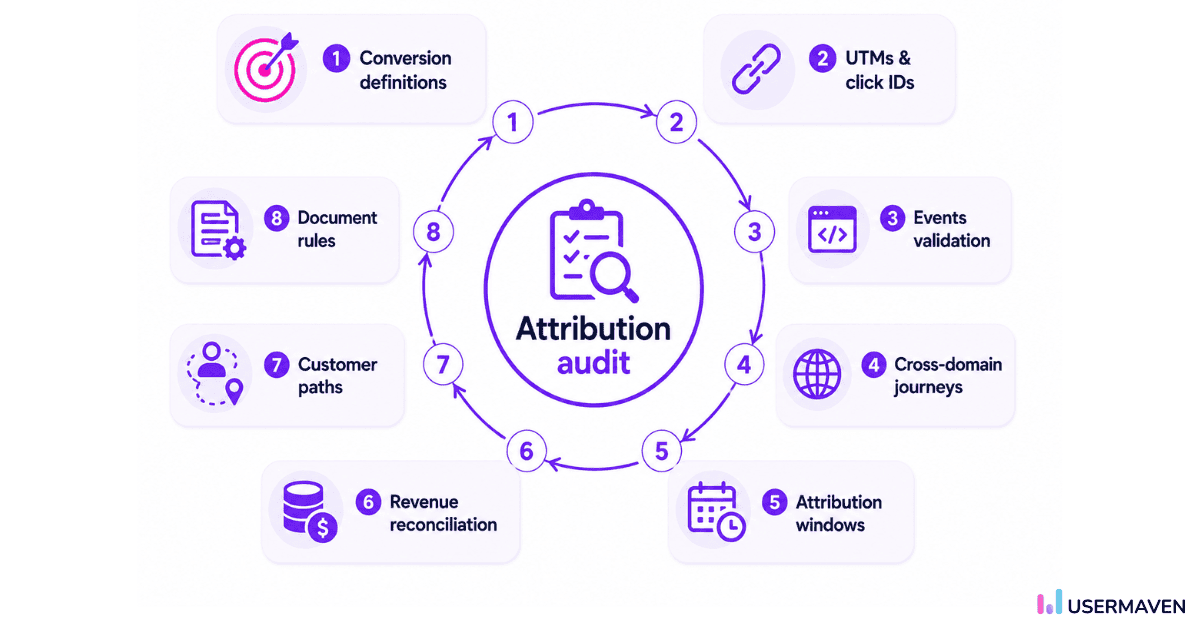
Use an attribution checklist to test the full measurement chain instead of reviewing dashboards in isolation. The guide on how to measure marketing attribution provides the broader measurement framework behind that audit.
1. Standardize client conversion definitions
Confirm what counts as a lead, qualified lead, purchase, opportunity, customer, revenue event, refund, and expansion. Attribution cannot be reconciled if the systems measure different outcomes.
2. Validate UTMs and click IDs
Open real ads and follow every redirect to the landing page. Confirm UTM parameters, click IDs, source values, and campaign names survive the complete path.
3. Test browser and server events
Compare browser pixels, server events, tag-manager events, CRM imports, and ad-platform conversions. One real business outcome should not accidentally become two attributed conversions.
4. Check cross-domain journeys
Test websites, applications, authentication, checkout, booking, and payment flows. A complete cross domain tracking review should preserve the original acquisition source through the entire customer path.
5. Compare attribution windows
Document click windows, view windows, conversion dates, time zones, and model settings before comparing totals. A conversion can be eligible in one platform and outside the window in another.
6. Reconcile CRM or ecommerce revenue
Check that qualified opportunities, purchases, deal values, refunds, subscriptions, and closed revenue reconnect with the original marketing history.
7. Trace several real customer paths
Choose actual customers from different channels and manually reconstruct their journeys. Real paths often reveal identity breaks, referral overwrites, or missing events that aggregate reporting hides.
8. Document each client’s attribution rules
Store the conversion definitions, model, windows, channel scope, naming conventions, and reporting source of truth. This prevents interpretation from changing every time a new account manager or client stakeholder joins.
From attribution to activation: The newer agency workflow
Modern agency attribution does not have to end at reporting. A stronger workflow can move from tracking to attribution, analysis, audience creation, activation, and optimization without rebuilding the same logic in several tools.
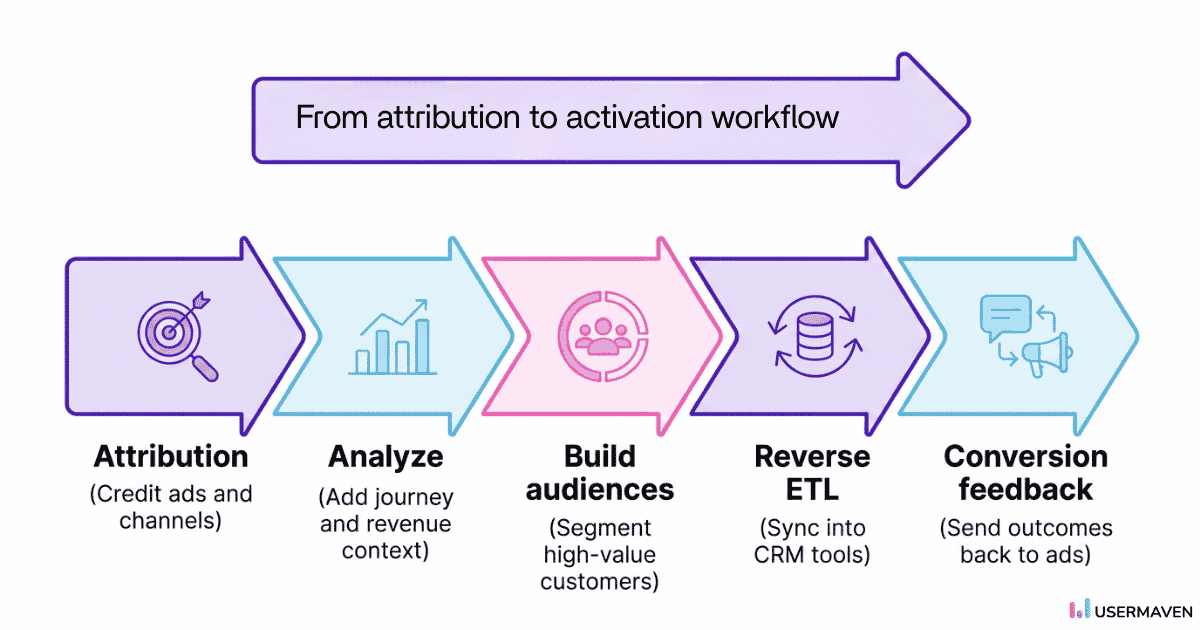
Track and attribute
Collect campaign and customer interactions, preserve identity where possible, and apply consistent attribution rules across the client’s material channels.
Analyze
Use customer journeys, funnels, CRM stages, revenue, and product behavior to understand whether attributed traffic is creating meaningful downstream outcomes.
Build and activate audiences
Create behavior- or value-based audiences from measured customer data, then sync those audiences into connected marketing systems when the platform supports Reverse ETL or native activation.
Return conversion feedback
conversion syncs can send verified outcomes back to ad platforms so bidding systems learn from qualified leads, customers, purchases, or revenue rather than shallow events alone.
How Usermaven supports agency ad attribution
Usermaven brings clarity to agency reporting through accurate, client-ready attribution. It connects campaign data directly to real business outcomes.
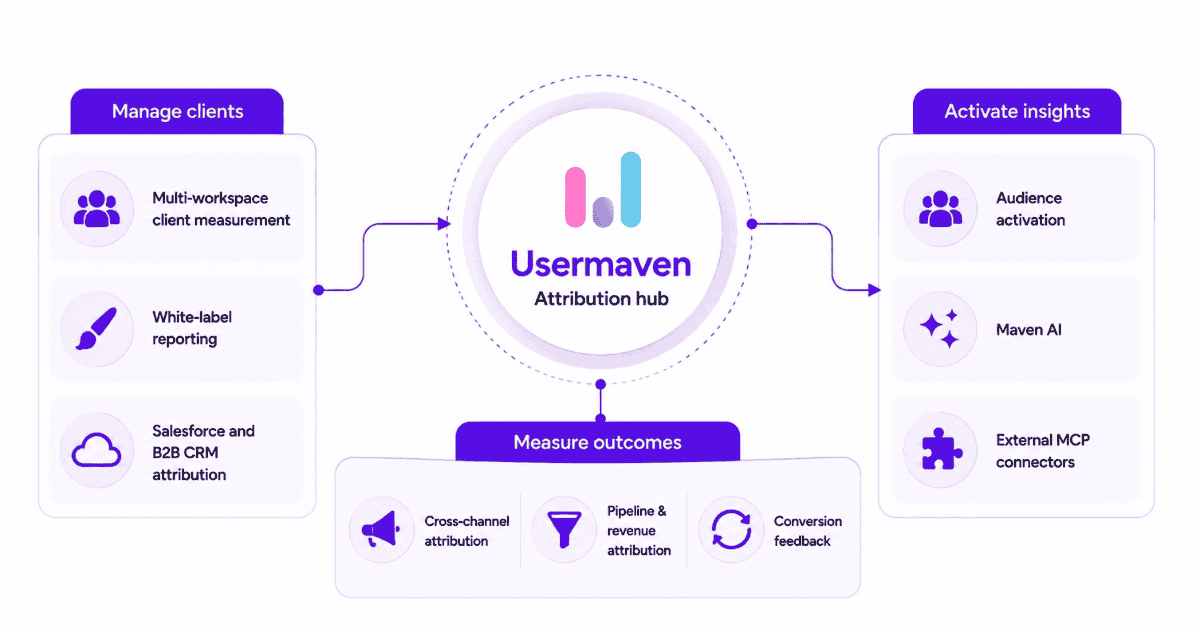
Multi-workspace client measurement
Usermaven workspaces keep client websites, dashboards, reports, and team access organized separately. Scale includes five workspaces, while Enterprise supports custom workspace counts and broader infrastructure controls.
White-label reporting
The white-label add-on supports custom branding, dashboard and tracking domains, white-labeled emails, themes, and multiple client workspaces. Agencies focused primarily on branded reporting can also review white label analytics.
Cross-channel attribution
It brings paid-ad, channel, content, landing-page, CRM, pipeline, revenue, and customer-journey attribution into one framework rather than adding native platform totals together.
Salesforce and B2B CRM attribution
The Salesforce integration is released and can sync Accounts, Contacts, Leads, Opportunities, stage history, and contact roles. Per-org field mapping and sandbox support make the connection more practical for agencies handling different Salesforce implementations.
Audience activation
Reverse ETL audience syncs can move Usermaven audiences into HubSpot and Customer.io. This lets agencies turn measured customer segments into activation workflows without exporting and rebuilding lists manually.
Maven AI and external MCP connectors
Maven AI can answer questions across attribution, journeys, funnels, campaigns, and connected behavioral data, while saved AI previews make repeated analysis easier to operationalize. External MCP connectors can extend approved agent workflows outside Usermaven with workspace-level permissions and consent.
Conversion feedback
Verified first-party outcomes can be synchronized back to advertising platforms so optimization can learn from meaningful downstream conversions instead of only top-of-funnel activity.
See Usermaven in action
Book a free demo and discover how powerful analytics can grow your business.
How to choose the right platform for your agency
Choosing the right platform depends on your clients, workflows, and reporting needs. The right fit saves time and improves accuracy across every account you manage.
1. Start with your client roster
Group clients by SaaS/B2B, ecommerce, direct response, lead generation, and mixed portfolios. The strongest platform usually follows the dominant client economics.
2. Map paid channels
List every channel with meaningful spend and confirm the attribution platform covers the channels that matter rather than only the two easiest integrations.
3. Define the final business outcome
Decide whether success is a lead, qualified lead, purchase, opportunity, revenue, retained customer, or LTV. This determines the required downstream integrations.
4. Check CRM and ecommerce integrations
Confirm whether the platform reads the systems where the client actually records opportunities, purchases, refunds, subscriptions, and revenue.
5. Compare client reporting needs
Decide whether the agency needs internal dashboards only, client portals, scheduled reports, white-label email, custom domains, or exportable raw data.
6. Evaluate attribution methods
Choose models based on the business question rather than one permanent default. Multi-touch, data-driven, and incrementality methods answer different questions.
7. Test data quality
Validate UTMs, click IDs, identity connection, deduplication, server-side events, and cross-domain journeys before judging the attribution model.
8. Check activation and conversion feedback
Audience sync and conversion feedback become more valuable when the agency is responsible for both measurement and optimization.
9. Calculate cost across the full roster
Model cost at current and expected client counts, including workspaces, traffic, revenue tiers, ad spend, users, support, and add-ons.
10. Run a parallel test
Keep existing reporting in place while the new platform collects data. Compare several real customer paths and client outcomes before migrating the reporting source of truth.
How much should an agency attribution platform cost?
Agency attribution pricing can range from low hundreds per month to large enterprise contracts. The more important question is how cost changes as the client roster, tracked traffic, revenue, ad spend, workspaces, and data requirements grow.
- Flat subscription: Predictable when the included workspaces, event volume, and feature set match the agency’s normal client profile.
- Per-client or workspace pricing: Simple to allocate to client retainers but can become expensive as the roster grows.
- Traffic or event pricing: Scales with the amount of measured activity rather than the number of client accounts.
- Tracked-revenue or GMV pricing: Common in direct-response and ecommerce products where plan cost grows with client revenue.
- Ad-spend pricing: Costs can increase quickly for agencies managing large paid-media budgets.
- Enterprise custom pricing: Usually reflects implementation, data volume, advanced modeling, integrations, support, and service levels.
Agencies should compare the price of the plan that includes the required client workflow, not the cheapest entry plan. A low starting price can be misleading if attribution, white labeling, extra workspaces, faster data, or activation require separate add-ons.
Final verdict
The right agency attribution platform should match the client mix, reporting workflow, and business outcomes the agency is responsible for proving.
Usermaven is a strong overall fit for agencies that need cross-channel attribution connected with client workspaces, CRM and revenue data, white-label reporting, activation, and AI-assisted analysis.
Agencies can start a free 14-day Usermaven trial to evaluate whether the platform fits their multi-client attribution and reporting workflow.
See what's working. Fix what's not. Grow faster.
FAQs
1. What is an ad attribution platform for agencies?
It is software that connects advertising interactions across client accounts and applies a consistent framework for assigning conversion or revenue credit. Agency-focused platforms also need client separation, reporting, and scalable account management.
2. What is the best ad attribution platform for agencies?
The best platform depends on the client roster. Usermaven fits mixed SaaS and B2B portfolios, RedTrack and Cometly fit performance agencies, Triple Whale and Northbeam fit ecommerce, Hyros fits direct response, and Ruler Analytics fits lead generation.
3. What should agencies look for in attribution software?
Look for multi-client separation, paid-channel coverage, strong tracking, attribution transparency, customer journey visibility, CRM or ecommerce revenue connection, client reporting, activation options, and pricing that scales with the roster.
4. Can one attribution platform manage multiple clients?
Yes, several platforms support agency or multi-workspace structures. Agencies should verify how client data is separated, how access is controlled, and whether pricing changes with workspaces, accounts, or data volume.
5. Can agency attribution software track Google and Meta together?
Yes. Cross-channel platforms can compare Google and Meta in one reporting framework, which is useful because the two networks can use different identities, attribution windows, and credit rules for the same conversion.
6. What is the difference between agency ad tracking and attribution?
Ad tracking records observable interactions such as clicks, sessions, calls, events, and conversions. Attribution uses those interactions to decide how campaigns and channels receive credit for the business outcome.

Written by
Ryan Mitchell
Marketing Analytics Strategist
Ryan Mitchell is a marketing analytics strategist specializing in campaign measurement, customer journeys, and marketing performance. He writes about analytics, reporting, and data-driven marketing strategies, helping SaaS and B2B teams measure what matters across every stage of the customer journey.
All articles by Ryan →