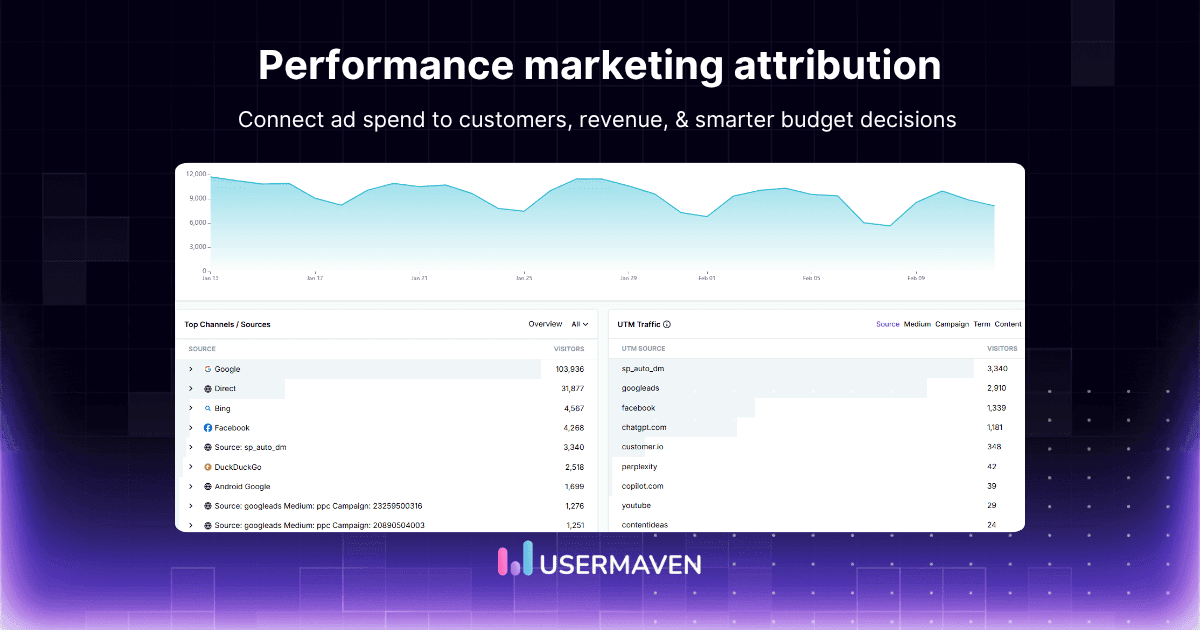
Marketing attribution is moving beyond browser-based conversion credit. Modern systems are expected to connect first-party behavior, campaign data, customer identities, CRM stages, product activity, revenue, and optimization in one measurement flow.
The shift matters because marketers no longer need only a report showing which ad appeared before a conversion. They need marketing attribution software that can explain the full customer journey, compare several measurement methods, and connect media investment with commercial value.

This guide separates established adoption from latest trends in marketing attribution technology. It explains what is changing, why it matters, and where marketing teams should focus before adding more models, automation, or artificial intelligence to an unreliable data foundation.
Key takeaways
- AI speeds up analysis, not judgment: AI is making attribution analysis faster and more conversational, but marketers still need to validate the data and business context.
- Measurement methods are converging: Multi-touch attribution, marketing mix modeling, and incrementality are increasingly used together because each answers a different question.
- First-party tracking is becoming standard: First-party and server-side tracking are becoming standard parts of reliable measurement infrastructure.
- Attribution is moving downstream: Attribution is shifting from leads and conversion counts toward pipeline, revenue, retention, and customer lifetime value.
- Attribution is becoming a feedback loop: Modern attribution increasingly works as an optimization loop that sends verified outcomes back to advertising platforms.
- The fundamentals still matter: Data quality, identity rules, governance, and model transparency remain essential regardless of the technology used.
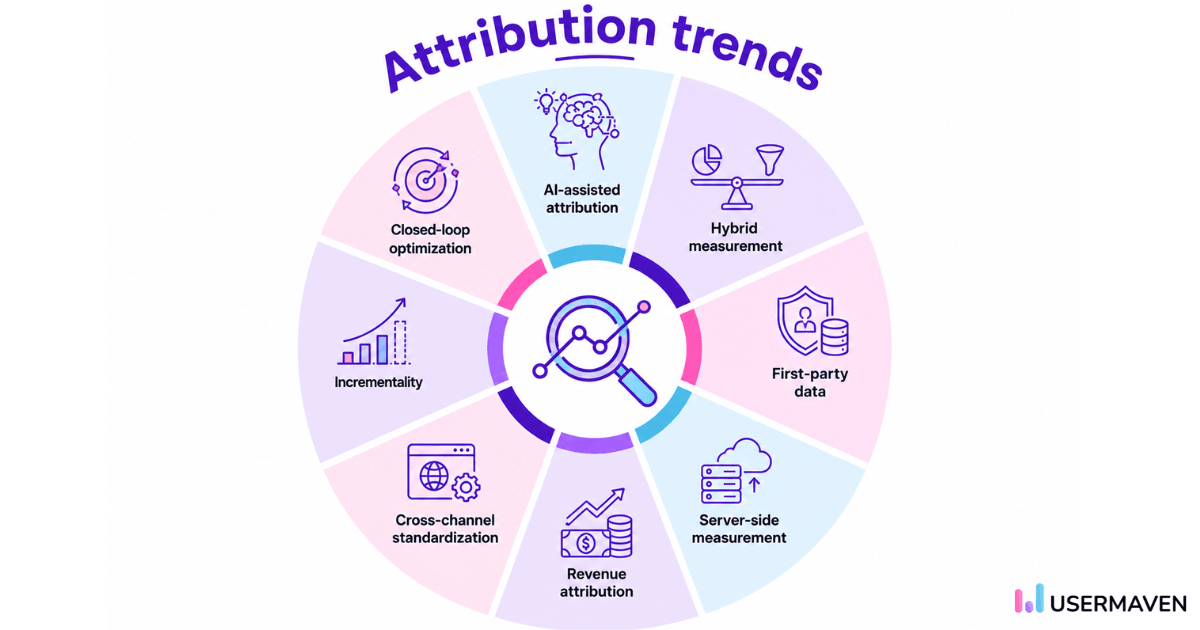
Table 1: Attribution technology trends at a glance
Before you explore each trend in detail, here’s a quick overview.
| Trend | Main change | Why it matters |
| AI-assisted attribution | Automated analysis and explanations | Reduces reporting effort |
| Hybrid measurement | MTA, MMM, and incrementality together | Answers different measurement questions |
| First-party data | Direct behavioral and customer signals | Reduces dependence on third-party signals |
| Server-side measurement | Events collected or forwarded through controlled infrastructure | Improves data continuity |
| Privacy-resilient attribution | Consent, modeling, and aggregated reporting | Supports sustainable measurement |
| Revenue attribution | Leads connected with pipeline and revenue | Measures commercial value |
| Cross-channel standardization | Shared definitions across platforms | Reduces reporting conflicts |
| Incrementality | Causal impact testing | Separates credit from true lift |
| Closed-loop optimization | Verified outcomes returned to ad platforms | Improves campaign optimization |
| Data governance | Stronger definitions and validation | Makes advanced models trustworthy |
Why is traditional attribution failing marketers in 2026?
Traditional attribution fails when one credit model is treated as a complete measurement system. First-touch and last-touch show where credit was assigned, but not causal lift, offline influence, brand effects, or post-conversion value.
Platform fragmentation deepens the problem. Google, Meta, LinkedIn, email, CRM, and analytics systems use different identities, windows, timestamps, and conversion definitions, so the same customer can produce conflicting performance totals.
Many setups also stop at clicks, forms, and signups. The business cares about qualified opportunities, revenue, retention, and expansion, so high-volume channels can appear successful while producing low-value customers.
The solution is not to discard attribution. It is to combine journey credit with first-party data, identity resolution, revenue outcomes, incrementality, and aggregate planning methods.
Marketing attribution technology trends
Here are the shifts shaping attribution right now. Each one addresses a real gap in how teams measure marketing performance today.
1. AI becomes an attribution analysis layer
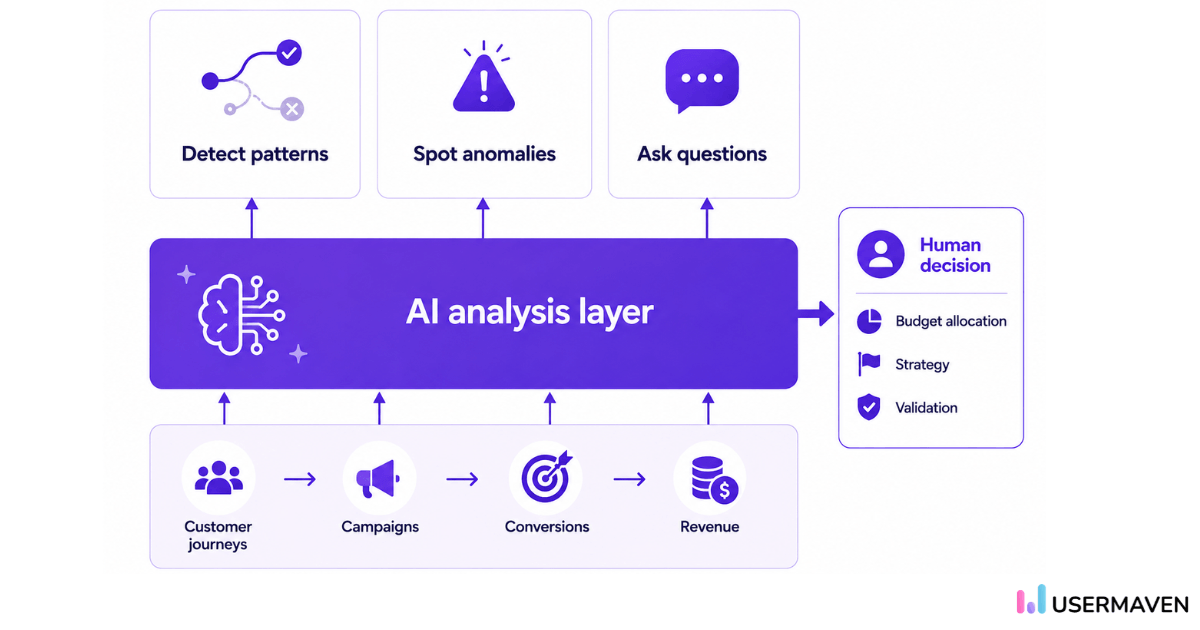
AI is increasingly placed above journey, campaign, conversion, and revenue data. It can compare converting and non-converting paths, surface recurring patterns, and flag changes that fixed dashboards may leave hidden.
Pattern detection across customer journeys
Data-driven attribution uses observed journey patterns rather than assigning every conversion through one fixed rule. AI can extend that analysis by comparing thousands of paths, identifying which combinations frequently appear before qualified pipeline, revenue, or retention.
Natural-language and automated analysis
Natural-language interfaces let marketers ask direct questions such as which campaigns generated the most qualified pipeline, why conversion quality changed, or which sources produced retained customers. Maven AI represents this shift from manually building every report toward querying connected analytics data in plain language.
Marketers remain accountable
AI can surface correlations and possible explanations, but budget allocation remains a human responsibility. Marketers still need to consider market conditions, campaign objectives, brand activity, sales feedback, seasonality, and strategic priorities that historical data may not represent.
The output is only as reliable as the inputs. Missing UTMs, duplicate conversions, disconnected CRM records, weak identity resolution, or incomplete revenue data can produce confident-looking but misleading recommendations.
2. MTA, MMM, and incrementality work together
Multi-touch attribution, marketing mix modeling, and incrementality are no longer best understood as competing methods. They answer different questions and become more useful when they calibrate one another.
Multi-touch attribution explains journeys
Marketing attribution models distribute conversion or revenue credit across recorded touchpoints. Multi-touch attribution is useful for understanding customer-level paths, comparing discovery and closing roles, and identifying common assisted journeys.
Marketing mix modeling supports planning
MMM works with aggregated data to estimate how investment, seasonality, pricing, promotions, market conditions, and offline channels relate to business outcomes. It is particularly useful when user-level tracking is incomplete or unavailable.
Incrementality tests causal impact
Incrementality asks whether a campaign created additional results that would not otherwise have occurred. Holdouts, geo tests, lift studies, and other experiments help distinguish causal effect from simple correlation.
The Think with Google modern measurement playbook presents marketing mix modeling, attribution, and incrementality testing as a unified measurement approach. The practical direction is a calibrated stack: MTA for customer journeys, incrementality for causal validation, and MMM for broader planning.
3. First-party data becomes the foundation
Attribution is moving toward data collected through direct customer interactions. Website events, product activity, forms, purchases, subscriptions, CRM updates, and support or sales outcomes create a more durable foundation than third-party browser signals alone.
Anonymous-to-known identity connection
A visitor may arrive anonymously, return several times, submit a form, create an account, and later become a customer. The Contacts Hub helps connect acquisition and behavioral history with known contacts and companies once identification becomes available.
First-party data is not automatically complete
Ownership does not guarantee quality. First-party data still depends on consent, event design, naming rules, identity logic, deduplication, and consistent conversion definitions across marketing, product, sales, and finance.
4. Server-side attribution becomes standard
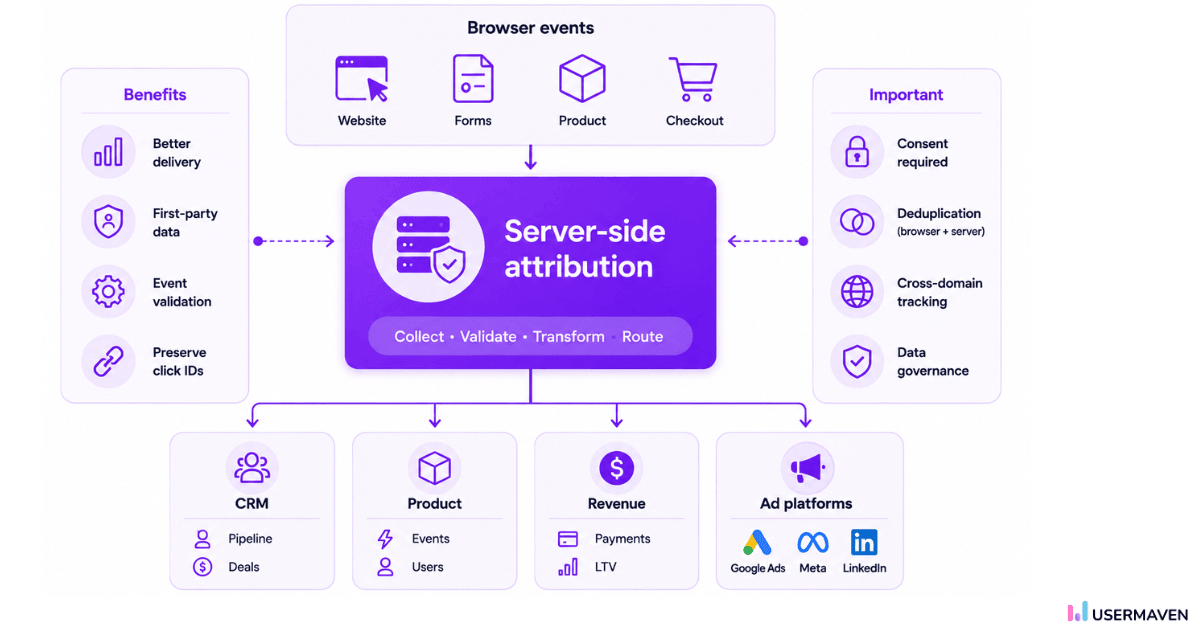
Server-side tracking collects or forwards events through controlled infrastructure instead of relying entirely on browser scripts. It can connect website events, product actions, CRM stages, offline outcomes, and advertising identifiers with greater continuity.
Why teams are adopting server-side measurement
The approach can improve event delivery, reduce browser-side loss, preserve click identifiers, and strengthen the feedback sent to advertising platforms. It also gives teams more control over how data is validated, transformed, and routed.
Meta describes its Conversions API as a connection between business data and its advertising systems. The broader trend is similar across major ad platforms: verified first-party outcomes are increasingly sent through direct integrations rather than depending only on pixels.
Server-side tracking is not a privacy bypass
Server-side infrastructure does not remove consent requirements, repair poor event definitions, or guarantee accurate attribution. Teams still need transparent collection rules, appropriate data minimization, and reliable browser-and-server deduplication.
Cross-domain tracking also remains important when customers move between a marketing site, application, authentication domain, checkout, payment provider, or booking system.
5. Privacy-resilient measurement replaces cookie dependence
The future is not one universal cookieless attribution system. Privacy-resilient measurement combines first-party data, consent management, server-side collection, aggregated reporting, modeled conversions, incrementality, and identity resolution where permitted.
Consent-aware measurement
Consent must remain visible throughout collection, identity connection, attribution, and activation. A platform should not treat server-side access as permission to ignore the user choices applied at the website or application layer.
Observed and modeled data must remain distinct
Observed events and statistically modeled outcomes can support the same decision, but they should not be presented as identical evidence. Marketers need to understand what was directly recorded, what was estimated, and which assumptions shaped the result.
Uncertainty becomes part of reporting
Modern attribution should communicate confidence, data coverage, attribution windows, and methodological limits. A single precise number can be less useful than a transparent range or clearly explained model.
6. Attribution moves from leads to revenue and LTV
The most important outcome is moving deeper into the customer lifecycle: lead -> qualified lead -> opportunity -> customer -> revenue -> retention. Attribution technology is increasingly expected to preserve the journey across those stages.
CRM and pipeline attribution
Marketing attribution CRM integration connects acquisition activity with lifecycle stages, opportunity IDs, deal values, close dates, and closed-won outcomes. This lets marketing compare campaigns by qualified pipeline rather than form volume.
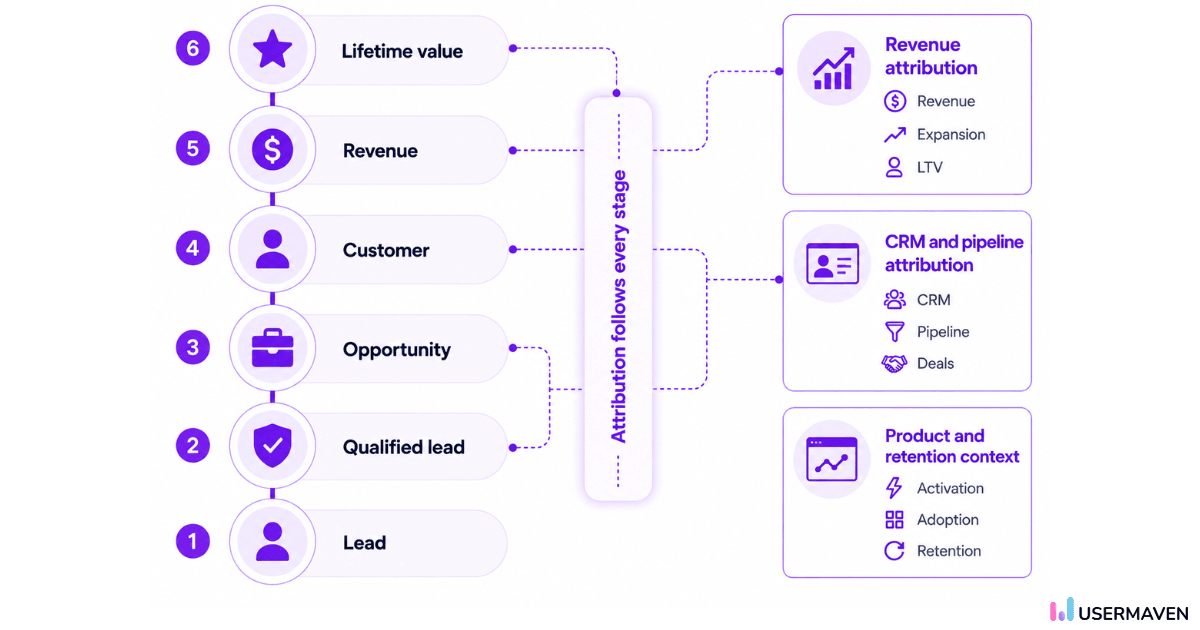
Product and retention context
The source generating the most signups may not generate the best customers. Product analytics can compare acquisition sources by activation, feature adoption, upgrade behavior, and retention.
Revenue and lifetime value
Revenue attribution extends the analysis to closed revenue, repeat purchases, subscription duration, expansion, and customer lifetime value. This changes channel evaluation from cost per lead to the value of the customers created.
7. Cross-channel measurement becomes standardized
Ad platforms frequently disagree because each system uses its own attribution window, identity method, eligible interactions, modeled conversions, and conversion date. The mismatch is often structural rather than a tracking error.
Ad platform discrepancies become easier to manage when teams use one neutral framework across Google, Meta, LinkedIn, email, partners, referrals, and direct traffic.
Shared taxonomies reduce fragmentation
Consistent source, medium, channel, campaign, and conversion definitions make cross-platform reporting more comparable. A shared UTM parameter convention prevents the same campaign from appearing under several spellings, capitalizations, and separators.
Standardization supports AI and automation
Automation depends on structured inputs. Clean taxonomies make it easier to compare campaigns, detect anomalies, train models, create dashboards, and route verified outcomes without rebuilding definitions for every system.
8. Incrementality becomes an attribution companion
A broader comparison of marketing analytics vs. attribution helps separate descriptive performance analysis from credit assignment. Attribution asks which interactions receive credit, while incrementality asks whether the activity caused additional results.
Common incrementality methods
Randomized holdout tests compare exposed and unexposed groups.
Conversion-lift studies estimate additional outcomes caused by advertising.
Geo and match-market tests compare regions with similar historical behavior.
Counterfactual models estimate what would have happened without the campaign.
Shadow-mode tests compare a new optimization strategy without immediately changing live spend.
Why attribution alone is insufficient
A campaign can appear in many converting journeys because it reaches people who were already likely to buy. Attribution identifies that pattern, while incrementality tests whether the campaign created additional demand.
How teams use both
A practical sequence is: attribution identifies patterns, experiments validate causal impact, and planning models estimate how budget changes may affect outcomes at scale.
9. Attribution becomes an optimization loop
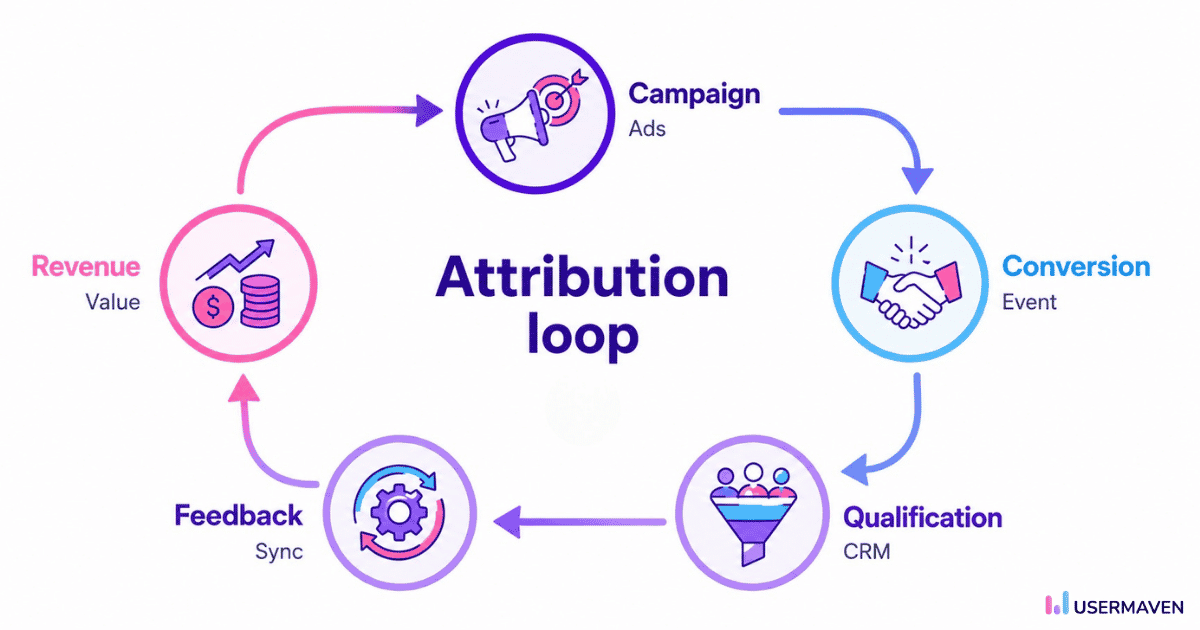
Modern attribution is moving beyond retrospective dashboards. You want a closed loop connecting campaign, conversion, qualification, revenue, and advertising feedback.
Conversion synchronization
Conversion syncs send verified first-party outcomes back to advertising platforms. The event may be a qualified lead, activated account, opportunity, purchase, upgrade, or another outcome that is closer to business value than an early form submission.
Deeper outcomes improve optimization
Ad algorithms can make better decisions when the feedback represents meaningful value. Optimizing toward closed customers or retained revenue can produce a different media mix than optimizing toward every lead equally.
Faster feedback cycles
Connected systems reduce the delay between campaign activity, sales qualification, revenue confirmation, and optimization. The challenge is balancing speed with enough time for the real outcome to mature.
10. Data quality and governance become product features
Advanced attribution methods increase the value of clean inputs and the cost of weak ones. UTM governance, event naming, identity rules, conversion deduplication, CRM definitions, currency handling, and revenue reconciliation become core platform requirements.
Model transparency
Marketers should be able to see which data was included, which touchpoints were eligible, which attribution window was used, whether results were observed or modeled, and how credit was calculated.
Access controls and auditability
As attribution influences budget and revenue reporting, teams need clear ownership, controlled access, change histories, and documented definitions. Measurement should be understandable to marketing, sales, product, finance, and leadership.
Human validation
Before a model influences budget, teams should trace real customer journeys from acquisition through conversion and revenue. A result that cannot be reconciled with source events, CRM records, and payments should not be treated as decision-grade evidence.
What these trends mean for marketing teams
These attribution trends only create value when teams turn them into practical measurement habits. The priority is to strengthen the data foundation, connect attribution to revenue, and use advanced models only when they support better decisions.
Build the data foundation first
Prioritize reliable conversion tracking, consistent campaign naming, CRM integration, identity connection, and revenue validation before adding sophisticated models. A better algorithm cannot compensate for missing or duplicated outcomes.
Add advanced measurement gradually
Start with understandable first-touch, last-touch, and multi-touch views. Add incrementality, MMM, and AI when the organization can explain the data, maintain the inputs, and connect the results with a real decision.
Measure commercial outcomes
Move reporting from traffic and lead counts toward qualified pipeline, revenue, retention, and LTV. The purpose of modern attribution is not to create a more complex dashboard; it is to improve resource allocation.
Keep humans accountable
Use AI and automation to reduce reporting effort and surface patterns. Keep human review for causality, brand effects, market context, risk, and strategic budget decisions.
Table 2: Which trends matter by business type?
| Business type | Most relevant trends |
| SaaS | AI analysis, product attribution, revenue, retention |
| B2B | Identity resolution, CRM attribution, pipeline, incrementality |
| Ecommerce | Server-side tracking, revenue attribution, conversion syncs |
| Lead generation | First-party leads, call and form outcomes, CRM stages |
| Agencies | Cross-channel standardization, governance, dashboards |
| Enterprise | Hybrid measurement, MMM, incrementality, data governance |
How Usermaven supports modern attribution
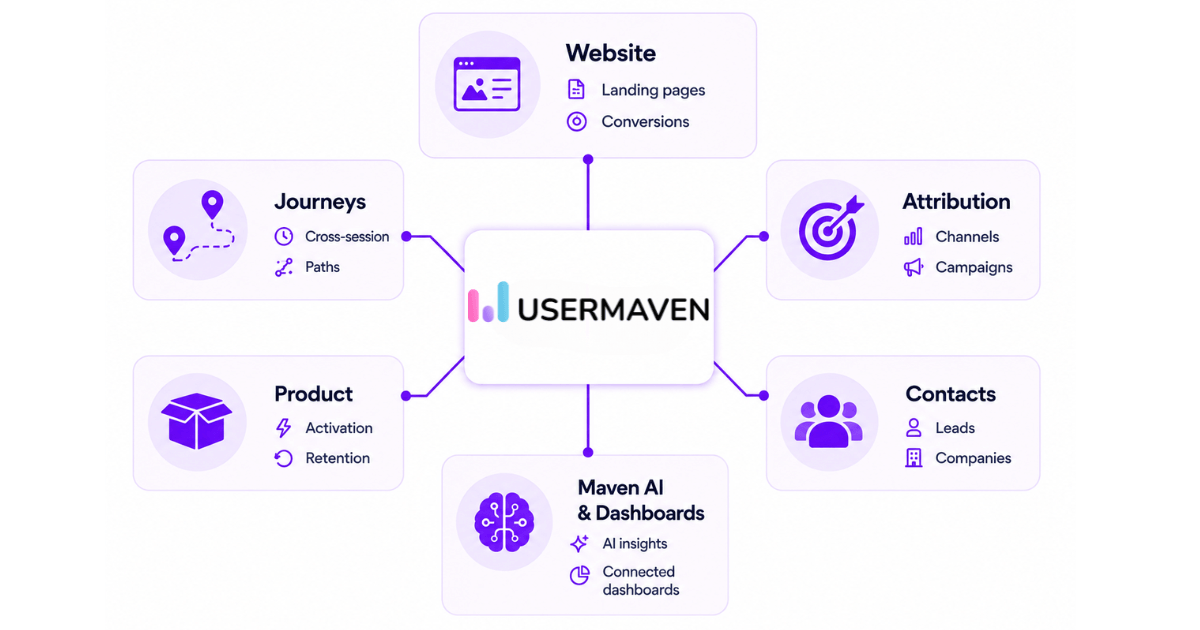
Usermaven connects attribution with website behavior, product activity, customer journeys, CRM outcomes, revenue, and AI-assisted analysis. The value is not one isolated model; it is a connected measurement layer from acquisition through customer value.
First-party website and product tracking
Website analytics captures traffic sources, landing pages, content behavior, and conversions. Product analytics adds activation, feature adoption, engagement, upgrades, and retention.
Cross-session customer journeys
User journeys preserve the sequence of sources, pages, product events, and conversions across return visits. Teams can inspect how discovery becomes signup, activation, opportunity, customer, and retained account.
Paid-ad and channel attribution
Attribution reporting compares channels, sources, campaigns, paid ads, content, conversion paths, CRM deals, pipeline, and revenue through several attribution perspectives.
Funnels, contacts, and commercial outcomes
Funnels show progression and drop-off between acquisition and product milestones. The Contacts Hub connects those journeys with known users, leads, and companies.
AI-assisted analysis and connected dashboards
Maven AI lets teams ask questions across connected analytics data. Analytics dashboards give marketing, product, revenue, and leadership teams shared views without maintaining separate definitions for every report.
See Usermaven in action
Book a free demo and discover how powerful analytics can grow your business.
What will not change in attribution
Data quality remains foundational: Better models cannot compensate for missing sources, duplicated conversions, or disconnected revenue.
No model answers every question: Journeys, causality, and strategic planning continue to require different methods.
Attribution is not absolute truth: Results depend on the available data, model, attribution window, identity rules, and conversion definition.
Marketers still make the decisions: Technology can surface patterns and recommendations, but budget allocation remains a strategic responsibility.
How to prepare for the next attribution stack
Audit the current data: Identify missing sources, duplicate events, disconnected CRM records, and inconsistent revenue definitions.
Standardize campaign tracking: Use shared source, medium, campaign, and content naming rules across channels.
Connect downstream outcomes: Bring qualification, pipeline, revenue, retention, and LTV into the measurement system.
Test server-side collection: Validate browser and server events, deduplication, click identifiers, and conversion APIs.
Compare measurement methods: Use attribution, incrementality, and MMM according to the question being answered.
Introduce AI carefully: Begin with reporting assistance and anomaly detection before relying on predictive recommendations.
Document governance rules: Define ownership for events, UTMs, identities, conversions, attribution windows, and revenue.
Validate real journeys: Trace actual customers from acquisition through commercial outcomes before acting on reports.
Final verdict
Marketing attribution is moving from browser-based credit assignment toward connected measurement built on first-party data, server-side tracking, AI-assisted analysis, hybrid methods, CRM outcomes, revenue, incrementality, and stronger governance.
Traditional attribution is not disappearing, but it is becoming one layer inside a broader system. Marketers still need journey-level credit, yet they also need causal testing, aggregate planning, identity connection, and downstream business outcomes.
Usermaven brings these areas together by connecting campaigns with website behavior, product activity, customer journeys, contacts, pipeline, revenue, retention, and AI-assisted analysis. Start a free 14-day Usermaven trial to evaluate modern attribution using real customer and business outcomes.
Drive business growth
with AI-powered analytics
Frequently asked questions
1. What are the latest trends in marketing attribution technology?
The leading trends are AI-assisted analysis, hybrid use of MTA, MMM and incrementality, first-party data, server-side measurement, privacy-resilient methods, revenue attribution, cross-channel standardization, conversion synchronization, and stronger data governance.
2. Why is traditional attribution failing marketers in 2026?
Traditional attribution fails when fixed credit rules, fragmented platform data, and shallow conversion goals are treated as a complete measurement system. It does not independently prove causality or connect every campaign with pipeline, revenue, and retention.
3. How is AI changing marketing attribution?
AI helps compare large numbers of customer journeys, detect anomalies, summarize performance, and answer questions through natural language. It supports analysis but still depends on reliable tracking, identity resolution, and human judgment.
4. Will AI replace traditional attribution models?
No. AI may help estimate relationships and compare patterns, but understandable first-touch, last-touch, and multi-touch models remain useful. Teams still need transparent baselines and human validation.
5. What is privacy-resilient attribution?
Privacy-resilient attribution combines consent-aware first-party data, server-side collection, aggregated reporting, modeled conversions, experiments, and permitted identity resolution rather than depending on one cookie or identifier.
6. Why is server-side tracking important for attribution?
Server-side tracking can improve event delivery, preserve identifiers, connect CRM or offline outcomes, and strengthen conversion feedback. It does not remove consent requirements or automatically fix poor event definitions.

Written by
Ryan Mitchell
Marketing Analytics Strategist
Ryan Mitchell is a marketing analytics strategist specializing in campaign measurement, customer journeys, and marketing performance. He writes about analytics, reporting, and data-driven marketing strategies, helping SaaS and B2B teams measure what matters across every stage of the customer journey.
All articles by Ryan →