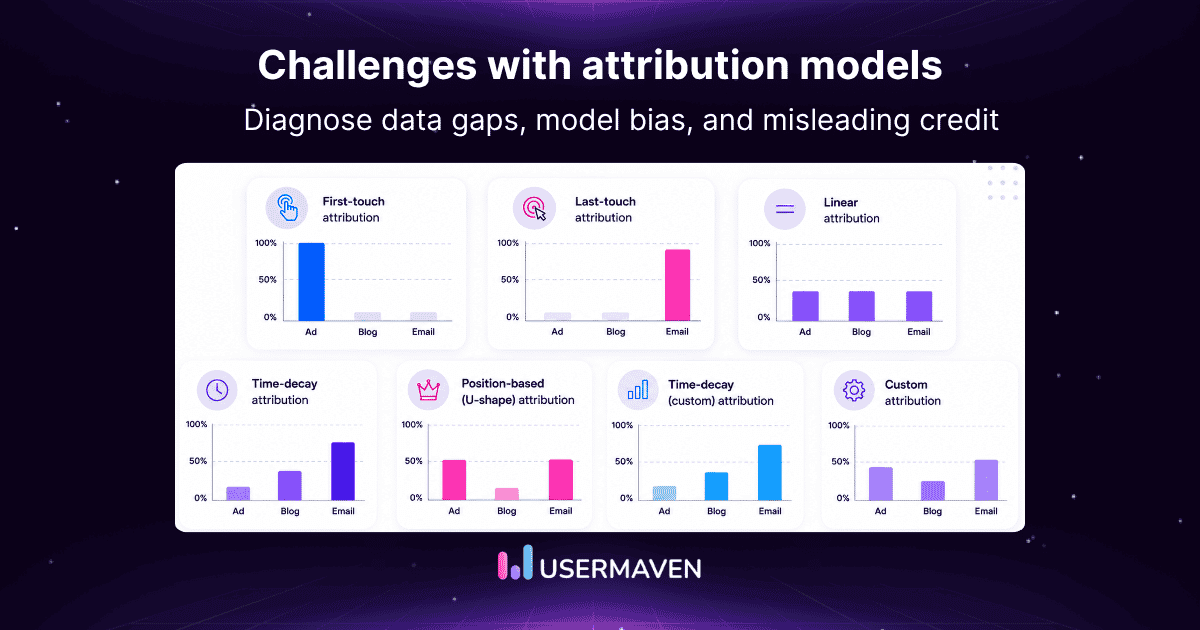
Change the weights in an attribution model and a channel can move from supporting player to apparent winner without a single customer journey changing. That is the power and the risk of custom attribution.
Standard models settle credit with predefined rules. A custom attribution model lets the business define its own logic, but those rules still depend on complete journeys, clean source data, and assumptions the team can defend.
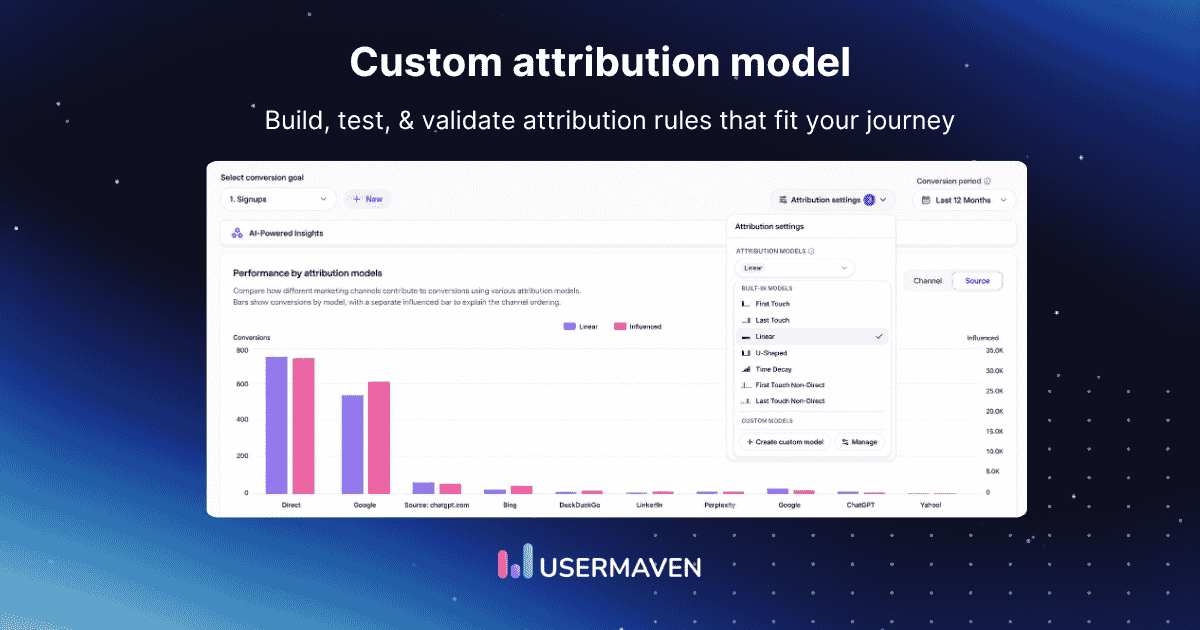
This guide shows how to build, test, and validate a custom model, then operationalize it with marketing attribution software without confusing customization with causal truth.
Custom attribution models at a glance
A custom attribution model is a business-defined framework for distributing conversion or revenue credit across eligible marketing touchpoints using weights, rules, channel adjustments, or funnel priorities that differ from a platform’s standard attribution models.
| Question | Short answer |
|---|---|
| What does a custom attribution model change? | How eligible touchpoints share credit |
| Does custom mean more accurate? | No. It means business-defined, not automatically more truthful. |
| Is it multi-touch attribution? | Usually, although custom rules can emphasize specific positions. |
| Who defines the weights? | The business or analyst. |
| Is it data-driven attribution? | Not necessarily. |
| Can it fix missing tracking? | No. |
| Should it replace every standard model? | Usually not. Keep a baseline for comparison. |
| What should validate it? | Journey evidence, model comparisons, sensitivity testing, and commercial outcomes. |
Key takeaways
The practical rules are simple: customize only after the measurement foundation is trustworthy, and keep a standard baseline visible so every credit shift can be explained.
- Custom models encode business assumptions: They let teams decide which journey positions or channels deserve more credit.
- Customization is not accuracy by default: A tailored model can still reflect weak assumptions.
- Data quality comes before weighting: Missing events, broken identities, inconsistent UTMs, or incomplete conversion records cannot be repaired by changing percentages.
- Model, channel mapping, window and outcome are separate controls: Changing one should not be confused with changing another.
- Sensitivity testing matters: If small weighting changes completely reverse the recommended budget decision, the model is fragile.
- Custom attribution measures contribution, not causality: Experiments are still needed when the question is incremental impact.
- Commercial outcomes are stronger validation: Pipeline, Closed Won revenue, retention, or LTV are more useful than form fills alone.
What is a custom attribution model?
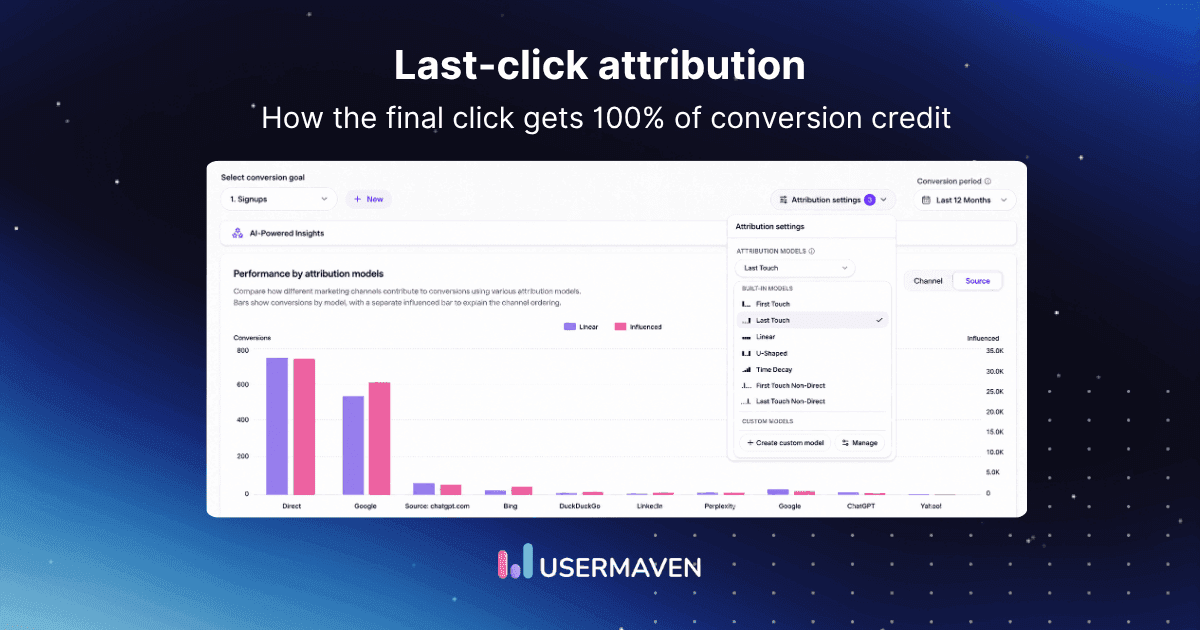
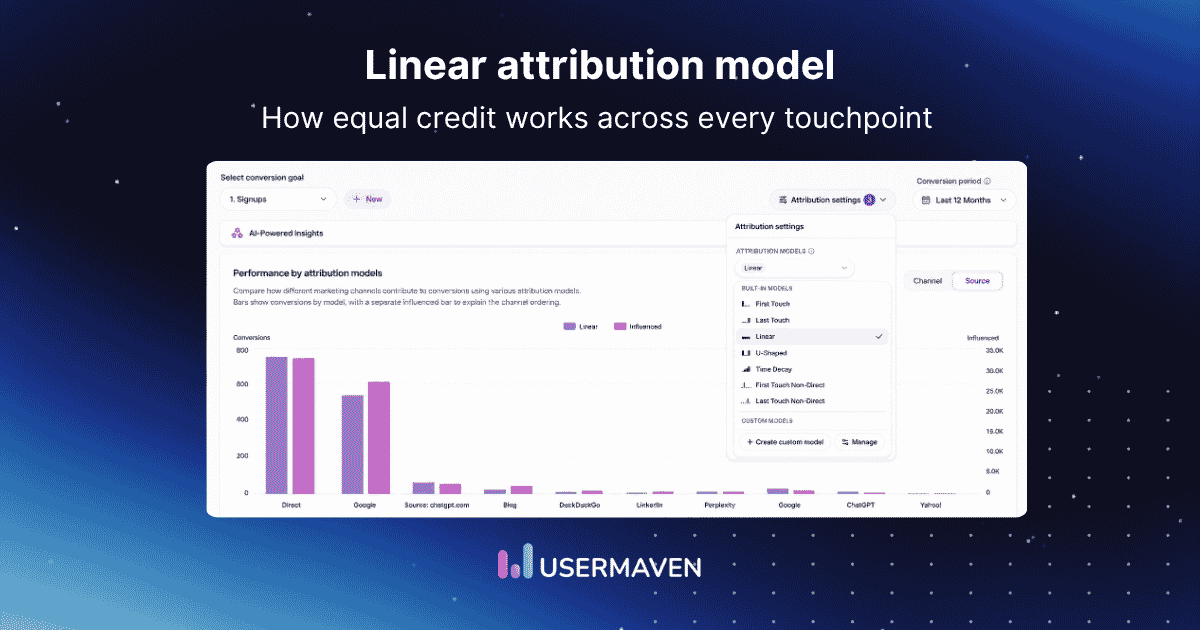
A standard model begins with a fixed attribution rule. First touch gives the opening interaction all the credit, last touch gives it to the closing interaction, and Linear spreads it evenly.
A custom model changes that logic to reflect a business-specific hypothesis. For the broader model landscape, see marketing attribution models.

The important word is hypothesis. A custom model does not discover the true value of each touchpoint.
It expresses a reasoned belief about how observable touchpoints should share credit, then lets the team test whether that view produces more useful decisions.
Three ways attribution becomes custom
Position weighting changes how much credit goes to the first, middle, and last parts of the journey.
A team might use a 30/40/30 split because it wants meaningful credit assigned to nurture interactions rather than only discovery or closing.
Channel adjustments change the relative value of selected channels.
A partner or webinar channel can receive more relative weight, while branded search or Direct can receive less when the business believes those touches are more likely to capture demand than create it.
Stage-based logic is common in longer B2B journeys. A modeling system may prioritize discovery, lead creation, opportunity creation, or closing milestones so the attribution view better reflects the sales process instead of treating every interaction identically.
Custom vs standard vs data-driven attribution
Before choosing a custom model, separate three approaches that can look similar in a report but use very different logic to assign credit.
| Dimension | Standard rule-based | Custom rule-based | Data-driven |
|---|---|---|---|
| Credit logic | Predefined | Business-defined | Learned from observed data |
| Weights | Fixed | Configurable | Algorithmic |
| Transparency | High | Usually high | Varies |
| Data requirement | Lower | Moderate | Usually higher |
| Business assumptions | Generic | Explicit | Embedded in model and data |
| Easy to explain | Yes | Usually | Often harder |
| Causality | No | No | No |
| Main risk | Oversimplification | Subjective weighting | Model or data bias |
Custom and data-driven attribution solve different problems. Custom rule-based attribution makes the assumptions visible and editable. Data-driven attribution estimates credit from observed patterns. Neither should be treated as proof that a channel caused the conversion.
See what's working. Fix what's not. Grow faster.
A custom model is also a form of multi-touch attribution when it distributes credit across more than one eligible interaction, but not every multi-touch model is custom.
Linear and time-decay models are multi-touch even when their rules are predefined.
Where AI fits into custom attribution
AI can help interrogate an attribution model after the measurement foundation exists. It can summarize how channel credit changes, surface model-sensitive campaigns, compare journey patterns, and answer questions about attributed pipeline or revenue.
See how AI-driven marketing attribution fits into the broader measurement workflow.
AI should not be used as a shortcut for weak attribution logic.
A language model can explain why a channel gained credit under a chosen model, but it does not make business-defined weighting assumptions causal or automatically correct.
When should you build a custom attribution model?
A custom model earns its complexity only when the buying journey contains repeatable patterns that a standard model cannot represent well.
Build one when the journey has a defensible reason for custom credit
Customization is most useful when several channels play clearly different roles, the buying cycle is long, meaningful funnel milestones exist, revenue is more useful than lead count,
or branded and Direct interactions routinely absorb closing credit that the team believes was created earlier.

For B2B SaaS, the case can be especially strong when marketing creates awareness months before an opportunity and the CRM outcome happens long after the first identifiable touch.
Do not build one yet when the inputs are unreliable
If UTMs are inconsistent, identities fragment across sessions, conversion events are missing, CRM outcomes are not connected,
or nobody can explain why the proposed weights exist, a custom model creates more precision in the formula than the data deserves.
| Situation | Customize now? | Why |
|---|---|---|
| Stable multi-channel journey | Yes | Business rules may add useful context. |
| Broken campaign tracking | No | Fix collection first. |
| Long B2B sales cycle | Often | Standard closing models can undervalue discovery. |
| Very low conversion volume | Usually no | Conclusions are likely to be unstable. |
| Ecommerce with retargeting and branded search | Potentially | Channel roles can differ materially. |
| Team wants a better-looking report | No | Do not reverse-engineer weights to a preferred answer. |
| A custom attribution model cannot repair a journey that was never captured. |
Fix the measurement foundation before the model
Attribution weights sit at the end of a measurement chain. Before changing the formula, confirm that the interactions the model will allocate are actually present and connected to the correct conversion.
| Coverage → identity → source quality → eligibility → window → outcome → model |
Capture the interactions
Ads, landing pages, forms, content, product actions, meetings, and other meaningful interactions need consistent collection. Events provide the behavioral units a model can later evaluate.
Preserve identity
Return visits and known-user transitions need to belong to the same person or account when the use case requires it. Customer journey analytics is useful because attribution becomes much more defensible when the underlying path can
be inspected.
Keep source data clean
Standardize UTM parameters and channel taxonomy before changing weights. A custom model cannot distinguish campaigns correctly if acquisition data enters the system inconsistently.
Define the outcome
Choose what receives attribution: signup, demo, MQL, opportunity, purchase, Closed Won, recurring revenue, or another business outcome. Different outcomes can justify different models.
Set the attribution window
A model can distribute credit only across touchpoints that remain eligible inside its lookback period. Choose an attribution window that reflects the actual buying cycle rather than a convenient default.
How custom attribution weighting works
The underlying math can be simple. Give each eligible touchpoint a relative weight, add the weights together, then normalize each touchpoint against the total.

| Attributed Creditᵢ = wᵢ / Σw × conversion value |
For example, consider a $7,000 deal with four eligible touches: LinkedIn, an article, a webinar, and branded search.
The team assigns relative weights of 2, 1, 3, and 1 because it believes the webinar and opening discovery touch deserve more credit than the later branded return.
| Touchpoint | Weight | Share | Attributed value |
|---|---|---|---|
| 2 | 28.6% | $2,000 | |
| Article | 1 | 14.3% | $1,000 |
| Webinar | 3 | 42.9% | $3,000 |
| Branded search | 1 | 14.3% | $1,000 |
The weights do not need to be percentages if the modeling system normalizes them.
Google Campaign Manager 360, for example, documents custom credit rules that use relative multipliers and normalize credit across the path.
The Google custom attribution model documentation shows how channel and interaction multipliers can modify a baseline model.
The lesson is not to copy another platform’s formula. The lesson is to make the assumptions explicit so the team can challenge them.
See Usermaven in action
Book a free demo and discover how powerful analytics can grow your business.
Custom model vs channel mapping vs attribution window
Several attribution controls are easy to confuse. A team can change how traffic is categorized without changing the attribution model, or change the lookback window without changing the weights.
| Setting | What changes | Example |
|---|---|---|
| Attribution model | How credit is shared | 30/40/30 |
| Channel adjustment | Relative credit of a channel | Partner = 150% |
| Channel mapping | How traffic is categorized | utm_medium=affiliate → Affiliates |
| Attribution window | Which touches remain eligible | 90 days |
| Conversion goal | Which outcome receives attribution | Demo or purchase |
| Conversion value | How much the outcome is worth | $500 or dynamic revenue |
A source attribution view answers where the interaction came from. It does not by itself decide how much credit that source should receive.
Usermaven also supports custom channel mapping so teams can define channel taxonomy separately from custom credit rules.
How to build a custom attribution model
The model should begin with a decision, not a percentage. Use the following process so the weighting logic remains auditable and comparable with a standard baseline.

- Define the decision. Specify what the model should improve: budget allocation, content investment, pipeline reporting, paid media optimization, or another decision.
- Define the attributed outcome. Choose the conversion or revenue event that the model will distribute across the journey.
- Define eligible interactions. Decide which ads, pages, events, forms, meetings, product actions, or CRM milestones can receive credit.
- Audit the measurement inputs. Check event capture, UTMs, identity, cross-domain tracking, integrations, and conversion feedback before weighting anything.
- Choose a standard baseline. Start from Linear, First Touch, Last Touch, U-shaped, Time Decay, or another existing model so the custom result has a reference point.
- Write the custom hypothesis. State why a specific position or channel is believed to be undercredited or overcredited.
- Assign weights or rules. Document the exact percentages, multipliers, and exceptions and why each one exists.
- Set the attribution window. Use observed sales-cycle or time-to-convert data instead of a convenient arbitrary period.
- Run the model historically. Compare how channel and campaign credit shifts relative to the baseline.
- Validate before operationalizing. Inspect journeys, test sensitivity, compare downstream pipeline or revenue, and challenge any conclusion that changes too easily.
Before a model becomes part of recurring reporting, use an attribution checklist to confirm the goal, campaign taxonomy, integrations, and model choice are aligned.
Before step 6, the measurement inputs should be trustworthy. Usermaven’s Measurement Trust Center evaluates collection, identity, integrations, delivery, and reliability so teams can identify data gaps before acting on attribution.
Custom attribution model examples
The right rules depend on the business model and the outcome being attributed. These examples show how the same custom-model idea changes across SaaS, ecommerce, and agency workflows.
B2B SaaS custom model
Journey: LinkedIn → organic article → webinar → demo → opportunity → Closed Won.
A reasonable custom hypothesis might give material credit to discovery, share middle credit across nurture touches, and avoid letting a branded return dominate simply because it happened immediately before the demo.
This is where B2B marketing attribution becomes useful. The custom model can be checked against opportunities, pipeline value, and Closed Won outcomes rather than only lead volume.

Ecommerce custom model
Journey: Meta ad → product page → email → branded search → purchase. A retailer may test whether branded search deserves less relative credit when paid social introduced the customer and email returned them to the site before purchase.
The purpose is not to suppress branded search automatically. It is to test a business hypothesis against ecommerce attribution data and customer outcomes. This use case is particularly relevant for ecommerce brands.
Agency custom model
An agency may manage one client whose key conversion is a qualified lead and another whose outcome is a completed booking across a separate domain. Marketing agencies need repeatable governance around goals, windows, cross-domain journeys,
and attribution logic rather than one universal formula for every client.
How to validate a custom attribution model
For marketing teams, validation matters because a custom model can directly influence channel reporting, budget allocation, and the story presented to leadership.
Validation should answer one question: does the custom model produce a more defensible decision than the baseline without becoming overly dependent on its own assumptions?
Compare it with standard models
Never review the custom result in isolation.
If the custom model makes one channel look dramatically better than Linear, First Touch, or Last Touch, that difference is a question to investigate, not immediate proof that the custom model is superior.
Inspect the journeys behind large shifts
When a channel gains or loses substantial credit, open the paths responsible. Determine whether the shift reflects a real pattern in customer behavior or simply the rule that was added.
Validate against pipeline and revenue
A model that reallocates form-fill credit but fails to explain downstream customer quality may not improve decisions. Revenue attribution provides a stronger validation layer because the attributed value is tied to commercial outcomes.
Compare with business reality
Sales-cycle knowledge is useful, but qualitative belief should not override contradictory evidence automatically. If sales insists webinars matter most while opportunity data shows no quality difference, the model assumption deserves another test.
Review the model over time
Revisit the model when the channel mix, sales process, conversion definition, product motion, or buying cycle changes. A model that fit last year’s funnel can become misleading after the business evolves.
Use sensitivity analysis before trusting the result
Sensitivity analysis asks whether the strategic conclusion survives reasonable changes to the assumptions. This is one of the fastest ways to detect false confidence in a custom model.
Assume the team believes webinar influence deserves a multiplier of 2.0. Instead of accepting that value immediately, test nearby values and observe whether channel rankings or budget recommendations remain broadly stable.
| Webinar multiplier | LinkedIn rank | Webinar rank | Budget conclusion |
|---|---|---|---|
| 1.5x | #2 | #3 | Balanced |
| 2.0x | #2 | #1 | Increase webinar |
| 2.5x | #3 | #1 | Increase webinar strongly |
| 3.0x | #4 | #1 | Major reallocation |
| If a small adjustment to one assumption completely reverses the investment recommendation, the model is fragile. |
A fragile model can still be useful for exploration, but it should not become the only view executives use to allocate budget.
Keep the baseline visible and document the range of assumptions that produce the same strategic conclusion.
Custom attribution still does not prove causality
Custom attribution distributes credit across observed journeys. It does not answer what would have happened if a channel had not existed. That is a different measurement question.
| Method | Main question |
|---|---|
| Custom attribution | How should observed journey credit be distributed? |
| Data-driven attribution | Which observed interactions appear most contributory? |
| Incrementality testing | What would not have happened without the marketing? |
| Marketing mix modeling | How does aggregate marketing relate to outcomes over time? |
For a broader comparison of journey-level attribution with aggregate measurement, see multi-touch attribution vs marketing mix modeling.
Can you build a custom attribution model in BigQuery?
Yes. BigQuery gives analysts much more control because raw journey data can be transformed with SQL into custom rule-based or algorithmic attribution logic.
A GA4 export can be sequenced into paths, joined to CRM or revenue records, and recalculated under several competing models.
The trade-off is operational. More flexibility means more engineering, more governance, and more maintenance.
The team has to define identity rules, conversion eligibility, path ordering, deduplication, lookback windows, and version control before the SQL result should influence budget.
For advanced teams, BigQuery is a strong build path when the business needs logic that a packaged analytics UI cannot represent. For most teams, a configurable attribution platform is faster to operate and easier to audit.
Custom attribution model in Google Analytics
Many search results still describe a Universal Analytics workflow where users opened the Model Comparison Tool and selected “Create new custom model.” That was a real feature, but it belongs to the legacy Universal Analytics interface.
Google now labels that documentation as legacy.
The official Universal Analytics custom model documentation still explains the historical workflow, including baseline models, lookback windows, and custom credit rules, but it should not be mistaken for a current GA4 custom-model builder.
For current GA4 workflows, teams use the attribution configuration available in GA4 and move advanced custom modeling into exported data, often through BigQuery, when they need business-defined logic beyond the standard interface.
How Usermaven custom attribution models work
Usermaven now lets Enterprise workspaces create named custom attribution models alongside built-in models. Teams can define their own position weighting, apply channel-specific multipliers, and compare the result without exporting every journey into a separate modeling stack.
The current custom attribution model documentation and the in-app workflow shown below use a first, middle, and last split with optional per-channel adjustments. The three position percentages must total 100%.
Open the custom model builder
From an Attribution report such as Channel / Source or Paid Ads, open the Attribution Models selector and choose Create custom model. Existing custom models can also be managed from the same selector.

Set the first, middle and last split
Name the model, then assign the percentage of credit that should go to the first touch, the pool of middle touches, and the last touch.
The preview updates immediately so the team can see how a sample journey would be distributed.

A 30/40/30 model keeps meaningful credit in the middle of the journey. The middle 40% is one shared pool across all middle touchpoints rather than 40% for each interaction.
With one touchpoint, that touch receives 100% of the credit. With two touchpoints, Usermaven normalizes the first and last percentages because no middle interaction exists. Direct touchpoints remain eligible.
Apply channel-specific adjustments
Switch to the Per channel view when selected channels should receive more or less relative credit.
This is useful for testing hypotheses such as whether partners, organic discovery, or paid search attribution is understated by the position split alone.

Usermaven allows relative channel factors from 0% to 500%, with up to 50 channel adjustments in a custom model.
A 100% value leaves the channel unchanged, 200% doubles its relative credit, and 50% halves it before normalization.
If every eligible touchpoint in a journey is adjusted to 0%, the current help documentation says the credit is reported under the system-controlled Unattributed bucket.
Save and reuse the custom model
After the model is saved, it appears in the Attribution Models selector with its name and first/middle/last split. Teams can select it like a built-in model and bring it into report comparisons.

Compare custom and built-in models
An Enterprise workspace can keep up to 10 active custom models, and a report can compare up to three models at once.
That makes validation practical because the custom view can remain beside First Touch, Last Touch, Linear, U-shaped, Time Decay, and non-Direct variants.
Use the model across attribution reporting
Current documentation applies custom models to Channel / Source and Paid Ads reporting, Conversion Paths, saved dashboards, shared dashboard views, scheduled reports, CSV exports, and Maven AI attribution requests.
For page-level performance, content attribution provides another useful model-comparison view. The September 14 product announcement also says custom models extend across Content and Actor Credit breakdowns as the Enterprise rollout reaches workspaces.
Manage model changes deliberately
The live help article says editing a model updates it wherever that model is used, while archiving removes it from new selections and allows saved content already using it to keep rendering.
That makes governance important. Record the owner, weighting logic, channel adjustments, effective date, and reason for every meaningful change so recurring reporting remains explainable as the model evolves.
Use custom attribution for pipeline and revenue
Custom weights become more useful when the attributed value represents qualified opportunity value, Closed Won revenue, recurring revenue, or another commercial outcome instead of only a lead or form-fill count.
Usermaven’s full-funnel revenue attribution view is designed to connect channels, campaigns, content, and touchpoints with leads, customers, pipeline, and revenue.
Its pipeline attribution workflow connects marketing touchpoints with CRM stages, opportunities, and Closed Won outcomes so model conclusions can be challenged against downstream business results.
Analyze custom models with Maven AI and MCP
Once the custom model is live, the next job is interrogation: understand where credit shifts, why it shifts, and whether that change matters commercially.
Use Maven AI to interrogate the model
Maven AI can use a selected custom attribution model in attribution requests.
Useful questions include which channels gain the most credit under the custom model, which sources change most versus Linear, and which channels receive the most attributed revenue.
The goal is not to ask AI which weighting is “correct.” The more defensible workflow is to use AI to investigate the result, find anomalies, and identify where human review should focus.
Use MCP when analysis happens outside Usermaven
Usermaven MCP lets authorized workspaces expose Usermaven analytics to compatible AI clients such as ChatGPT, Claude, Cursor, and Codex.
Teams can investigate attribution, journeys, funnels, and reports through the AI environment they already use while retaining Usermaven workspace permissions.
First-party evidence: Salt Marketing Group
Salt Marketing Group is not a custom-model case study. It is useful here because it demonstrates the measurement foundation that must exist before advanced weighting becomes worthwhile: reliable conversions, cross-domain journeys, and client-specific outcomes.
The Salt Marketing Group case study reports 15+ client accounts tracked and 10,000+ conversions attributed across client domains.
The agency standardized pinned events, conversion goals, and cross-domain tracking across clients with different tech stacks and booking flows.
That matters for custom attribution because every client can have a different conversion definition and journey while still requiring consistent measurement governance.
The model should be the final analytical layer, not a substitute for proving what converted.
Common custom attribution mistakes
Most custom-model failures come from weak inputs or unjustified assumptions rather than the arithmetic itself. These are the mistakes to catch before the model influences budget.
Choosing weights to justify an existing belief
If the team starts with “LinkedIn is undercredited” and tunes the model until LinkedIn becomes the top channel, the result is confirmation bias disguised as measurement.
Write the hypothesis first and test a plausible range of values.
Customizing before fixing tracking
Model sophistication cannot compensate for unreliable measurement inputs. A complex model applied to incomplete paths can be less useful than a simple baseline applied to trustworthy data.
Treating channel mapping as model weighting
Changing Paid Search, Organic Search, Referral, or Affiliate definitions changes classification. It does not automatically change how credit is distributed inside the journey.
Ignoring the attribution window
A shorter or longer lookback window can alter the set of eligible touches before the model is even applied. Test window assumptions separately from weighting assumptions.
Never comparing with a baseline
A custom model needs a reference point. Keep at least one standard model visible so the team can explain exactly what the customization changes.
Treating attribution as causal proof
An attributed channel is not automatically an incremental channel. Use experiments when the decision requires evidence about what would happen if spend disappeared.
Changing rules without governance
Record the model name, weights, channel adjustments, lookback window, effective date, owner, and reason for change. A model that cannot be reconstructed should not be the basis for recurring budget decisions.
Custom attribution model checklist
Use this checklist before a custom model becomes part of recurring reporting, executive dashboards, or budget decisions.
- Decision: What business choice will this model support?
- Outcome: Which conversion or revenue event receives credit?
- Coverage: Are the important touchpoints captured?
- Identity: Are sessions, users, and accounts connected correctly?
- Taxonomy: Are UTMs and channel mappings consistent?
- Window: Does eligibility match the buying cycle?
- Baseline: Which standard model will the custom result be compared against?
- Hypothesis: Why should specific positions or channels receive different credit?
- Sensitivity: Do reasonable changes to the weights preserve the conclusion?
- Commercial validation: Does attributed performance align with pipeline, revenue, or LTV?
- Governance: Are the weights, rules, owner, and changes documented?
- Review cycle: When will the model be challenged again?
Final verdict
A custom attribution model can be more useful than a generic rule when the company has stable tracking and a defensible reason to value touchpoints differently.
It gives the team a way to encode how its buying journey actually works instead of accepting one universal formula.
Its biggest risk is false precision.
A carefully tuned 37/26/37 model is not automatically more truthful than Linear attribution simply because it looks sophisticated, and a channel multiplier is still an assumption until the resulting decision is validated.
The most defensible workflow is clean journey data → clear outcome → standard baseline → custom hypothesis → sensitivity analysis → commercial validation. The model earns trust by surviving scrutiny, not by being custom.
Ready to see Usermaven in action? Explore the platform or book a demo for a closer look.
FAQs
1. What is a custom attribution model?
A custom attribution model is a business-defined framework for distributing conversion or revenue credit across eligible touchpoints using custom position weights, channel adjustments, or other explicit rules instead of relying only on a platform’s standard models.
2. How do you create a custom attribution model?
Start by defining the business decision and attributed outcome, audit the measurement inputs, choose a standard baseline, write a clear hypothesis, assign the custom weights or rules, set the lookback window, run the model historically, and validate it with sensitivity testing and commercial outcomes.
3. Is a custom attribution model more accurate?
Not automatically. A custom model can better reflect the business’s assumptions about the journey, but those assumptions can still be wrong. Accuracy depends on reliable journey data, defensible rules, and validation against outcomes.
4. What is the difference between custom and data-driven attribution?
Custom rule-based attribution uses explicit weights or rules defined by the business. Data-driven attribution learns credit patterns from observed data using an algorithm. Both estimate contribution from observed journeys, and neither proves causality.
5. What is the difference between a custom attribution model and custom channel mapping?
A custom attribution model changes how credit is distributed. Custom channel mapping changes how traffic sources are categorized. A team can change its channel taxonomy without changing the attribution formula.
6. Can I build a custom attribution model in GA4?
Updated

Written by
Junaid Ahmed
Content Writer & Digital Marketer
Junaid Ahmed is a content and copywriter with 3+ years of experience creating research-driven content across SaaS, B2B, ecommerce, and digital marketing. He specializes in turning complex topics into clear, practical content that helps marketers better understand their challenges, evaluate solutions, and make informed decisions. His work spans educational content, industry insights, and actionable marketing guides.
All articles by Junaid →