Triple Whale is a popular ecommerce analytics and attribution platform for Shopify and DTC brands. It helps teams track store performance, ad spend, attribution, and customer insights in one place.
But Triple Whale pricing is not a single flat monthly cost. It changes based on annual GMV, plan type, and the level of measurement a brand needs.
That matters because ecommerce teams are not just buying dashboards. They are buying clarity on which campaigns, products, channels, and user journeys drive profitable growth.
In this guide, we’ll explain how Triple Whale pricing works, what affects the cost, what each plan includes, and when a broader attribution platform may offer better value.
How Triple Whale pricing works
Triple Whale says its pricing is based on two main factors: your brand’s annual GMV and the package you choose.
Its current pricing page lists Foundation, Automate, and Enterprise as package options and states that every paid plan includes unlimited users and integration with as many stores as needed.

That means two stores may not pay the same price even if they both use Triple Whale. A smaller Shopify store in a lower GMV tier may see a lower starting price, while a larger brand with higher revenue, more data, and more advanced feature needs may pay more.
In the pricing page view shared above, for annual GMV under $250K, Triple Whale shows:
| Plan | Monthly price shown |
| Free | $0/month |
| Foundation | $219/month |
| Automate | $749/month |
| Enterprise | Contact Sales |
The page also shows a monthly/annual billing toggle, with annual billing offering two months free.
The important takeaway is simple:
Triple Whale pricing is GMV-based, so your actual cost depends on your revenue tier and the package you select.
Triple Whale pricing plans explained
Triple Whale currently groups its pricing into Free, Foundation, Automate, and Enterprise plans. The exact features and costs may change over time, so buyers should always confirm current details on Triple Whale’s official pricing page before purchasing.
| Triple Whale plan | Starting point | What it is generally for | Best-fit user |
| Free | $0/month | Basic ecommerce visibility, AI visibility, blended ROAS, and tracking foundations | Small Shopify stores exploring Triple Whale |
| Foundation | $219/month in the under-$250K GMV view | Attribution, dashboarding, customer segments, first-party data activation, and Moby AI workflows | Shopify brands ready for stronger ecommerce attribution |
| Automate | $749/month in the under-$250K GMV view | Automation, monitoring, reporting workflows, strategic guidance, and more advanced measurement needs | Growing ecommerce teams that want automation and deeper reporting |
| Enterprise | Contact Sales | MMM, incrementality, MTA, custom integrations, onboarding, governance, security, and dedicated support | Larger ecommerce brands operating at scale |
Triple Whale’s Shopify App Store listing also shows a free option and paid tiers, including a $219/month package with features such as multi-touch attribution, analytics, cohort analysis, dashboards, SQL editor, and Moby AI operator.
What affects Triple Whale cost?
Triple Whale pricing is shaped by more than the plan name. These are the main factors buyers should evaluate.
Annual GMV
Triple Whale prices according to annual GMV and selected package, so the cost can rise as your ecommerce revenue grows.
Package type
Free, Foundation, Automate, and Enterprise are built for different levels of reporting, automation, measurement, and support.
Attribution depth
Basic ecommerce visibility is different from multi-touch attribution, customer segmentation, first-party tracking, post-purchase surveys, and model comparison.
AI and automation needs
Triple Whale positions Moby AI strongly across its product experience, while Automate and Enterprise go further into automated workflows and operating support.
Measurement sophistication
Enterprise-level measurement such as MMM, incrementality, holdouts, and geo-lift testing is valuable for larger brands, but not every team needs that level of complexity.
Ecommerce focus
Triple Whale is built around ecommerce and Shopify-style reporting, which is a strength for DTC brands but may be limiting for SaaS, B2B, product-led, or CRM-led teams.
Is Triple Whale free?
Yes, Triple Whale has a free option.
The Shopify App Store listing also shows Triple Whale with a free plan available.
The free plan is useful if you want to explore Triple Whale, connect store data, and get basic ecommerce visibility. But businesses that need more advanced attribution, dashboards, automation, AI workflows, or measurement features will usually need one of the paid plans.
Is Triple Whale pricing worth it?
Triple Whale can be worth it for ecommerce brands that are deeply focused on Shopify performance, paid media, and store-level reporting. But the value depends on your business model, GMV, and whether you need ecommerce-only analytics or broader attribution across the full customer journey.
Strong Shopify fit
Triple Whale makes the most sense for Shopify and DTC brands that want ecommerce-specific analytics built around orders, ROAS, MER, products, and customer behavior.
Useful paid media visibility
If your team spends heavily on paid social and paid search, Triple Whale can help centralize ad performance and ecommerce attribution in one place.
Helpful post-purchase context
Post-purchase survey data can add useful self-reported attribution signals, especially when platform-reported ROAS is incomplete or inflated.
GMV-based cost
Because Triple Whale pricing changes with annual GMV, the tool may become more expensive as your store grows.
Ecommerce-first limitation
Triple Whale is less ideal for SaaS, B2B, agency, product-led, or CRM-led teams that need attribution beyond Shopify purchases.
Advanced features may require higher plans
Features like automation, MMM, incrementality, holdouts, and custom enterprise support are more relevant to larger brands and may not be necessary for every team.
Triple Whale vs Usermaven: which offers better value?
Triple Whale and Usermaven both help teams understand performance, but they are built for different buyers.
Triple Whale is ecommerce-first. Usermaven is broader marketing attribution software for SaaS, ecommerce, agencies, and growing teams that need to connect campaigns, customer journeys, product activity, and revenue.
| Category | Triple Whale | Usermaven |
| Primary focus | Ecommerce analytics and attribution for Shopify/DTC brands | Marketing attribution, website analytics, product analytics, dashboards, user journeys, and AI |
| Pricing model | Based on annual GMV and package selected | Public pricing with Growth at $84/month and Scale at $199/month |
| Free option | Free plan available | 14-day free trial |
| Paid entry point | Foundation shown at $219/month in the under-$250K GMV view | Growth starts at $84/month |
| Advanced plan | Automate shown at $749/month in the under-$250K GMV view | Scale starts at $199/month |
| Best fit | Shopify and DTC ecommerce teams | SaaS, ecommerce, agencies, B2B, product-led, and growing teams |
| Attribution scope | Ecommerce attribution, multi-touch attribution, surveys, Shopify-focused reporting | Paid ads attribution, channel attribution, content attribution, CRM/deals attribution, conversion paths, and revenue analytics |
| Analytics scope | Store performance, ecommerce dashboards, creative/product analytics | Website analytics, product analytics, funnels, cohorts, dashboards, user journeys, and attribution |
| AI | Moby AI | Maven AI |
| Team access | Paid plans include unlimited users | Scale includes unlimited users |
| Key limitation | Less ideal for non-Shopify, SaaS, CRM-led, or product-led attribution | Not built only for Shopify-native ecommerce workflows |
| Better-value angle | Strong for Shopify brands that want ecommerce-specific analytics | Strong for teams that want broader attribution and analytics with transparent pricing |
Usermaven’s pricing page lists Growth at $84/month and Scale at $199/month. Growth is positioned as a foundation for marketing and product analytics, while Scale is built for growing teams that need more advanced analytics and attribution capabilities.
Triple Whale works if your main problem is Shopify ecommerce intelligence. Usermaven is best if your team wants broader marketing attribution, website analytics, product analytics, customer journeys, dashboards, and AI on a single, transparent platform.
See what's working. Fix what's not. Grow faster.
When to choose Triple Whale
Choose Triple Whale if your business is Shopify-first and your main measurement problem is ecommerce performance.
Shopify is your core platform
Triple Whale is strongest when your revenue, campaigns, and reporting workflows are centered around Shopify.
Ecommerce attribution is the priority
It works well for teams that mainly want to understand which ads, products, campaigns, and customer journeys drive purchases.
Paid media drives growth
If Meta, Google, TikTok, or other paid channels are central to your growth, Triple Whale’s ecommerce reporting can be valuable.
Store performance matters daily
Triple Whale is useful when your team reviews ROAS, MER, AOV, orders, products, and revenue every day.
Post-purchase surveys are important
If your team relies on survey responses to understand attribution, Triple Whale’s ecommerce-focused approach may fit well.
GMV-based pricing feels acceptable
Triple Whale is easier to justify when your store revenue is large enough to support pricing that scales with GMV.
When to choose Usermaven instead
Choose Usermaven if you want broader attribution and analytics without being locked into a Shopify-first or GMV-based pricing model.
Prefer transparent pricing
Usermaven shows public pricing, so teams can compare plans without relying on a GMV slider or sales-led quote.
Need more than ecommerce analytics
Usermaven works across website analytics, product analytics, funnels, user journeys, analytics dashboards, and attribution.
Not only a Shopify brand
It is a better fit for SaaS, B2B, agencies, product-led businesses, and hybrid teams that need broader visibility into the customer journey.
Required CRM and deals attribution
Marketing attribution in Usermaven helps teams connect marketing activity to CRM/deal outcomes, not just ecommerce purchases.
Care about product behavior
If signups, activation, retention, feature usage, or product journeys matter, Usermaven gives more flexibility than ecommerce-only reporting.
Power of Maven AI
Maven AI helps teams ask questions, analyze performance, and get faster insight from attribution and analytics data.
Platform instead of a stack
Usermaven can replace separate tools for web analytics, product analytics, attribution, dashboards, user journeys, and reporting.
To understand the alternative to the Triple Whale platform in depth, explore this link.
Triple Whale pricing alternatives: why Usermaven stands out
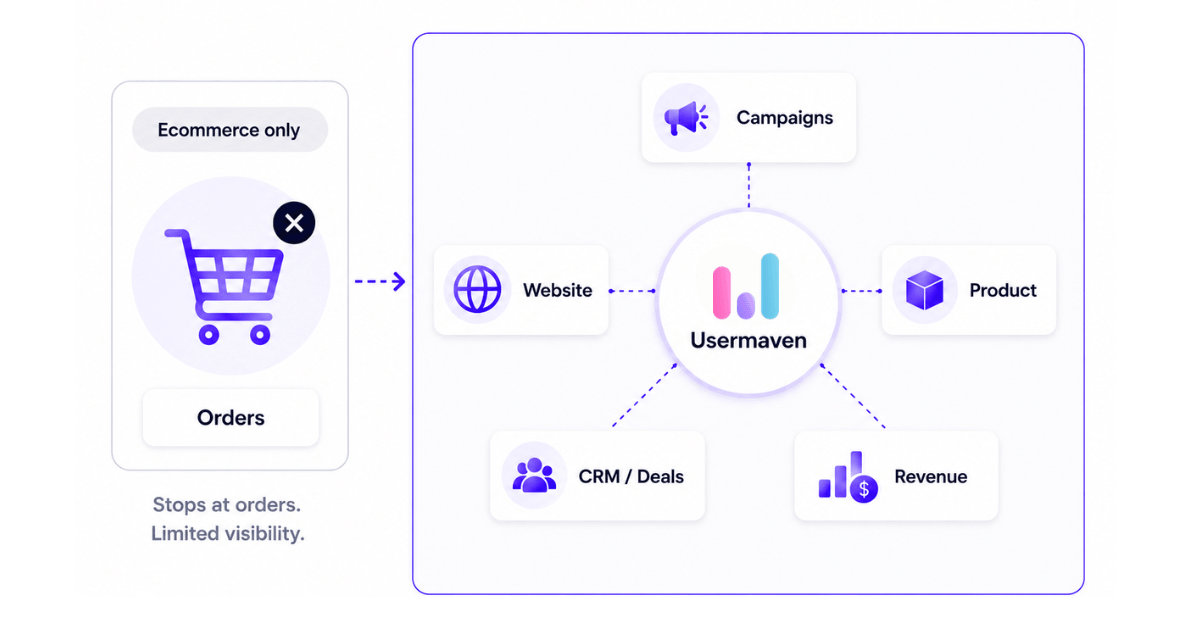
Usermaven stands out as an alternative to Triple Whale, giving teams a comprehensive attribution view across campaigns, website behaviour, product activity, customer journeys, and revenue, not just Shopify orders.
Broader attribution scope
Usermaven helps teams understand where visitors come from, which campaigns drive conversions, and how channels assist revenue across the full journey.
Website and product visibility
Instead of stopping at orders, Usermaven shows how users move through your website, what product actions they take, and which behaviors lead to conversion.
Revenue-connected journeys
Usermaven helps connect campaigns, channels, journeys, cohorts, CRM/deals, and revenue, so teams can see what creates valuable customers.
Better fit beyond Shopify
For ecommerce brands, this broader view is useful. For SaaS, B2B, agencies, and product-led companies, it is often essential.
Transparent evaluation
If pricing is part of your decision, you can compare Usermaven pricing after identifying which attribution and analytics workflows your team actually needs.
Final verdict: Is Triple Whale pricing right for you?
Triple Whale pricing makes the most sense for Shopify and DTC brands that want ecommerce-specific analytics, attribution, AI, and automation. Its GMV-based model allows pricing to scale with business size, and its paid plans include unlimited users and support multiple stores.
But it may not be the best fit for every team.
If you want broader attribution across paid, organic, content, product journeys, CRM/deals, funnels, cohorts, and revenue, Usermaven offers a more flexible and transparent alternative.
Triple Whale is strong for ecommerce intelligence.
Usermaven is stronger for teams that want attribution and analytics across the full customer journey.
Ready to see Usermaven in action? Explore the platform or book a demo for a closer look.
Unlock insights that drive growth
FAQs
1. How much does Triple Whale cost?
Triple Whale pricing depends on your annual GMV and the package you choose. In the under-$250K GMV pricing view, the plans shown are Free at $0/month, Foundation at $219/month, Automate at $749/month, and Enterprise as Contact Sales. Triple Whale’s official pricing page says all prices are based on annual GMV and the selected package.
2. Does Triple Whale have a free plan?
Yes. Triple Whale offers a free plan. Its Shopify App Store listing also shows that a free plan is available.
3. Why does Triple Whale pricing change by GMV?
Triple Whale prices based on annual GMV because larger ecommerce brands usually have more data, more orders, more reporting complexity, and more advanced measurement needs. This means pricing can increase as a brand grows.
4. Is Triple Whale only for Shopify?
Triple Whale is best known for ecommerce analytics and attribution, especially for Shopify and DTC brands. It also has a Shopify App Store listing, which reflects its strong fit within the Shopify ecosystem.
5. Is Triple Whale worth it?
Triple Whale can be worth it for Shopify brands that need ecommerce-specific attribution, store analytics, creative reporting, post-purchase surveys, and AI workflows. It may be less ideal for SaaS, B2B, agency, or product-led teams that need broader attribution and analytics beyond ecommerce.
6. What is the best Triple Whale alternative?
Usermaven is a strong Triple Whale alternative for teams that want transparent pricing, marketing attribution, website analytics, product analytics, user journeys, funnels, dashboards, CRM/deals attribution, and Maven AI in one platform.
7. Is Usermaven cheaper than Triple Whale?
Updated

Written by
Junaid Ahmed
Content Writer & Digital Marketer
Junaid Ahmed is a content and copywriter with 3+ years of experience creating research-driven content across SaaS, B2B, ecommerce, and digital marketing. He specializes in turning complex topics into clear, practical content that helps marketers better understand their challenges, evaluate solutions, and make informed decisions. His work spans educational content, industry insights, and actionable marketing guides.
All articles by Junaid →