A funnel might say 40% of trial users activated. It cannot tell you whether those users arrived through a pricing page, watched a demo, left for three days, or explored five product features before reaching activation.
Funnels show progression. Journeys show behavior. Teams need both because aggregate conversion rates reveal where movement slows, while the actual customer path explains what happened around that stage.
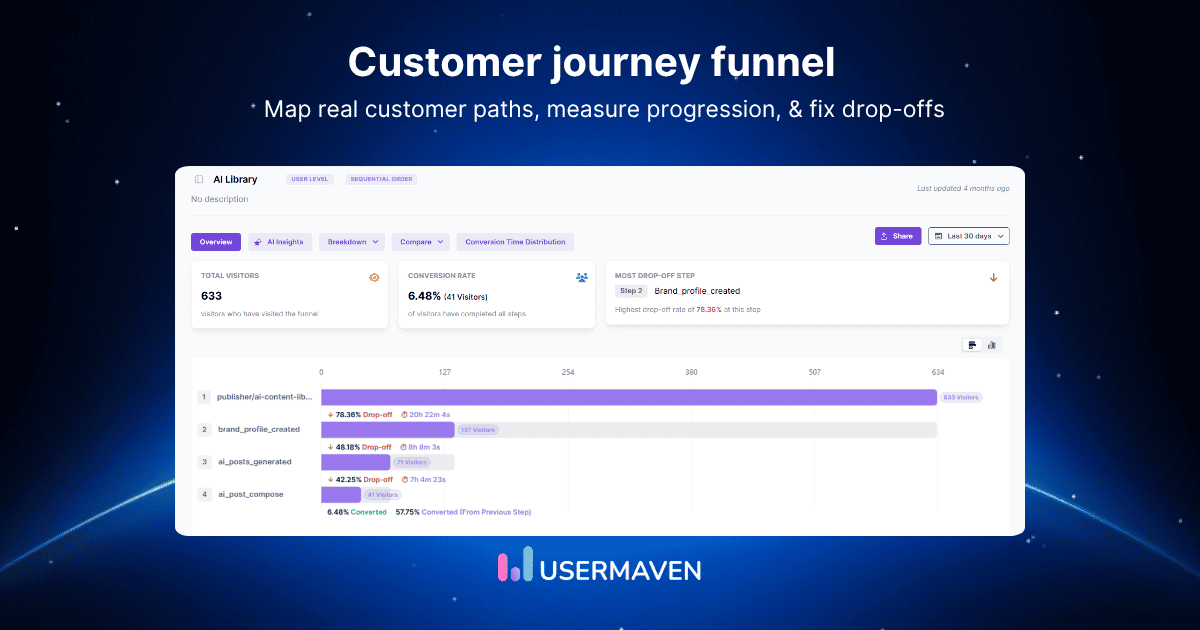
A customer journey funnel combines those views. This guide shows how to define stages, map real paths, diagnose drop-offs, and use marketing attribution software to connect acquisition, product behavior, and customer outcomes without forcing a linear journey.
Customer journey funnel at a glance
A customer journey funnel is a measurement framework that organizes a nonlinear customer journey into meaningful lifecycle stages. It lets teams quantify progression while still analyzing the paths, detours, returns, and post-purchase behavior behind those stage-level numbers.
| Question | Short answer |
|---|---|
| Is a customer journey funnel linear? | The stages are ordered; actual customer behavior does not have to be. |
| What does the funnel measure? | Progression, conversion and drop-off between meaningful stages. |
| What does the journey add? | The actual sequence of interactions before, between and after those stages. |
| How many stages are there? | No universal number; five is a practical general model. |
| Common general stages | Awareness → Consideration → Conversion → Loyalty → Advocacy |
| SaaS extension | Add Activation and often Retention explicitly. |
| Is it the same as a sales funnel? | No. A sales funnel is usually CRM/commercial-stage focused. |
| What is the goal? | Measure progression without losing the behavioral context behind it. |
The funnel gives the journey structure; the journey gives the funnel context.
Key takeaways
- Funnels and journeys answer different questions: Funnels quantify progression; journeys explain how people moved.
- Customers do not need to behave linearly: They can leave, return, repeat steps, skip optional interactions, and use several channels before progressing.
- There is no universal stage model: Five stages work well generally, while SaaS often needs explicit activation and retention stages.
- Stage metrics need journey context: A conversion rate alone does not explain which paths created the result.
- Funnel leaks should be diagnosed, not guessed: Source, segment, device, timing, and behavior can all explain a drop-off.
- B2B funnels may need account-level measurement: Several contacts can contribute to the same company journey.
- Post-purchase behavior matters: Activation, retention, repeat purchase, expansion, and advocacy belong in the lifecycle.
What is a customer journey funnel?
A traditional funnel describes the progression a business wants customers to make. A customer journey describes what people actually do. A customer journey funnel combines those two perspectives instead of treating one as a substitute for the other.

| FUNNEL: Awareness → Consideration → Conversion → Loyalty → Advocacy |
| ACTUAL JOURNEY: Ad → Blog → Exit → Search → Pricing → Email → Demo → Return → Signup → Product use → Upgrade |
| Funnel view | Journey view |
|---|---|
| Aggregate | Individual or path-based |
| Stage-oriented | Interaction-oriented |
| Measures progression | Explains movement |
| Highlights drop-off | Reveals detours, sequence and returns |
| Useful for conversion rates | Useful for behavioral context |
Visualize & optimize
user journeys with Usermaven
Where AI helps with customer journey funnels
AI can shorten the distance between a behavioral question and an analysis. It can surface recurring paths, compare funnel performance, summarize segment differences, and highlight unusual drop-offs that deserve investigation.
It should not decide what “activation” means, which stage represents customer value, or whether a correlation is causal. Those definitions depend on product strategy, customer research, and the commercial outcome the team is trying to improve.
The practical role of AI is pattern discovery and faster analysis, not replacing the judgment required to design a meaningful lifecycle funnel.
Customer journey funnel stages
There is no universal stage count. The right customer journey stages should reflect the business and its lifecycle rather than force every company into the same diagram. The five-stage model below is a strong general starting point.
1. Awareness
At the awareness stage, a potential customer discovers the company or the problem it solves. Discovery might come from search, an ad, social content, a recommendation, a community, an event, or an AI answer.
Useful metrics include qualified visits, new visitors, first-touch source, engaged sessions, and the percentage of visitors who progress to higher-intent content.
When social content is an important discovery channel, a social media management tool can help coordinate publishing and distribution. The funnel should still judge success by whether that reach progresses into engaged visits and consideration.
2. Consideration
Consideration begins when the customer actively evaluates fit. Pricing pages, product pages, reviews, case studies, webinars, comparison content, and return visits often signal that the journey has moved beyond simple awareness.
Track key-page progression, engaged users, CTA interactions, return visits, and behaviors that indicate trial, demo, or purchase intent.

3. Conversion
Conversion is the primary business action the funnel is designed to reach. That might be a purchase, trial, demo, signup, or booked call.
A clear conversion tracking definition prevents the funnel from optimizing around low-value actions that look impressive but do not represent meaningful progress.
Measure conversion rate, completions, time to conversion, and conversion value where the outcome has a financial value.
4. Loyalty
The customer journey continues after conversion. Ecommerce teams may track repeat purchase, repeat-customer rate, subscription renewal, or reorder behavior. SaaS teams usually need more granularity because a signup is not the same as receiving product value.
For SaaS, split loyalty into activation, adoption, and retention where those milestones matter. A dedicated user activation event helps distinguish new accounts from users who actually reach the product’s first meaningful value.
Service quality can also shape loyalty after conversion. For teams that need broader coverage or multilingual capacity, customer support outsourcing can extend support operations, while retention data shows whether the post-purchase experience is actually improving customer value.
5. Advocacy
Advocacy captures customer behavior that creates new demand: referrals, reviews, invited teammates, testimonials, recommendations, or other customer-led acquisition. It is most valuable when those behaviors materially affect growth.
General funnel vs. SaaS customer journey funnel
The five-stage framework is useful for broad customer lifecycle planning, but subscription products usually need explicit activation and retention stages. A signup starts the product journey; it does not prove the customer received value.
| General model | SaaS / subscription model |
|---|---|
| Awareness | Awareness |
| Consideration | Consideration |
| Conversion | Signup or trial |
| Loyalty | Activation |
| Advocacy | Adoption |
| — | Retention |
| — | Expansion / advocacy |
| SaaS operating model: Acquisition → Signup → Activation → Adoption → Retention → Expansion |
This is especially important for B2B SaaS, where marketing, website behavior, product usage, CRM progression, and revenue can span weeks or months before a customer becomes commercially valuable.
Marketing funnel vs. customer journey
A marketing funnel and a customer journey describe the same market from different viewpoints. The funnel is the organization’s structured view of progression; the journey is the customer’s real sequence of interactions and decisions.
| Dimension | Marketing funnel | Customer journey | Customer journey funnel |
|---|---|---|---|
| Perspective | Business | Customer | Both |
| Structure | Stage-based | Nonlinear | Stages + actual paths |
| Main question | Are people progressing? | What are customers doing? | How do real paths affect progression? |
| Typical data | Stage conversion | Touchpoints, actions, sequence | Funnel + behavioral journey data |
| Ends at purchase? | Often | No | No |
| Best use | Conversion planning | Experience understanding | Lifecycle optimization |
This distinction is also why customer journey mapping and customer journey analytics complement funnel measurement rather than replace it.
HubSpot’s customer journey funnel framework similarly extends the traditional marketing and sales funnel beyond conversion into retention and advocacy, which is useful when the objective is customer value rather than acquisition alone.
Customer journey funnel vs. journey map
Journey maps and journey funnels are often grouped together because both use lifecycle stages. Their jobs are different: a map documents the experience, while a funnel measures whether customers progress through it.
| Customer journey funnel | Customer journey map |
|---|---|
| Quantitative progression framework | Experience documentation framework |
| Measures stage conversion | Documents actions, needs, friction and emotions |
| Population-level analysis | Often persona- or experience-oriented |
| Built from behavioral data | Built from research + behavioral evidence |
| Optimizes progression | Improves experience design |
When research is still missing, a user journey map can help document assumptions and customer needs. Behavioral data should then test whether those assumptions match what people actually do.
Turn visitors into paying
customers with funnel analysis
Customer journey funnel vs. sales funnel
A sales funnel focuses on commercial progression toward a deal. A customer journey funnel is broader: it includes the marketing and product behavior surrounding the sale and continues into onboarding, value realization, retention, and advocacy.
| CUSTOMER JOURNEY: LinkedIn → Article → Webinar → Demo → Onboarding → Product adoption |
| SALES FUNNEL: Lead → MQL → SQL → Opportunity → Closed Won |
| Sales funnel | Customer journey funnel |
|---|---|
| Lead/opportunity-oriented | Experience/lifecycle-oriented |
| Mostly pre-sale | Pre- and post-sale |
| CRM-centric | Marketing + website + product + CRM |
| Sales-stage progression | Customer behavior + lifecycle progression |
In B2B, both views may describe the same account. One person can read an article, another can attend a webinar, and a third can book the demo that creates the opportunity.
Why funnels and journeys should be analyzed together
A funnel is excellent at exposing where progression slows. A journey is better at explaining what customers did before, between, and after those stages. The strongest diagnosis uses the two views together.
| 10,000 visitors → 2,000 signups → 1,000 activated → 300 paid |
That funnel reveals the scale of each transition, but it does not explain the paths that produced those outcomes. Two customers can reach the same signup stage through completely different journeys.
| Journey A: SEO → comparison article → pricing → signup |
| Journey B: LinkedIn → webinar → email → case study → branded search → signup |
| Funnel analysis answers | Journey analysis answers |
|---|---|
| How many progressed? | How did they progress? |
| Where did users drop? | What happened before the drop? |
| Which step converts? | Which paths reach the step? |
| Which segment performs better? | What does that segment do differently? |
Adobe makes a similar technical distinction in its current Customer Journey Analytics guidance: funnel/fallout analysis measures progression through predefined touchpoints, while flow-style analysis explores the paths customers actually take.
How to build a customer journey funnel
The most reliable customer journey funnels are not drawn first and justified later. Start with the business outcome, observe real behavior, and then use stages to summarize the progression that matters.

1. Start with the business outcome
Decide what the funnel must ultimately explain: a paid customer, activated user, demo, order, renewal, or another meaningful outcome. A funnel with no clear outcome usually becomes a collection of convenient pageviews rather than a decision tool.
2. Choose the audience
Define who belongs in the analysis. All visitors, new trials, enterprise accounts, paid traffic, and existing customers can follow different journeys even when the destination is the same.
3. Observe real customer paths
Use actual behavioral evidence before deciding which steps are mandatory. Customer journey tracking helps reveal common routes, repeated visits, high-intent actions, and detours that a workshop-only funnel can miss.
4. Identify recurring meaningful steps
Choose actions that represent progression, not every click. Pricing viewed, trial created, first project created, demo booked, purchase completed, or teammate invited can be meaningful. Menu clicks usually are not lifecycle stages.
5. Group the steps into lifecycle stages
Now translate observed behavior into a stage model such as Awareness → Consideration → Conversion → Activation → Retention. The stage names should help the team reason about progress rather than mirror an analytics menu.
6. Instrument the events
A funnel can only measure stages represented by reliable data. Usermaven Events provides a canonical place for product and website actions that later become funnel steps, conversion goals, journey nodes, and segment conditions.
7. Choose order and completion rules
Not every funnel should enforce the same sequence. Sequential funnels require the defined steps to occur in order but allow unrelated activity in between. Strict funnels are appropriate only when the exact sequence itself matters.
Optional steps are useful when an interaction may assist conversion but is not required for every customer, such as reading documentation before a signup.
8. Set the completion window
Define how long a customer can take to finish the funnel. A one-day checkout flow and a 60-day B2B buying journey should not use the same completion window. This is a funnel completion rule, not an attribution-window setting.
9. Validate the funnel against real journeys
Inspect high-value customers and major drop-offs. If important users routinely progress through routes the funnel excludes, revise the model. The funnel is a representation of progression; customer behavior should continually challenge it.
Customer journey funnel metrics to track
Stage counts are only the starting point. A useful customer journey funnel measures progression, speed, quality, and post-conversion value so teams can tell the difference between more users and better customers.
Stage conversion rate
| Stage conversion rate = users reaching next stage ÷ users entering current stage × 100 |
Drop-off rate
| Drop-off rate = 1 − stage conversion rate |
End-to-end conversion rate
| End-to-end conversion = final-stage users ÷ funnel entrants × 100 |
Time to next stage
Measure the median time between meaningful milestones. This exposes stages where customers are not necessarily dropping out but are taking much longer than expected to progress.
Activation rate
For SaaS products, activation separates registrations from customers who reach first value. It is often a stronger leading indicator than signup volume alone.
Retention or repeat purchase
Post-conversion quality matters. Customer retention metrics help determine whether users who complete the funnel continue receiving value or disappear immediately afterward.
| Stage | Useful metrics |
|---|---|
| Awareness | Qualified visits, first-touch source, engaged sessions |
| Consideration | Key-page progression, return visits, CTA actions |
| Conversion | Conversion rate, completions, time to convert, value |
| Activation | Activation rate, time to activation, activation-event completion |
| Loyalty | Retention, repeat purchase, churn, active usage |
| Advocacy | Referrals, invites, reviews, advocacy events |
For a deeper methodology, funnel analysis adds step-level conversion, segment comparison, timing, and bottleneck diagnosis to these lifecycle metrics.
How to find and fix funnel leaks
A drop-off is a symptom, not an explanation. Before changing copy, pricing, onboarding, or media spend, compare the leaking stage with the journeys and segments around it.
| Signal | Possible explanation | What to investigate |
|---|---|---|
| Strong awareness, weak consideration | Poor audience fit or unclear value | Source + landing-page journeys |
| Strong consideration, weak conversion | Trust, pricing, form or checkout friction | Paths around the conversion step |
| Strong signup, weak activation | Onboarding or setup friction | Activation journey and first-value actions |
| Strong activation, weak retention | Value does not persist | Cohorts, repeated behavior, retention |
| One segment strongly outperforms | Different customer path or intent | Compare segment journeys |
| Long delay between steps | Friction or natural buying cycle | Time-to-convert distribution |
For growth teams, this distinction matters because the next opportunity may be a stronger acquisition source, a conversion fix, or a channel bringing customers who retain longer—not simply the funnel step with the largest percentage drop.
Segment the funnel before changing the experience
Aggregate conversion can hide important differences. Compare the same funnel by acquisition source, campaign, device, plan, geography, persona, company, or product behavior before assuming every customer needs the same intervention.
| Example segment | Trial → paid |
|---|---|
| Overall | 20% |
| Organic search | 31% |
| 27% | |
| Paid search | 16% |
With Segments, teams can group visitors, users, leads, or companies using behavior, events, attributes, and acquisition data, then compare how those audiences progress through the same funnel.
Individual vs. account-level customer journey funnels
Person-level funnels work well when one user controls most of the journey. B2B buying is often different because several people can contribute to one commercial outcome.
| Person A → reads article | Person B → attends webinar | Person C → books demo | Account → opportunity |
If those people are measured only as separate user funnels, the account-level progression can disappear. The appropriate analysis unit should match the buying motion.
Contacts Hub can add contact and company context around those behavioral journeys when teams need to understand who participated in the path rather than only which anonymous browser completed a step.
Customer journey funnel examples
Examples are most useful when the stages represent real business progression. The three patterns below show how the same framework changes across SaaS, ecommerce, and sales-led B2B.
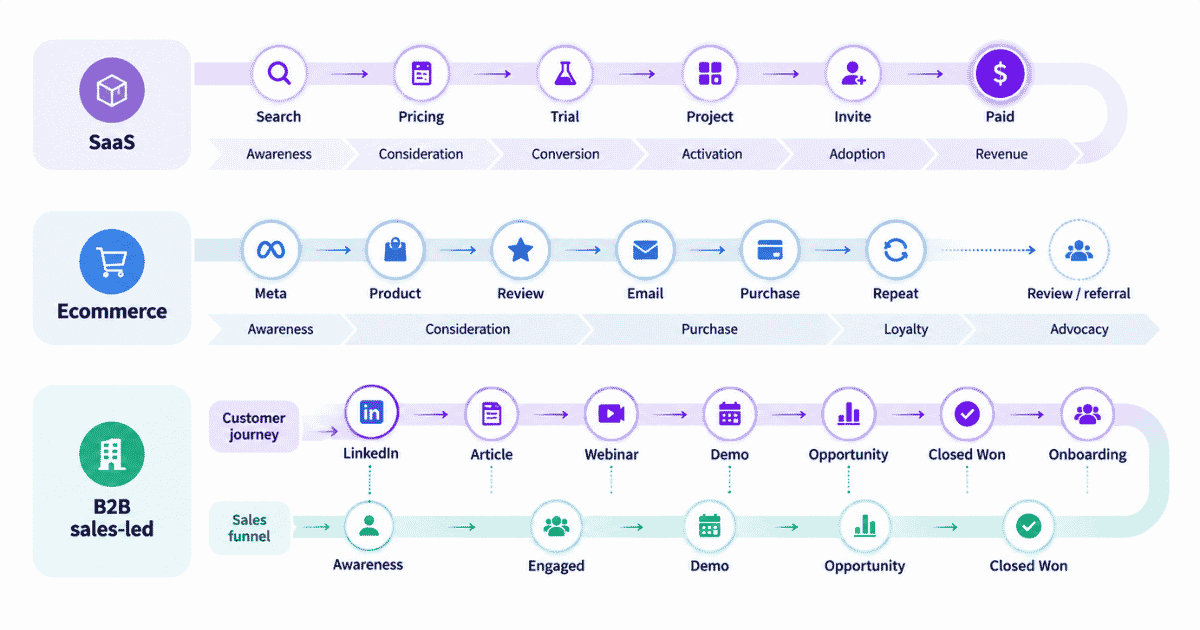
SaaS example
| Organic search → Pricing → Trial → Create project → Invite teammate → Paid |
Stages: Awareness → Consideration → Conversion → Activation → Adoption → Revenue. The important shift is that trial creation is not treated as the end of the funnel; product analytics helps measure whether users reach value after signup.
Product teams can connect acquisition with activation, engagement, conversion, retention, and revenue to understand which sources create customers who progress beyond signup.
Ecommerce example
| Meta ad → Product page → Reviews → Email → Purchase → Repeat purchase → Referral |
Stages: Awareness → Consideration → Purchase → Loyalty → Advocacy. A strong ecommerce funnel continues beyond checkout because repeat purchase and customer value can change which acquisition sources are worth scaling.
Ecommerce brands can connect acquisition spend with purchases, repeat behavior, customer value, and attributed revenue instead of optimizing only for first-order conversion.
B2B sales-led example
| LinkedIn → Article → Webinar → Demo → Opportunity → Closed Won → Onboarding |
The journey stages and CRM stages overlap but are not identical. Marketing behavior can begin long before the lead exists, while onboarding and product value continue after the deal closes.
How Usermaven measures the customer journey funnel
Usermaven combines the two views a customer journey funnel requires. Funnels quantify progression through defined stages, while User Journeys reveals the paths visitors, users, or accounts actually take around those stages.
Measure stage progression with Funnels
Funnels can use page URLs, custom events, or pinned events as steps. Current controls include Sequential and Strict order, optional steps, user- or company-level analysis, and configurable completion windows.
Funnel reports surface conversion rate, biggest drop-off, time between steps, breakdowns, segment filters, and comparisons so teams can move from a single conversion number to a more useful diagnosis.

The onboarding view compares flexible and exact paths while showing total users, overall conversion, and the biggest drop-off. It helps teams see whether optional steps assist progression without incorrectly making them mandatory.
See what happens before a conversion
User Journeys reveals the sequence of activity around an anchor event such as a demo booking. Interactive depth can expand the analysis when teams need to inspect more of the path.

This view is useful when customers reach the same funnel stage through different sequences. The funnel shows the conversion point; the journey exposes the routes that led into it.
Connect journey behavior with conversion paths
For acquisition analysis, conversion path analysis adds channel context to the behavioral journey. It helps show which sources appear early, in the middle, and near conversion instead of crediting only the final interaction.

The conversion-path view separates early, middle, and late touchpoints and lists the channel combinations that reached conversion. This connects acquisition context with the funnel and journey behavior that followed.
Compare funnel performance
Funnel comparison helps answer whether a redesign, campaign period, onboarding change, or new audience actually improved stage progression. Compare date ranges and segments before attributing a change to one intervention.
Analyze different customer segments
Apply saved segments to the funnel to compare new vs. returning users, trials vs. paying customers, enterprise accounts vs. SMB, or users from different acquisition sources. Segment-level conversion can expose patterns that disappear in the aggregate view.
Bring external milestones into the journey
Usermaven’s current Event Sources release lets teams import payments, CRM updates, webinar attendance, manual/offline sales, CSV history, webhooks, and Zapier events as native events that can participate in Funnels and Journeys.
| Ad → Website → Demo → CRM opportunity → Payment → Customer |
That makes it possible to measure a lifecycle funnel that crosses the website, sales process, and billing system rather than ending wherever browser analytics stops.
Keep Funnels and Journeys together in Analytics Hub
Analytics Hub centralizes Funnels, Journeys, Trends, and Retention so behavioral analyses can be created and managed from one workspace instead of being treated as unrelated reports.
Analyze funnel and journey questions with Maven AI
Maven AI can help investigate questions such as where the biggest drop-off occurs, which paths lead to activation, how paid and organic users differ, or what changed after an onboarding update.
The useful role is accelerating analysis and pattern discovery while the team retains control over the business definitions that determine the funnel stages and outcomes.
Explore analytics through MCP
Usermaven MCP makes authorized funnel and customer-journey analytics available in compatible AI clients such as ChatGPT, Claude, Cursor, and Codex. Read actions can inspect analytics, while write actions such as creating a funnel or journey require approval.
First-party evidence: PostNitro
PostNitro is a strong example of why funnel progression becomes more useful when teams can inspect the behavior around a drop-off.
The team could see traffic in GA4 but needed clearer visibility into what users did after arriving and how they moved toward activation.
Manual analysis of the signup and homepage experience could take 2–5 hours. Behavioral data then showed that a meaningful group of high-intent visitors reached the site but did not continue into the product or create an account.
PostNitro introduced a demo experience so visitors could try the product before making a signup commitment. The resulting flow became one of its strongest activation drivers.
| Result | Outcome |
|---|---|
| Demo → signup conversion | ~70% |
| Organic traffic growth | 55% |
| Create Carousel clicks | 6,555 |
| Reporting time reduction | ~50% |
The full PostNitro case study shows how onboarding and journey behavior informed changes to the demo, homepage, and signup experience rather than relying on funnel percentages alone.
The lesson is straightforward: the funnel revealed lost progression; the behavior around that point suggested the experience that could fix it.
Customer journey funnel checklist
- Outcome: What customer or business result defines success?
- Audience: Which visitors, users, customers, or accounts belong in the analysis?
- Stages: Do they represent meaningful progression rather than arbitrary pageviews?
- Behavior: Were the stages informed by actual customer journeys?
- Events: Is every required step reliably measurable?
- Order: Should the funnel be sequential, strict, or include optional steps?
- Window: How long can customers reasonably take to progress?
- Segments: Do important audiences behave differently?
- Paths: What happens before and after the biggest drop-offs?
- Activation: Does a signup actually reach product value?
- Retention: Do converted customers continue receiving value?
- Revenue: Which paths create commercially valuable customers?
- Review: Does the funnel still match how customers actually behave?
Final verdict
A customer journey funnel becomes useful when it stops pretending customers behave like a diagram. The stage framework should simplify the lifecycle without erasing the nonlinear behavior that actually produced the conversion.
Use the funnel to quantify progression, conversion, and drop-off. Use journey analysis to understand the paths, detours, returns, and context around those stage-level changes.
The strongest measurement workflow combines both views, then follows customers into activation, retention, repeat behavior, and value instead of ending the analysis at the first conversion.
Ready to see Usermaven in action? Explore the platform or book a demo for a closer look.
FAQs
1. What is a customer journey funnel?
A customer journey funnel is a measurement framework that organizes the customer lifecycle into meaningful stages while preserving the behavioral context of the paths people take between those stages. It combines funnel progression with customer journey analysis.
2. What are the five stages of the customer journey funnel?
A practical general model uses Awareness, Consideration, Conversion, Loyalty, and Advocacy. SaaS and subscription businesses often add Activation and Retention because signup alone does not prove that a customer received value.
3. What is the difference between a marketing funnel and a customer journey?
A marketing funnel is a business-defined stage model used to measure progression. A customer journey is the real sequence of interactions, decisions, returns, and detours a customer experiences across channels and time.
4. What is the difference between a customer journey funnel and a sales funnel?
A sales funnel primarily tracks commercial stages such as lead, opportunity, and Closed Won. A customer journey funnel spans marketing, website, product, sales, onboarding, retention, and advocacy, depending on the business model.
5. Is a customer journey funnel linear?
The stages are ordered for measurement, but real customer behavior does not have to be linear. Customers can leave, return, repeat actions, skip optional steps, or use multiple channels before progressing.
6. How do you build a customer journey funnel?
Start with the business outcome, choose the audience, observe real customer paths, identify meaningful steps, group them into lifecycle stages, instrument the required events, configure order and timing rules, and validate the funnel against actual journeys.
Updated

Written by
Junaid Ahmed
Content Writer & Digital Marketer
Junaid Ahmed is a content and copywriter with 3+ years of experience creating research-driven content across SaaS, B2B, ecommerce, and digital marketing. He specializes in turning complex topics into clear, practical content that helps marketers better understand their challenges, evaluate solutions, and make informed decisions. His work spans educational content, industry insights, and actionable marketing guides.
All articles by Junaid →