Choosing the right attribution model for Google Ads can change how you evaluate campaign performance and decide where to spend your budget.
But which model should you actually use?
Data-driven attribution is the best starting point for most Google Ads advertisers. It distributes conversion credit across eligible ad interactions based on your account’s data, rather than giving all the credit to the final click.
Last-click attribution can still be useful when you want a simpler view of which ad interaction happened immediately before a conversion.
Google Ads currently offers these two attribution models, but choosing between them depends on your campaign goals, conversion data, and how customers interact with your ads.
Let’s compare both models, understand when each makes sense, and explore how marketing attribution software can help you connect ad performance with conversions and revenue.
Maximize your ROI
with accurate attribution
Key takeaways
- Data-driven attribution is generally the best starting point for Google Ads because it distributes conversion credit across eligible ad interactions based on account data.
- Last-click attribution assigns all conversion credit to the final eligible ad interaction, making it useful for evaluating the last step before conversion.
- Multi-touch attribution models like linear, U-shaped, and time-decay distribute credit across multiple interactions, making them useful for evaluating longer customer journeys.
- Google Ads’ native attribution has limitations. It doesn’t provide a complete view of how Google Ads works alongside other marketing channels throughout the customer journey.
- Marketing attribution platforms like Usermaven help you compare attribution models, connect Google Ads spend with conversions and revenue, and make more informed budget decisions.
What is the best attribution model for Google Ads?
The best attribution model for Google Ads depends on your customer journey, conversion goals, and how different marketing channels contribute to results.
For businesses with short buying cycles, last-touch attribution can provide a straightforward view of which interaction occurred immediately before a conversion.
But when customers interact with multiple ads, channels, and campaigns before converting, multi-touch attribution models can provide a more useful perspective by distributing conversion credit across several touchpoints.
For example, imagine someone discovers your business through a Google Search ad, returns through organic search, clicks a LinkedIn ad, and eventually books a demo.
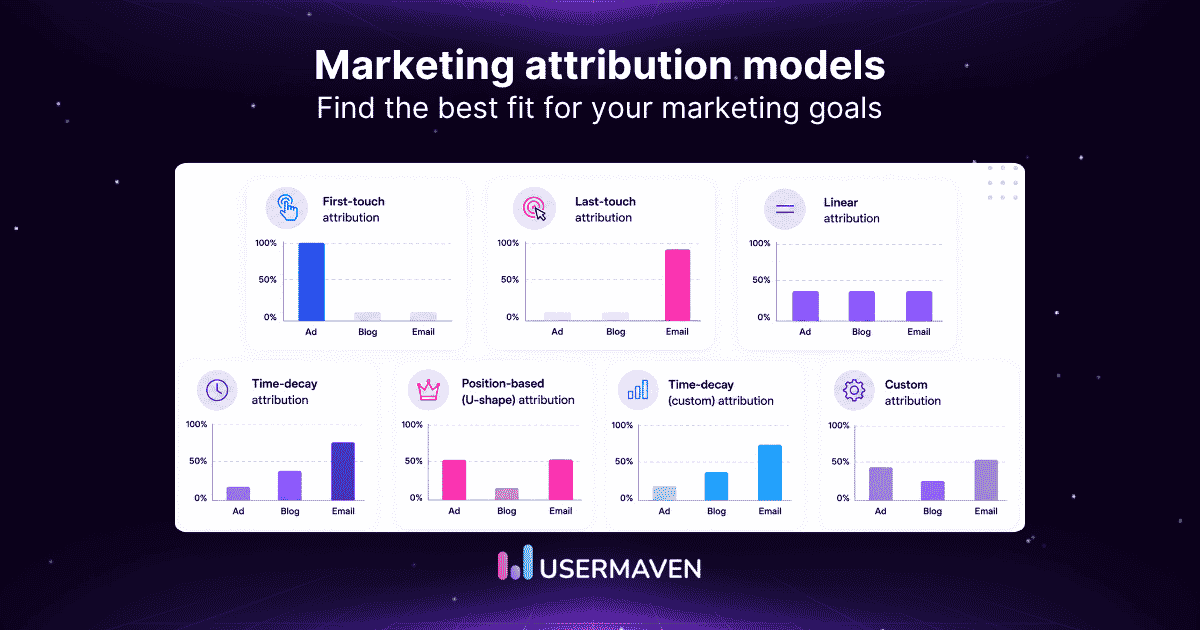
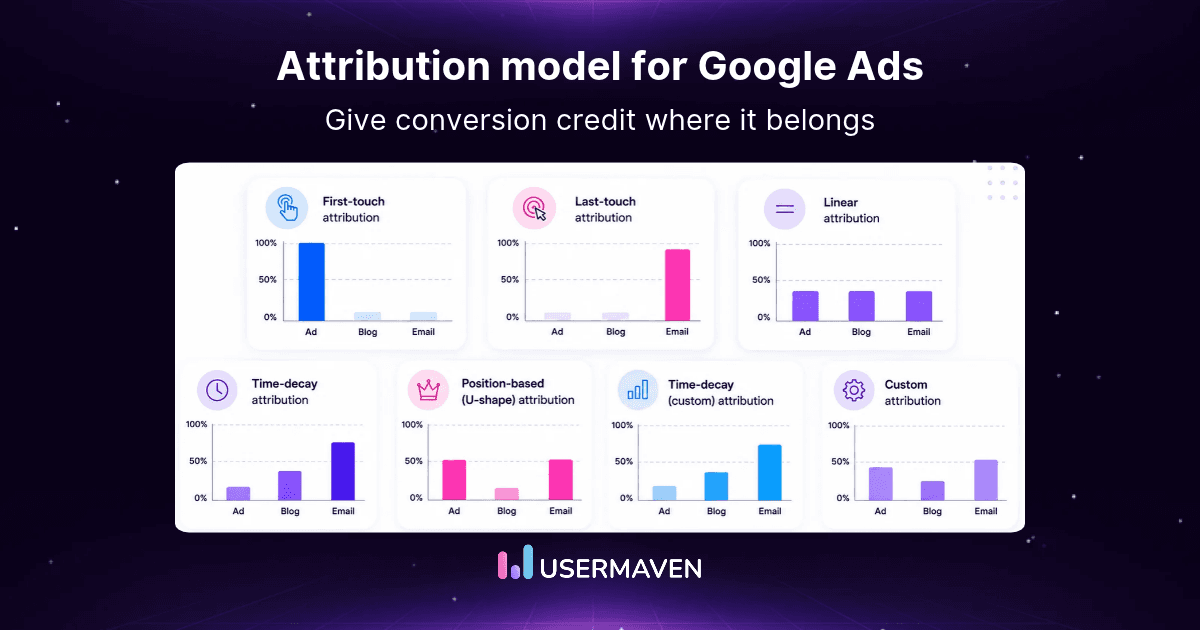
A last-touch model credits LinkedIn for the conversion. A first-touch model credits Google Ads. A linear model distributes credit equally across the three recorded interactions.
None of these models changes what actually happened. They change how conversion credit is assigned.
That’s why comparing models is often more useful than relying on just one.
Comparing attribution models for Google Ads
Different marketing attribution models help answer different questions about campaign performance.
| Attribution model | How it assigns credit | Best for |
|---|---|---|
| First-touch | 100% to the first recorded interaction | Identifying acquisition channels |
| Last-touch | 100% to the final recorded interaction | Understanding conversion-closing channels |
| Linear | Equal credit across recorded interactions | Evaluating contributions across the journey |
| U-shaped | More credit to the first and last interactions | Emphasizing discovery and conversion |
| Time-decay | More credit to interactions closer to conversion | Evaluating later-stage touchpoints |
| First non-direct | 100% to the first non-direct interaction | Identifying initial non-direct acquisition sources |
| Last non-direct | 100% to the final non-direct interaction | Evaluating the last non-direct channel before conversion |
| Custom | Credit based on configured weights and rules | Aligning attribution with specific business priorities |
These models can help you understand whether Google Ads primarily introduces new customers, contributes during consideration, or appears closer to conversion.
For example, if Google Ads receives significantly more credit under first-touch than last-touch attribution, it may indicate that paid search frequently introduces customers who later convert through other channels.
That doesn’t necessarily mean Google Ads caused those conversions, but it gives you a reason to investigate its role in customer acquisition.
What about attribution models inside Google Ads?
Google Ads currently offers two attribution models for supported conversion actions:
- Data-driven attribution: Uses Google’s modeling to distribute credit across eligible ad interactions based on their estimated contribution to conversions.
- Last-click attribution: Assigns credit to the final eligible Google Ads interaction before conversion.
Google discontinued first-click, linear, time-decay, and position-based attribution as selectable models within Google Ads.
However, those broader attribution approaches can still be used in third-party marketing attribution platforms that track customer interactions across multiple channels.
You can learn more about Google’s current options in its official attribution documentation.
Why comparing attribution models matters
Imagine Google Ads generates plenty of first-time visitors, but most eventually convert through email, organic search, or another channel.
If you only evaluate the final interaction, you might underestimate Google Ads’ role in introducing those customers.
On the other hand, relying entirely on first-touch attribution could overvalue acquisition while overlooking the channels that help move prospects toward conversion.
Comparing multiple models helps you:
- Identify undervalued channels: Discover where Google Ads contributes earlier in the journey.
- Understand conversion paths: Evaluate how paid search works alongside other marketing channels.
- Compare campaign performance: Examine how attributed conversions and revenue change under different models.
- Make better budget decisions: Use attribution insights alongside actual revenue, acquisition costs, and campaign performance.
The goal isn’t to find a model that makes Google Ads look better. It’s to understand how your marketing activities work together to generate business results.
Maximize your ROI
with accurate attribution
Why Google Ads attribution alone isn’t enough
Google Ads can tell you which campaigns, keywords, and ads receive credit for conversions. But what happens when someone interacts with several marketing channels before becoming a customer?
That’s where relying only on Google Ads attribution can leave important questions unanswered.
Google Ads primarily measures performance within its own advertising ecosystem. While it supports conversion tracking and data-driven attribution, it doesn’t independently provide a complete view of every interaction across your marketing channels.
Here are four limitations worth understanding.
1. It doesn’t capture the complete cross-channel journey
Imagine someone clicks your Google Search ad, visits your website again through organic search, reads an email, and eventually converts after clicking a LinkedIn ad.
Google Ads may record and attribute eligible conversions according to its tracking and attribution settings, but it won’t independently show how every external channel contributed to that customer’s journey.
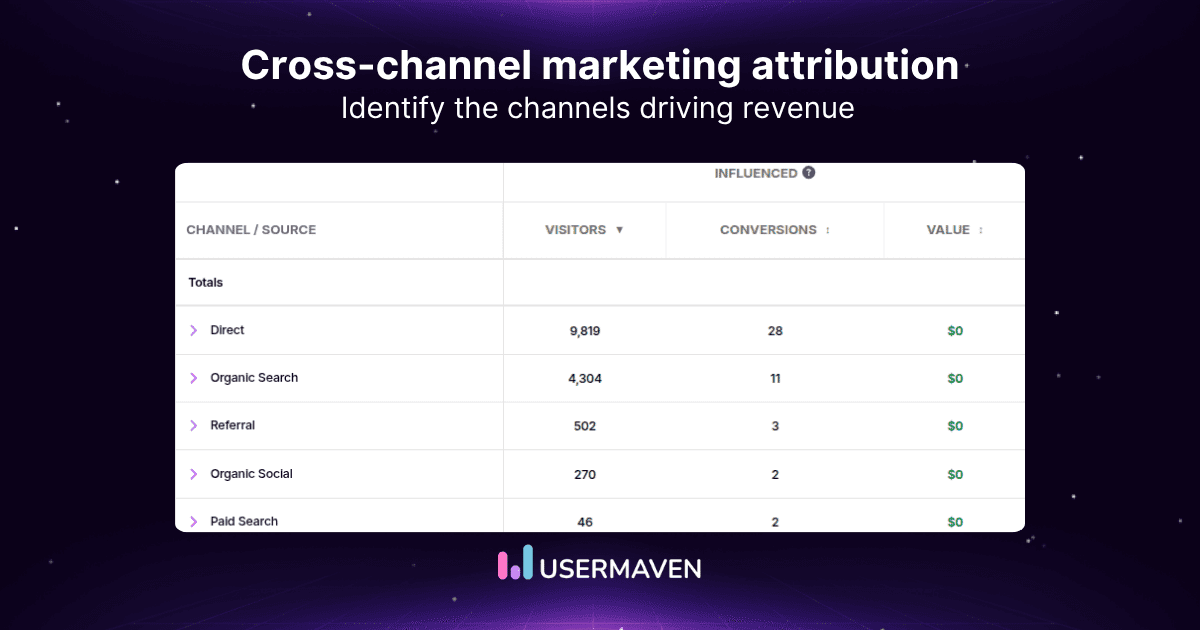
With cross-channel attribution, you can evaluate recorded interactions across different marketing sources rather than analyzing Google Ads in isolation.
This helps you understand whether Google Ads is primarily introducing customers, supporting consideration, or appearing closer to conversion.
2. Conversion numbers don’t always reflect business value
Not every conversion has the same value.
For example, two Google Ads campaigns might each generate 50 leads. But what if one produces mostly unqualified leads while the other generates opportunities that eventually become paying customers?
Looking only at lead volume could make both campaigns appear equally successful.
To understand their actual value, you need to connect advertising activity with outcomes such as:
- Qualified leads: Which campaigns attract prospects who fit your target audience?
- Sales pipeline: Which campaigns contribute to sales opportunities?
- Revenue: Which campaigns are associated with paying customers?
- Customer acquisition cost: How much are you spending to acquire customers?
Google Ads can report conversion values and offline outcomes when the appropriate data is imported. However, connecting advertising activity with your broader CRM and customer journey data provides additional context for evaluating performance.
3. One attribution model can hide important contributions
A last-touch model gives conversion credit to the final eligible interaction. That makes reporting straightforward, but earlier touchpoints receive no credit.
For example, a Google Ads campaign might introduce prospects who later return through organic search or email before converting.
Under a cross-channel last-touch model, Google Ads could receive little or no credit for those conversions, even though it appeared earlier in the recorded journey.
A first-touch model would show a different result. Linear, U-shaped, and time-decay models would distribute credit differently again.
Using multi-touch attribution helps you compare these perspectives and investigate how different channels contribute throughout the customer journey.
4. Longer sales cycles make attribution more complicated
For businesses running Google Ads for SaaS, longer sales cycles can make it difficult to understand which campaigns contribute to conversions and revenue.
A prospect might click a Google Ad today, attend a webinar next week, book a demo later, and become a customer several months afterward.
If your measurement focuses only on the initial lead conversion, you may miss how that lead progresses toward revenue.
Longer journeys also create tracking challenges involving attribution windows, identity resolution, and missing touchpoints.
A broader marketing attribution approach can help connect recorded acquisition interactions with later funnel stages, making it easier to evaluate which campaigns are associated with pipeline and revenue.
So, what should you measure beyond Google Ads?
Google Ads reporting is still essential for optimizing campaigns, evaluating ad performance, and managing bidding strategies.
But for broader marketing decisions, it’s useful to combine platform reporting with cross-channel journey analysis, ad attribution model comparisons, and actual business outcomes.
8 attribution models for measuring Google Ads performance
Different attribution models can tell very different stories about your Google Ads campaigns.
One model might show Google Ads as your strongest acquisition channel, while another gives more credit to email, organic search, or other channels that appear later in the customer journey.
Let’s look at eight common attribution models and how they can help you evaluate Google Ads performance.
1. First-touch attribution
First-touch attribution gives 100% of the conversion credit to the first recorded marketing interaction.
For example, a customer discovers your business through a Google Search ad, returns through organic search, and eventually converts through email.
Under first-touch attribution, Google Ads receives all the credit.
Best for: Understanding which campaigns and channels introduce potential customers to your business.
Limitation: It ignores the interactions that help move prospects toward conversion after their initial visit.

2. Last-touch attribution
Last-touch attribution assigns 100% of the conversion credit to the final recorded interaction before conversion.
Imagine someone discovers your product through LinkedIn, returns through a Google Search ad, and books a demo.
If Google Ads is the final recorded touchpoint, it receives all the credit.
Best for: Identifying the channels and campaigns associated with the final step before conversion.
Limitation: Earlier interactions receive no credit, even when they played an important role in the recorded customer journey.

3. Linear attribution
Linear attribution distributes conversion credit equally across all eligible recorded touchpoints.
Suppose a customer interacts with:
- Google Ads
- Organic search
- LinkedIn Ads
If all four interactions qualify, each receives 25% of the conversion credit.
Best for: Businesses that want to recognize interactions throughout longer, multi-channel journeys.
Limitation: Every touchpoint receives equal weight, regardless of its position or potential importance.

4. U-shaped attribution
U-shaped attribution, also called position-based attribution, places greater emphasis on the first and last interactions.
A common configuration assigns 40% of the credit to the first touchpoint, 40% to the last, and distributes the remaining 20% across interactions in between.
For example:
Google Ads → Organic search → Email → Direct visit
Under this configuration, Google Ads receives 40% of the credit as the first interaction, while the final direct visit receives 40%. The middle interactions share the remaining 20%.
Best for: Businesses that want to emphasize customer acquisition and the final conversion interaction.
Limitation: Middle-of-funnel activities may receive less credit, even when they help prospects evaluate the product.

5. Time-decay attribution
Time-decay attribution gives progressively more credit to interactions closer to conversion.
Imagine a customer:
- Clicks a Google Search ad.
- Visits through organic search several days later.
- Returns through a remarketing campaign.
- Converts after clicking an email.
Under time-decay attribution, later interactions generally receive more credit than earlier ones.
Best for: Evaluating campaigns and channels that engage prospects closer to conversion.
Limitation: Early awareness activities can be undervalued, particularly when customers take weeks or months to convert.

6. First non-direct attribution
First non-direct attribution gives all conversion credit to the first recorded interaction that isn’t classified as direct traffic.
For example:
Direct visit → Google Ads → Organic search → Conversion
Google Ads receives 100% of the credit because it’s the first non-direct interaction.
Best for: Understanding which identifiable marketing sources first bring users into the recorded journey, without assigning credit to direct traffic.
Limitation: Later interactions receive no credit, and the result depends on how traffic sources are classified.
7. Last non-direct attribution
Last non-direct attribution assigns conversion credit to the final recorded non-direct interaction before conversion.
For example:
Google Ads → Organic search → Direct visit → Conversion
Organic search receives all the credit because it’s the last non-direct interaction.
If Google Ads had been the final non-direct touchpoint, it would receive the credit instead.
Best for: Evaluating the marketing channels associated with conversions while excluding direct visits from credit assignment.
Limitation: It can overlook earlier interactions that introduced or influenced the customer.
8. Custom attribution
Custom attribution models allow businesses to define how conversion credit is distributed based on their measurement priorities.
Instead of using a fixed model, you can configure weights for different stages or touchpoints, depending on the platform’s capabilities.
For example, a B2B SaaS company might place greater emphasis on interactions associated with lead creation, opportunity generation, or the final conversion.
Best for: Businesses with complex buying journeys, multiple conversion milestones, or specific attribution requirements.
Limitation: Custom models require careful configuration and validation. Poorly chosen weights can create a misleading picture of campaign performance.
Which attribution model should you use for Google Ads?
The right model depends on the question you’re trying to answer.
- Want to know which campaigns attract new customers? Start with first-touch attribution.
- Want to identify the final interaction before conversion? Look at last-touch attribution.
- Want to understand contributions across several channels? Compare linear, U-shaped, and time-decay models.
- Want to exclude direct visits from credit assignment? Consider first non-direct or last non-direct attribution.
- Need attribution aligned with specific business milestones? Explore custom attribution.
For businesses running Google Ads alongside SEO, email, social media, and other channels, comparing multiple models is usually more informative than relying on a single attribution view.
Remember that these are broader marketing attribution models. Google Ads itself currently offers data-driven and last-click attribution, while other models can be applied through dedicated cross-channel attribution platforms.
Maximize your ROI
with accurate attribution
How to choose the best attribution model for Google Ads
Choosing an attribution model isn’t just about how conversion credit is distributed. It’s about understanding what role Google Ads plays in generating customers and revenue.
A model that works well for an ecommerce store might not provide the same insights for a B2B SaaS company with a six-month sales cycle.
Here are four factors to consider before choosing your attribution approach.
1. Consider your business model
Different businesses have different conversion journeys, so their attribution needs aren’t always the same.
| Business type | Models worth comparing | Why |
|---|---|---|
| B2B SaaS | First-touch, U-shaped, linear, custom | Understand acquisition, longer journeys, and revenue-related milestones |
| Ecommerce | Last-touch, time-decay, linear | Evaluate interactions leading to purchases |
| Lead generation | First-touch, U-shaped, last-touch | Identify lead acquisition and conversion-closing channels |
| Subscription businesses | First-touch, linear, custom | Connect acquisition sources with activation and customer value |
| Agencies | Multiple models based on client goals |
Google Ads attribution example: How different models change conversion credit
Let’s say a B2B SaaS company acquires a customer worth $5,000 in revenue.
Before converting, the customer interacts with four marketing channels:
Google Ads → Organic search → LinkedIn Ads → Email → Conversion
How much credit should Google Ads receive for that $5,000?
The answer changes depending on the attribution model.
| Attribution model | Google Ads credit | Attributed revenue |
|---|---|---|
| First-touch | 100% | $5,000 |
| Last-touch | 0% | $0 |
| Linear | 25% | $1,250 |
| U-shaped (40/20/40) | 40% | $2,000 |
| Time-decay | Varies | Depends on interaction timing |
| First non-direct | 100% | $5,000 |
| Last non-direct | 0% | $0 |
| Custom | Varies | Depends on configured weights |
What does this tell us?
Under last-touch attribution, Google Ads receives no credit because email was the final interaction.
But under first-touch attribution, Google Ads receives all $5,000 because it introduced the customer.
Linear and U-shaped attribution offer different perspectives by distributing credit across multiple interactions.
The customer generated the same $5,000 in revenue regardless of the model. Only the attribution credit changed.
That’s why relying on a single attribution model can lead to incomplete conclusions about campaign performance.
By comparing multiple models, you can investigate whether Google Ads primarily attracts new prospects, contributes throughout the buying journey, or appears closer to conversion.
These insights become more useful when combined with advertising costs, customer acquisition data, and actual revenue.
How Usermaven helps you measure Google Ads performance beyond conversions
Your Google Ads dashboard might show which campaigns generate conversions. But are those conversions turning into paying customers? And how much credit should Google Ads receive when other channels are involved?
That’s where Usermaven can help.
Usermaven is an AI-powered marketing attribution platform that connects marketing spend, user journeys, conversions, pipeline, and revenue, helping you understand which activities contribute to business growth.
Instead of evaluating Google Ads in isolation, you can examine its role throughout the customer journey.
1. Compare attribution models to understand Google Ads’ contribution
A Google Ads campaign might receive little credit under last-touch attribution but significantly more under first-touch.
Does that mean the campaign isn’t performing? Not necessarily.
With Usermaven’s multi-touch attribution, you can compare different models to understand how conversion credit changes across your marketing channels.
Usermaven supports first-touch, last-touch, linear, U-shaped, time-decay, first non-direct, and last non-direct attribution, with Custom Attribution Models available.
This helps you:
- Identify campaigns that introduce potential customers.
- Understand which channels appear throughout the buying journey.
- Compare attributed conversions and revenue across models.
- Investigate channels that may be undervalued under last-touch reporting.
Rather than choosing a model that makes Google Ads look better, you can compare perspectives to understand its contribution more clearly.
2. Connect Google Ads spend with pipeline and revenue
Getting more clicks or leads doesn’t always mean generating more revenue.
Imagine two Google Ads campaigns:
- Campaign A: Generates 100 leads but only $5,000 in attributed revenue.
- Campaign B: Generates 40 leads and $20,000 in attributed revenue.

If you only evaluate lead volume, Campaign A looks stronger. But Campaign B may be attracting customers who generate more business value.
Usermaven helps connect advertising and conversion data with downstream outcomes, including pipeline and revenue, when the relevant tracking and integrations are configured.
This makes it easier to investigate which campaigns are associated with qualified opportunities, paying customers, and stronger returns.
You can evaluate Google Ads using metrics such as attributed revenue, return on ad spend (ROAS), and customer acquisition cost (CAC), alongside other business outcomes.
3. Understand what happens between the ad click and conversion
A prospect might click a Google Search ad, explore your product pages, leave, and return through another channel before booking a demo.
Looking only at the initial click or final conversion doesn’t explain what happened in between.
With Usermaven’s user journeys, you can explore recorded interactions across your website and product to better understand how visitors move toward conversion.
You can investigate:
- Which pages Google Ads visitors explore before converting.
- How users return through different marketing channels.
- Which interactions commonly appear along conversion paths.
- Where prospects leave before completing an important action.
Combine these insights with funnel analytics to measure conversion rates and identify drop-offs between important stages.
This helps you investigate whether a campaign is attracting the wrong audience or whether friction after the click may be affecting results.
4. Use Maven AI to investigate campaign performance
Comparing multiple campaigns, channels, and attribution models can take time.
With Maven AI, you can ask questions about your marketing data in natural language and investigate performance changes.
For example, you could ask:
“Compare Google Ads performance over the last 30 days with the previous period. Identify campaigns with changes in conversions and attributed revenue, and compare first-touch and last-touch attribution to highlight differences.”
You can use the findings to investigate changes, identify potential opportunities, and decide which campaigns deserve closer attention.
Maximize your ROI
with accurate attribution
Make Google Ads decisions with more context
The best attribution model isn’t necessarily the one that gives Google Ads the most credit. It’s the one that helps you answer the right questions about your marketing performance.
With Usermaven, you can compare attribution models, analyze recorded customer journeys, and connect marketing activity with revenue-related outcomes.
That gives you more context for deciding which campaigns to optimize, where to investigate wasted spend, and how to allocate your marketing budget.
Book a demo to explore how Usermaven can help you measure Google Ads performance beyond clicks and conversions.
FAQs
1. What is the importance of attribution in paid ads?
Attribution helps identify which touchpoints in the customer journey contribute most to conversions. It enables marketers to allocate budgets effectively, prioritize high-performing ads, and optimize campaigns for better ROI.
2. How does Usermaven’s attribution model differ from others?
Usermaven offers flexibility by providing both single-touch and multi-touch attribution models. This adaptability allows businesses to choose the best model for their strategy, ensuring accurate insights across different ad platforms.
3. Can I track multiple ad platforms with Usermaven?
Yes, Usermaven supports tracking for various ad platforms, including Google Ads, LinkedIn Ads, and Meta Ads. This gives you a comprehensive view of how your campaigns are performing across multiple channels.
4. How do I choose the right attribution model for my campaign?
The right model depends on your campaign goals. For quick conversions, last-click attribution might work, while multi-touch models like position-based or data-driven attribution are ideal for long-term campaigns and brand-building efforts.
5. What is the benefit of using data-driven attribution?
Data-driven attribution uses machine learning to assign credit based on actual customer behavior, offering more precise and customized insights. It adapts to your specific data, making it a powerful tool for businesses with complex buyer journeys.
6. Can Google Ads track attribution across multiple marketing channels?
Google Ads tracks eligible ad interactions and conversions within its supported measurement scope, but it doesn’t provide a complete view of every interaction across SEO, email, social media, and other channels. A like Usermaven helps you analyze recorded cross-channel journeys and understand how Google Ads contributes to conversions and revenue alongside other marketing activities.

Written by
Lauren Brooks
Lifecycle Marketing Strategist
Lauren Brooks is a lifecycle marketing strategist with 4+ years of experience helping SaaS businesses create meaningful customer experiences. She specializes in user engagement, retention, and conversion optimization, helping brands build stronger customer relationships beyond acquisition.
All articles by Lauren →