A billboard for a new smartphone, an Amazon Sponsored Product, a Google Shopping result, and an Instagram product demo can all be product advertising, even though they look completely different.
They share one purpose: promoting a specific product or product line rather than the company as a whole. The message may educate the market, build preference, compare alternatives, or push a ready buyer toward purchase.
This guide separates product advertising types, channels, and formats, then shows how to build a campaign and measure it beyond clicks.
A strong marketing attribution software setup should ultimately connect product advertising with customer behavior, conversions, revenue, and customer value.
Product advertising at a glance
Product advertising is paid promotional communication designed to create demand for a specific product or product line by communicating its benefits, features, differentiation, use case, or offer to a defined audience.
| Question | Short answer |
|---|---|
| What does product advertising promote? | A specific product or product line |
| Main goal | Generate awareness, consideration, trial, or purchase |
| Three main purposes | Inform, persuade, compare |
| Common channels | Search, Shopping, social, marketplaces, video, display, outdoor |
| Common formats | Sponsored listing, video, carousel, static ad, comparison, billboard |
| Is product marketing the same thing? | No |
| Is brand advertising the same thing? | No |
| Best measurement | Connect ad spend with product outcomes and revenue |
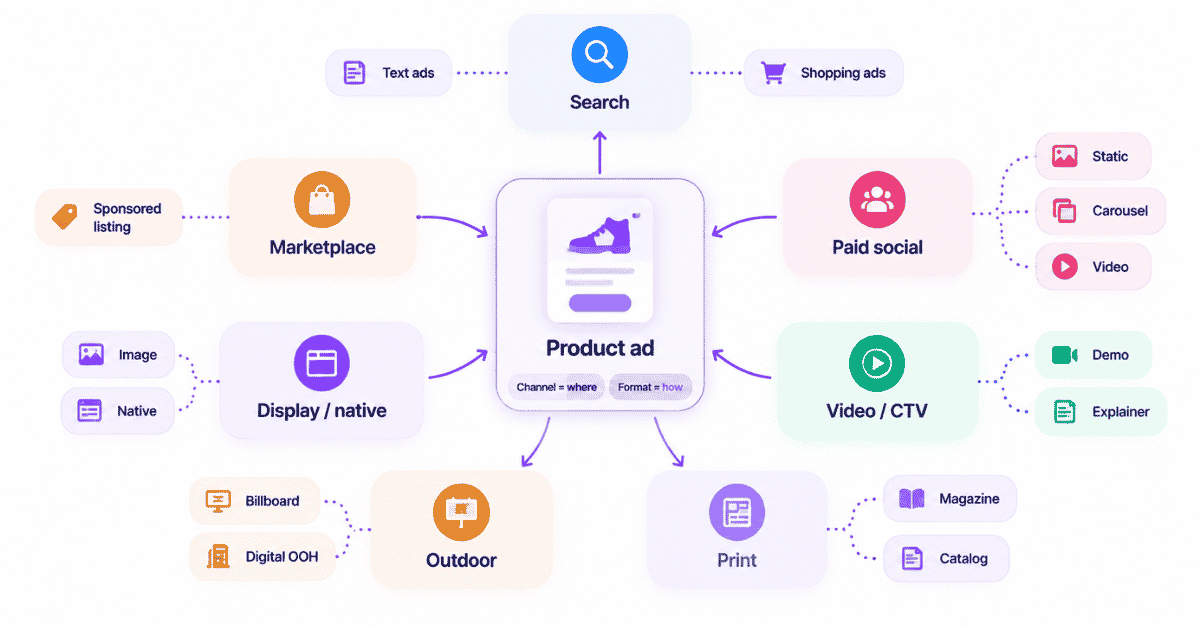
A type describes what the message is trying to accomplish. A channel describes where the ad runs. A format describes what the audience sees.
Key takeaways
- Product advertising promotes a specific product, not simply the company.
- Informative, persuasive, and comparative are the three clearest strategic types.
- Pioneering, competitive, and comparative are older labels for similar strategic jobs.
- Search, social, marketplaces, video, retail media, and outdoor are channels, not advertising types.
- Product advertising and product marketing are not interchangeable.
- The best message depends on the product lifecycle stage and the buyer’s level of intent.
- Clicks are weak success measures when the business outcome is purchase, subscription, upgrade, or revenue.
- Platform-reported ROAS should be compared with downstream customer and revenue outcomes before budget changes.
Product advertising vs. related concepts
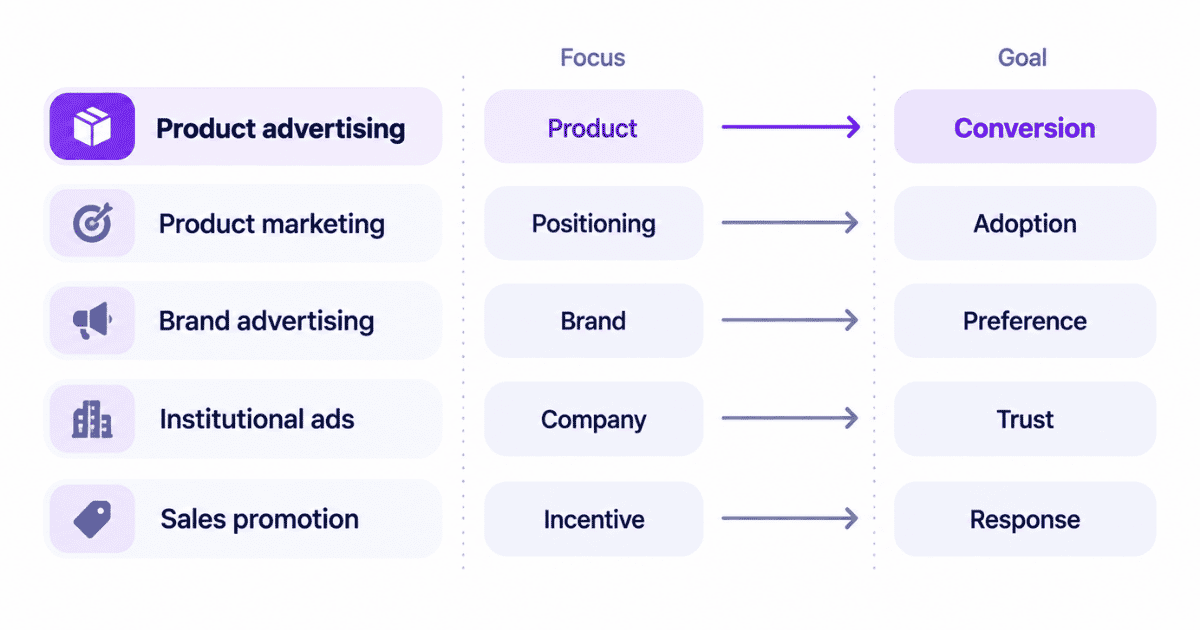
| Concept | Primary focus | Typical goal |
|---|---|---|
| Product advertising | Specific product | Demand and conversion |
| Product marketing | Positioning and go-to-market | Adoption and growth |
| Brand advertising | Brand identity | Awareness and preference |
| Institutional advertising | Company reputation | Trust and corporate image |
| Sales promotion | Short-term incentive | Immediate response |
Product advertising vs product marketing
Product advertising is one paid promotional activity inside a much broader product strategy. Product marketing covers market research, positioning, messaging, launches, competitive analysis, sales enablement, adoption, lifecycle strategy, and the work required to help a product succeed in the market.
Product marketing decides what the product should mean to the market. Product advertising pays to distribute that message.
Product vs. institutional advertising
| Product advertising | Institutional advertising | |
|---|---|---|
| Focus | Specific product or service | Company or organization |
| Message | Benefits, features, differentiation | Values, mission, trust |
| CTA | Buy, try, book, compare | Learn, trust, remember |
| Measurement | Product conversions and revenue | Awareness, sentiment, brand lift |
A product ad asks the buyer to consider a specific offer. Institutional advertising is more concerned with the reputation or image of the organization behind the offer.
Power up your SaaS
with perfect product analytics
Where AI helps product advertising
AI can accelerate creative production and analysis. Teams can use it to generate creative variations, adapt product benefits for different audiences, summarize reviews, identify weak campaigns, compare creative performance, and propose tests.
But AI cannot make a weak product offer relevant, repair a broken checkout, or recover conversion evidence that was never collected. AI can speed up creative and analysis. It cannot replace product-market fit or trustworthy measurement.
The 3 main types of product advertising
Different marketing texts use different labels, but most product advertising maps to three strategic jobs.
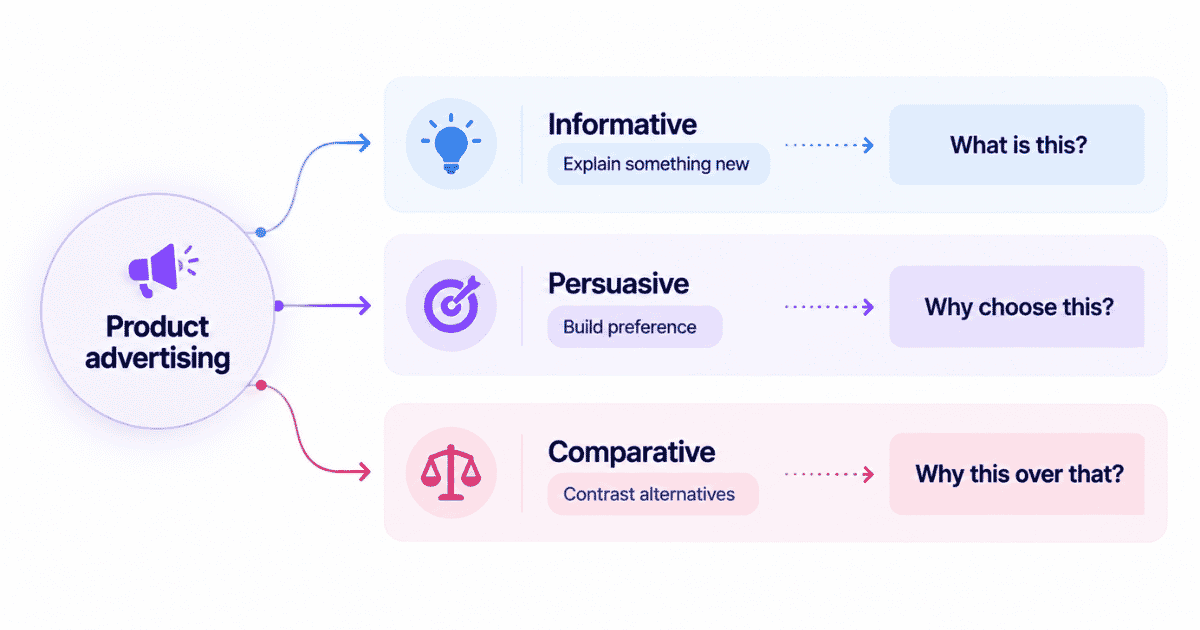
| Modern purpose | Traditional label | Main job |
|---|---|---|
| Informative | Pioneering | Explain something new |
| Persuasive | Competitive | Build preference |
| Comparative | Comparative | Contrast alternatives |
Informative product advertising
Informative advertising is most useful when the buyer does not yet understand the product, category, use case, or new capability. The ad answers a basic question: What is this, and why should I care?
Common use cases include new product launches, category creation, unfamiliar technology, and major feature introductions. A health wearable, for example, may need to explain what it measures before it can persuade someone to buy.
Persuasive product advertising
Persuasive advertising works when buyers already understand the category and need a reason to prefer one product. The message can emphasize performance, convenience, price, quality, proof, availability, or a differentiating feature.
The core question is: Why should I choose this product?
Comparative product advertising
Comparative advertising explicitly contrasts one product with another or with a familiar alternative. It is common in mature markets, high-consideration purchases, competitive SaaS, consumer electronics, financial products, and performance categories.
The core question is: Why this product instead of that one?
Product advertising channels and formats
The same advertising type can appear in many channels. The channel determines where the buyer encounters the product, while the format determines how the product is presented.
| Channel | Common product-ad formats |
|---|---|
| Search | Text ads, Shopping ads |
| Marketplace and retail media | Sponsored listings, product cards |
| Paid social | Static image, carousel, video, catalog |
| Video and CTV | Demo, testimonial, explainer |
| Display and native | Image, product card, native placement |
| Outdoor | Billboard, transit, digital OOH |
| Magazine, catalog, direct mail |
Search and Shopping ads
Paid search captures demand with keyword-triggered messaging. Shopping advertising is different because the ad is built from structured product data. Google explains that product-focused campaigns can use Merchant Center data such as images, price, availability, and descriptions to create ads and match products with relevant searches. Google Shopping documentation provides the current feed-driven model.
This makes Shopping one of the clearest examples of product advertising: the buyer sees the item, price, merchant, and other product information before clicking.
Marketplace and retail media
Marketplaces place product advertising close to purchase intent. Amazon Sponsored Products are cost-per-click ads that promote individual product listings. They can appear in Amazon shopping results, on product pages, and on selected premium apps and websites. Brands selling across multiple online marketplaces should also account for differences in shopper intent, listing rules, and sponsored-placement options when planning product visibility.
Retail media is especially powerful because the buyer is already in a shopping environment. The advertising job is often to win visibility and comparison rather than explain why shopping matters.
Paid social
Meta, TikTok, Pinterest, and LinkedIn can all carry product advertising. The strongest paid-social product ads usually make the product easy to understand quickly with visual proof, a clear use case, and one primary CTA.
Video and CTV
Video is useful when the product benefits from demonstration. Software can show a workflow, beauty products can show application, and physical products can show size, motion, before-and-after use, or real-world performance.
Outdoor and print
Outdoor and print can still be product advertising when the message promotes one product or launch rather than the company in general. A smartphone billboard, a new-car transit ad, or a magazine spread for a specific fragrance are product ads because the product is the focus. For local launches or offline distribution, adaptable flyer templates can carry the same product promise into print without changing the core offer or campaign message.
Drive business growth
with AI-powered analytics
Product advertising examples by channel
| Example | Channel | Why it qualifies |
|---|---|---|
| Running shoe Shopping ad | Google Shopping | Specific product, image, price, merchant |
| Sponsored coffee machine | Amazon marketplace | Paid placement for one product listing |
| Skincare carousel | Product benefits and visual proof | |
| Kitchen gadget demo | TikTok | Product shown solving a problem |
| SaaS comparison ad | Search or social | Specific software product contrasted with an alternative |
| New smartphone billboard | Outdoor | Promotes one product launch |

Google Shopping: Capture active demand
A customer searches for “men’s trail running shoes.” The ad shows a product image, title, price, and merchant before the click. This format works because the advertising appears at a moment of explicit commercial intent.
Amazon Sponsored Products: Win marketplace intent
A shopper searches or browses inside Amazon and sees a sponsored coffee machine among other products. The ad drives directly to the product detail page. The product does not need to create demand for ecommerce itself. It needs to win attention and preference inside an existing buying context.
Instagram: Make the product visual
A skincare carousel can move through problem, application, proof, and CTA. Product advertising on visual platforms works best when the creative makes the product understandable before the caption has to do heavy work.
TikTok: Demonstrate the product
A short product video can follow a simple sequence: hook, problem, product in action, proof, CTA. This is especially useful for products that become more persuasive once the buyer sees them used.
SaaS comparison ad: Differentiate the product
A SaaS company can advertise a specific software product with a message such as “Alternative to X: get feature Y without Z.” The product is digital, but the advertising logic is the same: identify the product, clarify the benefit, and create a reason to act.
Billboard: Build launch awareness
Outdoor advertising can be effective when a product launch needs broad visibility. The message has to be compressed into a product, one idea, and a memorable reason to care.
Match advertising to the product lifecycle
| Product stage | Advertising job | Typical message |
|---|---|---|
| Launch | Educate | What is it? |
| Early growth | Persuade | Why is it valuable? |
| Competitive growth | Differentiate | Why choose us? |
| Mature | Reinforce | Offer, reminder, use case |
| Expansion | Reintroduce | New feature, plan, audience |
A new product often needs informative advertising first. Once the category is understood, the campaign can shift toward proof, differentiation, offers, and comparison. Teams measuring a launch should connect advertising with the product launch analytics that show whether attention turns into signups, adoption, and revenue.
The same logic applies to launch KPIs. Usermaven’s product launch metrics guide covers the metrics needed before, during, and after launch so the campaign is judged by more than reach.
How to advertise a product
A product-advertising strategy should begin with the business outcome, not the ad format.
1. Define the business outcome
Choose the outcome the advertising is supposed to create: awareness, product-page visits, trial, purchase, demo, upgrade, repeat purchase, or another meaningful business action. “More clicks” is rarely a sufficient goal on its own.
2. Define the buying situation
Go beyond demographics. Ask what problem, trigger, context, or task makes the product relevant now. A trail shoe may become relevant after a runner changes terrain. Analytics software may become urgent after reporting breaks or a team starts spending across several channels.
3. Choose the message
Pick one dominant promise: benefit, feature, proof, differentiation, price, or offer. Product advertising becomes harder to understand when one ad tries to communicate every capability at once.
4. Match the channel to intent
Search and Shopping are strong when demand already exists. Social and video can create demand. Marketplaces are useful when the buyer is actively comparing products. Outdoor can create broad launch awareness. Channel choice should follow the buying situation rather than habit.
5. Align the destination
The product page or landing page should continue the promise made by the ad. If the ad promotes a specific feature or discount, the destination should make that benefit immediately visible instead of sending the buyer to a generic homepage.
6. Track the full outcome
Do not stop at ad click and page view. Preserve UTM parameters so campaign context survives the landing page, then track the sequence from product interaction to the business outcome: add to cart, signup, demo, activation, purchase, upgrade, and revenue as appropriate.
7. Test one variable at a time
Test the hook, creative, offer, audience, landing page, or CTA while keeping enough of the measurement logic stable to understand what changed. Changing creative, audience, attribution window, and conversion definition together makes the result difficult to interpret.
Product advertising metrics that matter
The best metric depends on what the product ad is supposed to accomplish. Usermaven’s digital marketing metrics and KPIs guide covers the wider performance framework, but product advertising is easiest to evaluate when metrics are mapped to the buying journey.
| Stage | Useful metrics |
|---|---|
| Reach | Impressions, reach, CPM |
| Attention | CTR, video completion |
| Traffic | CPC, product-page visits |
| Intent | Add to cart, signup, demo |
| Conversion | CVR, CPA, CAC |
| Revenue | Revenue, ROAS, AOV |
| Customer value | Repeat purchase, LTV |
| Efficiency | CAC payback, MER where relevant |
Ecommerce measurement
For ecommerce brands, the useful chain is usually: ad -> product page -> add to cart -> checkout -> purchase -> repeat purchase. Purchase ROAS matters, but average order value, repeat purchase, and LTV help show whether acquisition is creating valuable customers rather than one-off orders.
SaaS measurement
For SaaS product advertising, the chain may be: ad -> landing page -> signup -> activation -> upgrade -> subscription revenue. Product analytics is useful here because the ad may generate the signup while product behavior determines whether that acquisition becomes revenue.
Platform ROAS vs business revenue
Suppose Meta reports $80,000 in revenue and Google reports $60,000 for the same period while the CRM records $95,000 total. That does not automatically mean one system is broken.
Platforms can use different attribution windows, identity signals, view-through rules, conversion definitions, and modeling. Usermaven’s ad platform discrepancies guide explains why correctly configured systems can still produce different totals.
The same purchase can also contain several meaningful interactions. Multi-touch attribution helps evaluate how several channels participated instead of forcing all credit onto one click.
Product-ad performance should not be judged only by whichever platform claims the highest ROAS.
How Usermaven measures product advertising
Usermaven does not create, publish, or buy product ads. Its role is measuring what happens after and around the advertising by connecting paid acquisition with customer journeys, product behavior, conversion value, and revenue.
Ad spend -> journey -> product behavior -> conversion -> revenue
Connect paid spend with revenue
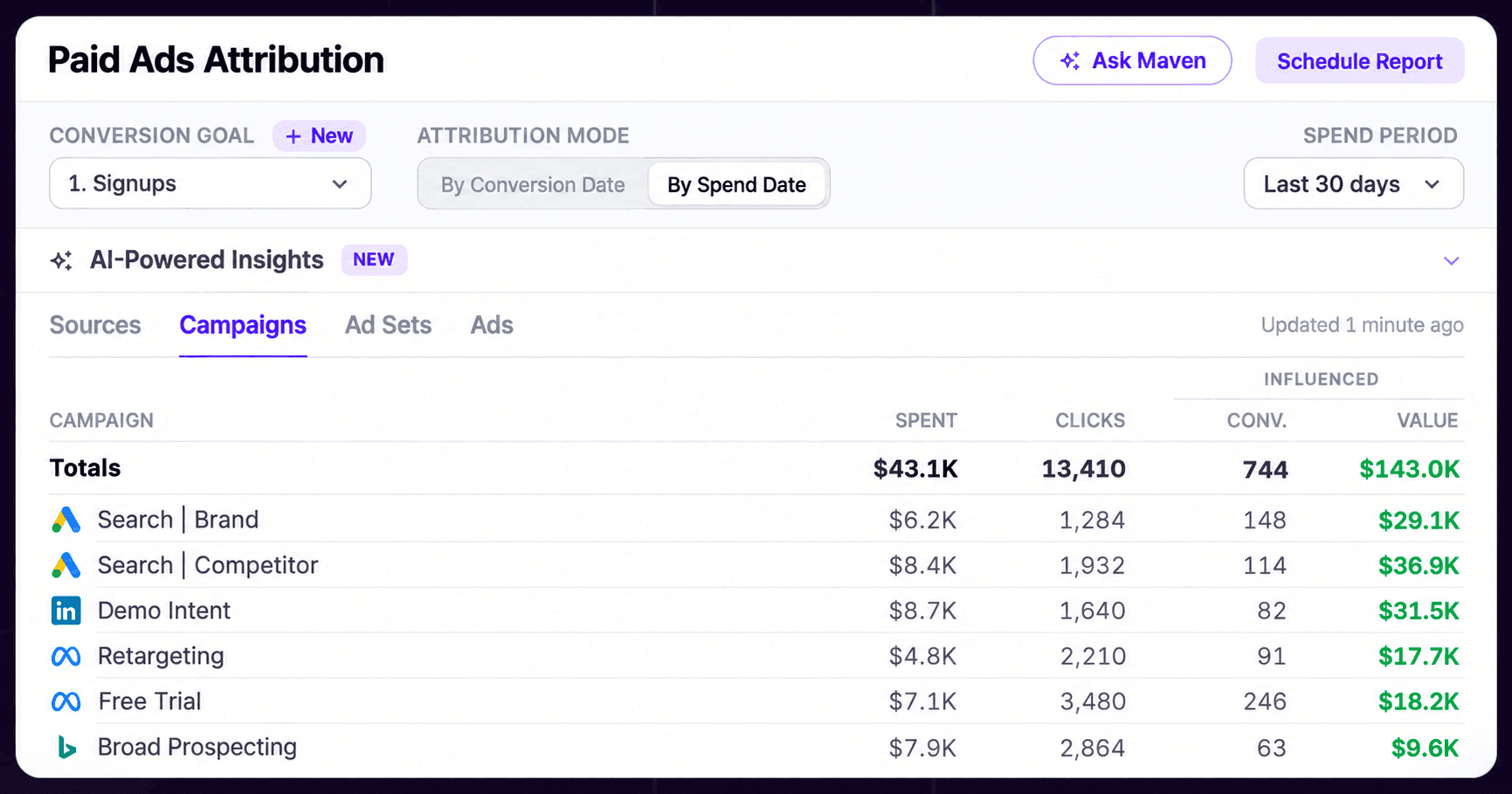
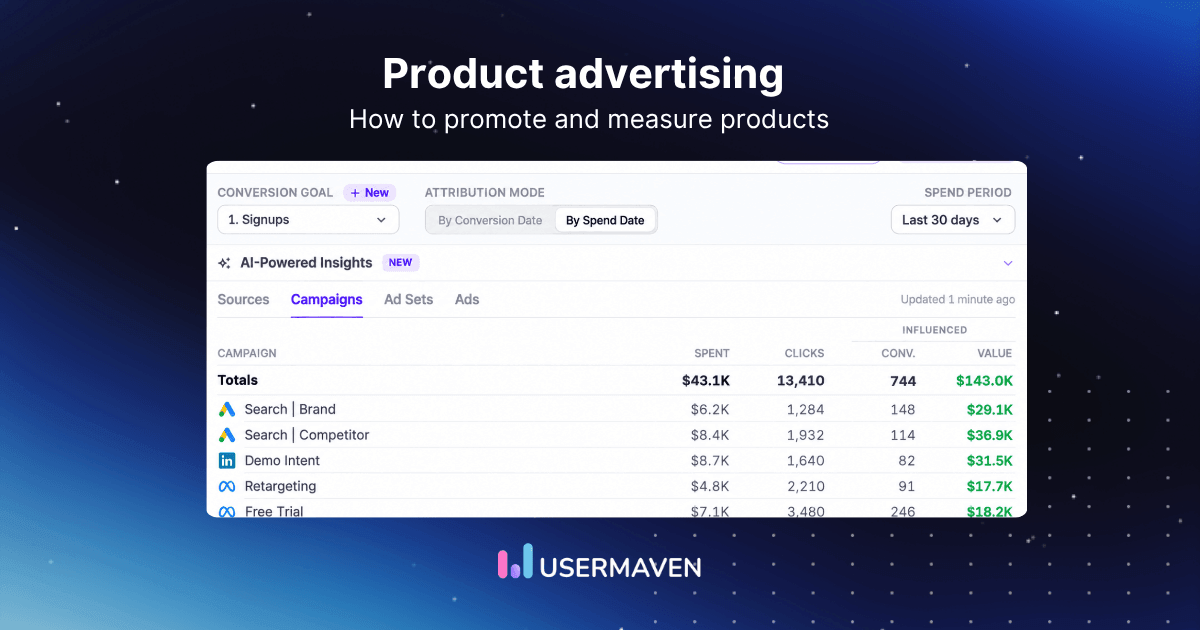
Usermaven’s paid ads attribution connects Google, Meta, LinkedIn, and Microsoft Ads with first-party conversions, conversion value, customer journeys, attributed revenue, and ROAS. This allows teams to judge campaigns by what they create beyond the click.
Compare campaigns beyond conversions
Campaign A can produce 1,000 conversions and $30,000 in revenue while Campaign B produces 600 conversions and $55,000. If the business optimizes only for conversion volume, it can move spend toward the weaker revenue outcome.
Bring off-site outcomes into attribution
Important product outcomes can happen outside the website. Usermaven Event Sources can bring payments, CRM events, offline sales, webinar activity, webhooks, and historical imports into the same analytics environment. This extends full-funnel revenue attribution beyond the initial browser conversion.
Send stronger signals back to ads
Usermaven’s conversion syncs can return supported downstream conversion or revenue signals to Google and Meta so platform optimization can learn from outcomes that matter more than a shallow page event. This improves feedback quality without making the ad platform the only source of measurement truth.
Compare attribution assumptions
Different attribution models can change how much credit a product-ad campaign receives. Usermaven supports standard models such as first touch, last touch, linear, U-shaped, and time decay.
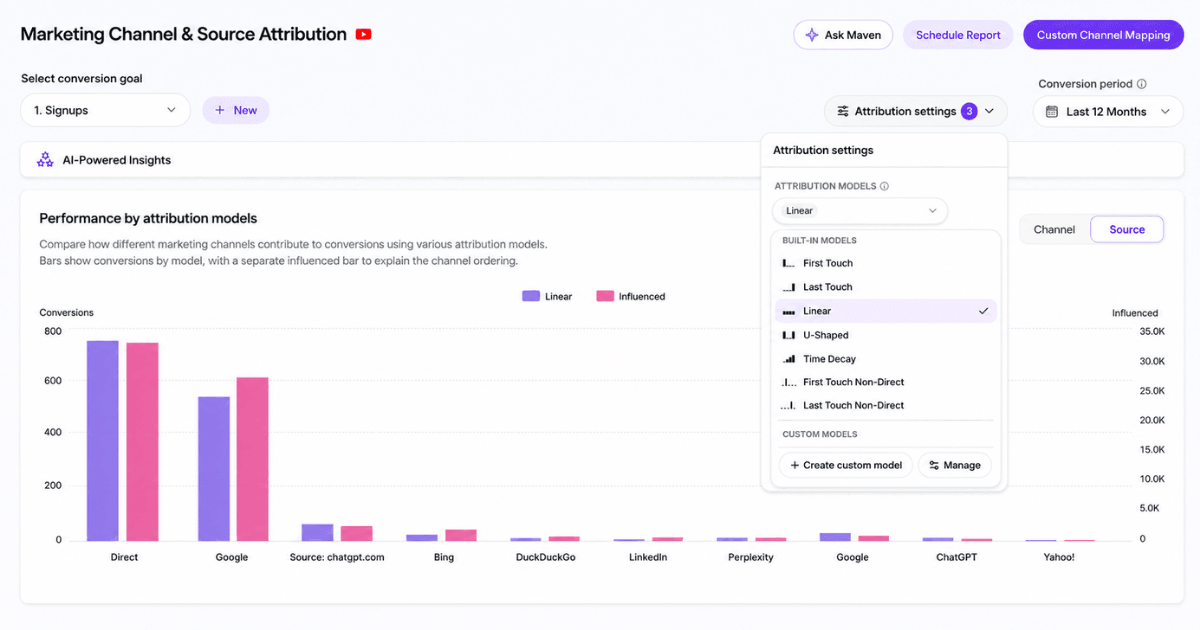
Enterprise teams can also build a custom attribution model with business-specific weights and channel multipliers, then apply it across Paid Ads and other attribution breakdowns. A custom model can represent a known buying pattern, but it should not be used to manufacture a preferred answer.
Check data quality before changing spend
Before moving budget, the Measurement Trust Center checks campaign tracking, customer matching, connected platforms, conversion feedback, and data confidence. It provides a Trust Score and prioritized fixes so teams can resolve the highest-impact measurement gaps before acting on campaign reports.
Do not change product-ad spend based on data that is not ready for the decision.
Analyze paid performance with Maven AI
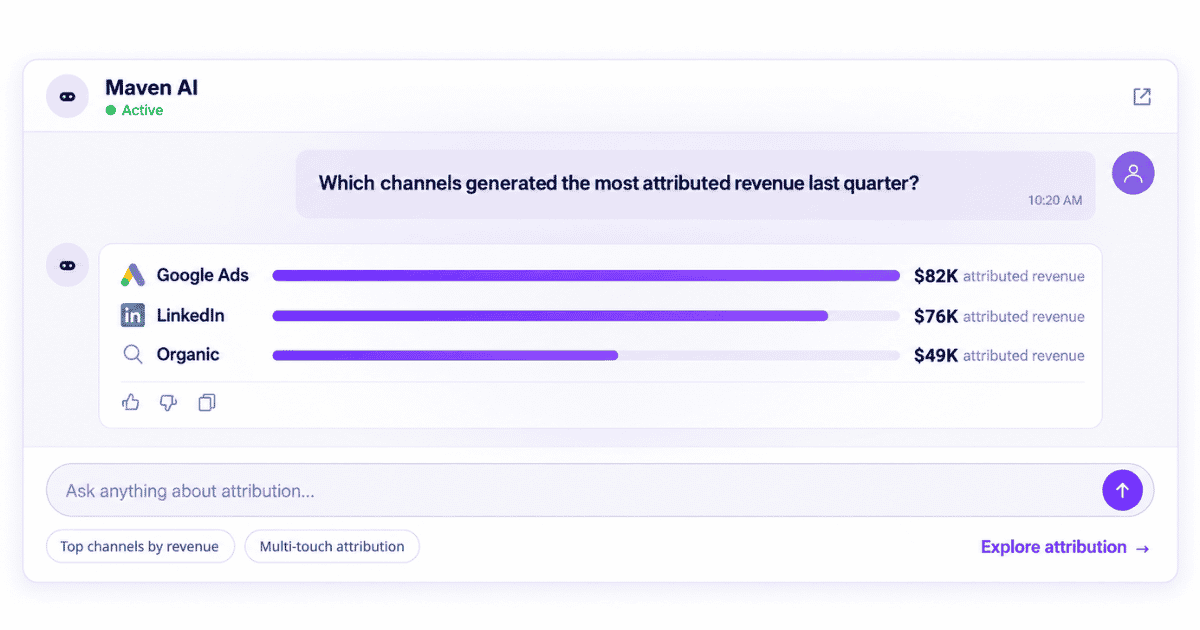
Maven AI can investigate paid and product-performance data through natural-language questions such as “Which product campaigns generated the most revenue?” or “Which ads have strong conversion volume but weak customer value?” The latest September 2026 release also improved streaming speed, concurrent conversations, activity steps, and interactive funnel results.
Evidence: Our Taap measured campaigns to revenue
Our Taap is an ecommerce example of why product-advertising measurement needs to extend beyond the click. The brand runs high-volume ecommerce campaigns where funnel and checkout changes can affect revenue quickly.
Before Usermaven, the team was switching between multiple reporting tools to understand campaign performance, funnel behavior, checkout activity, and attribution. After centralizing those workflows, the case study reports faster analysis and clearer campaign-to-revenue visibility.
| Reported outcome | Result |
|---|---|
| Campaign analysis time | 31% lower |
| Orders tracked back to campaigns | 32% |
| Funnel and checkout issue detection | 2x faster |
| Reporting workflow | Centralized across campaign, funnel, attribution, and checkout analysis |
The Our Taap case study reports that the team could identify which campaigns drove high-intent users and connect campaign activity more directly with revenue-driving actions.
This does not mean Usermaven created the advertisements. It shows why product advertising becomes more useful when campaign spend can be connected with purchase behavior, conversion paths, and revenue.
Product advertising checklist
| Check | Question |
|---|---|
| Product | What exactly is being promoted? |
| Goal | Awareness, trial, purchase, upgrade, or repeat purchase? |
| Audience | What buying situation creates demand? |
| Message | Feature, benefit, proof, comparison, or offer? |
| Type | Informative, persuasive, or comparative? |
| Channel | Where does this intent exist? |
| Format | What best demonstrates the product? |
| Destination | Does the landing or product page match the ad? |
| Tracking | Are campaign parameters intact? |
| Conversion | Is the real product outcome measured? |
| Revenue | Can conversions be tied to value? |
| Attribution | Are channels compared consistently? |
| Customer value | Does measurement extend beyond first purchase? |
Final verdict
Product advertising promotes a specific product by helping the buyer understand it, compare it, or purchase it.
The best approach depends on the product lifecycle stage and customer intent. Informative advertising introduces, persuasive advertising builds preference, and comparative advertising differentiates.
The strongest product-advertising programs measure beyond impressions and clicks by connecting the campaign with product behavior, conversion, revenue, and longer-term customer value.
Ready to see Usermaven in action? Explore the platform or book a demo for a closer look.
FAQs
1. What is product advertising?
Product advertising is paid promotional communication focused on a specific product or product line. It can educate buyers, build preference, compare alternatives, or encourage a purchase, trial, demo, or other product-level action.
2. What are the three types of product advertising?
The three clearest strategic types are informative, persuasive, and comparative advertising. Traditional marketing texts may use the labels pioneering, competitive, and comparative for similar purposes.
3. What is an example of product advertising?
A Google Shopping ad that shows a specific running shoe with its image, title, price, and merchant is product advertising. Amazon Sponsored Products, Instagram product demos, and product-launch billboards are other examples.
4. What is the difference between product advertising and product marketing?
Product advertising is paid promotion of a product. Product marketing is broader and includes research, positioning, messaging, launches, competitive strategy, enablement, adoption, and lifecycle growth.
5. What is the difference between product and institutional advertising?
Product advertising promotes a specific product and is usually measured through product demand, conversions, or revenue. Institutional advertising promotes the company or organization and focuses more on reputation, trust, awareness, or brand image.
6. What are the best channels for product advertising?
The best channel depends on buyer intent and the product. Search and Shopping capture active demand, marketplaces reach in-market shoppers, paid social and video can create demand, and outdoor can build broad launch awareness.
Updated

Written by
Adeel Khan
Growth Marketing Expert
Adeel Khan is a full-stack SaaS marketer with 10+ years of experience in content marketing, paid advertising, analytics, and conversion rate optimization. He shares practical insights and strategies drawn from hands-on experience, helping B2B SaaS marketers improve performance and make better marketing decisions.
All articles by Adeel →