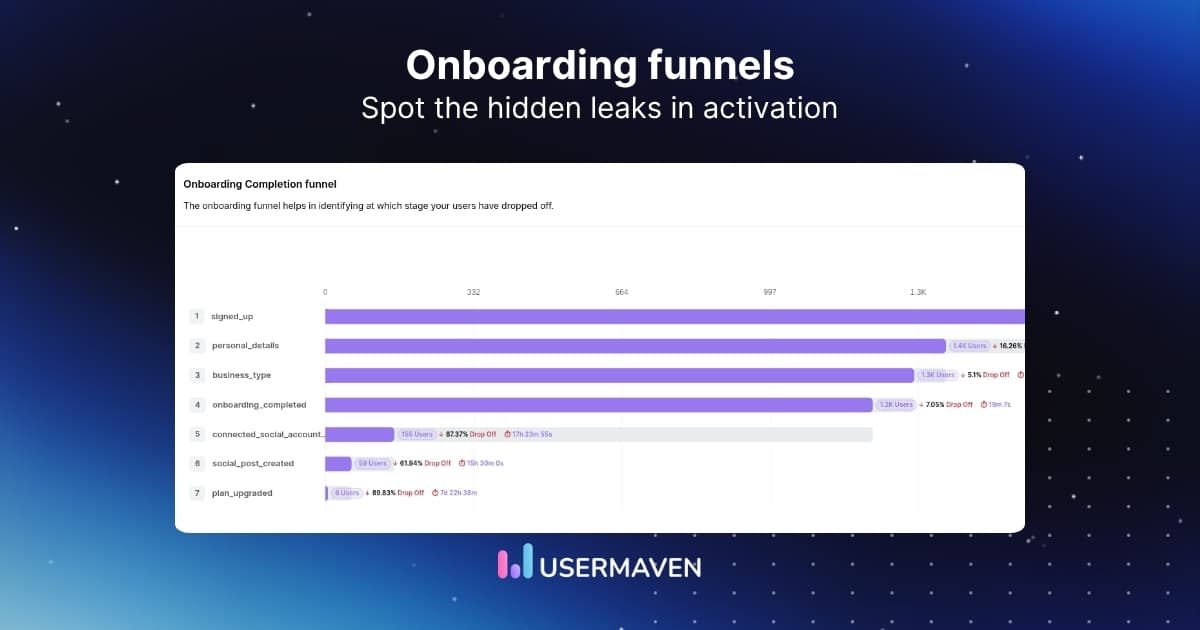
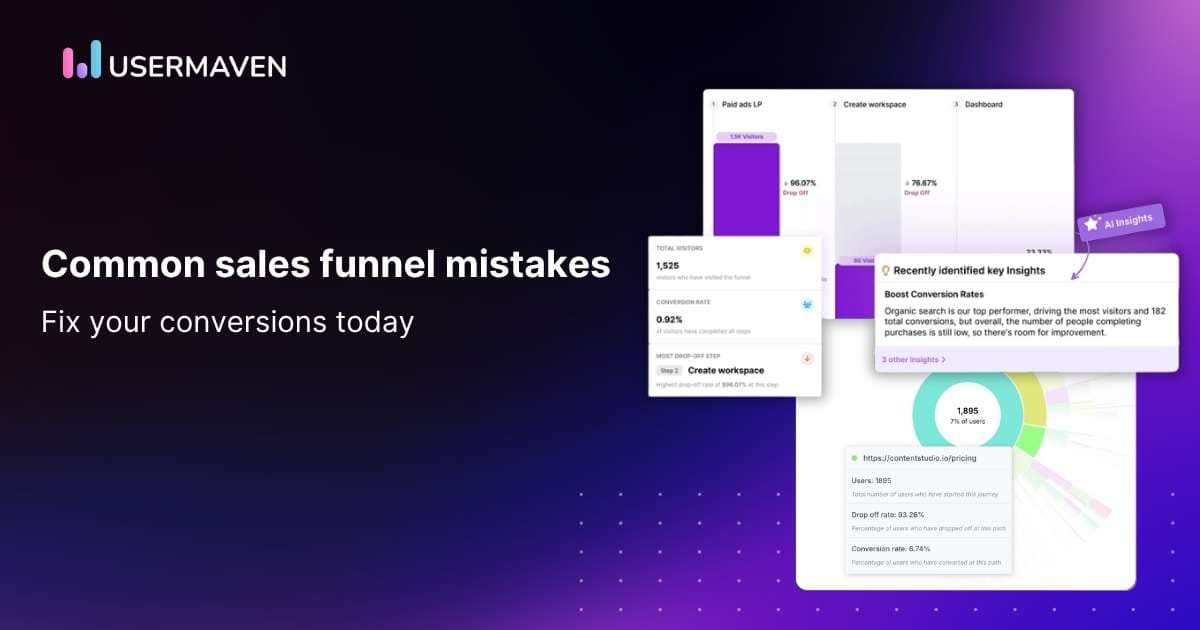
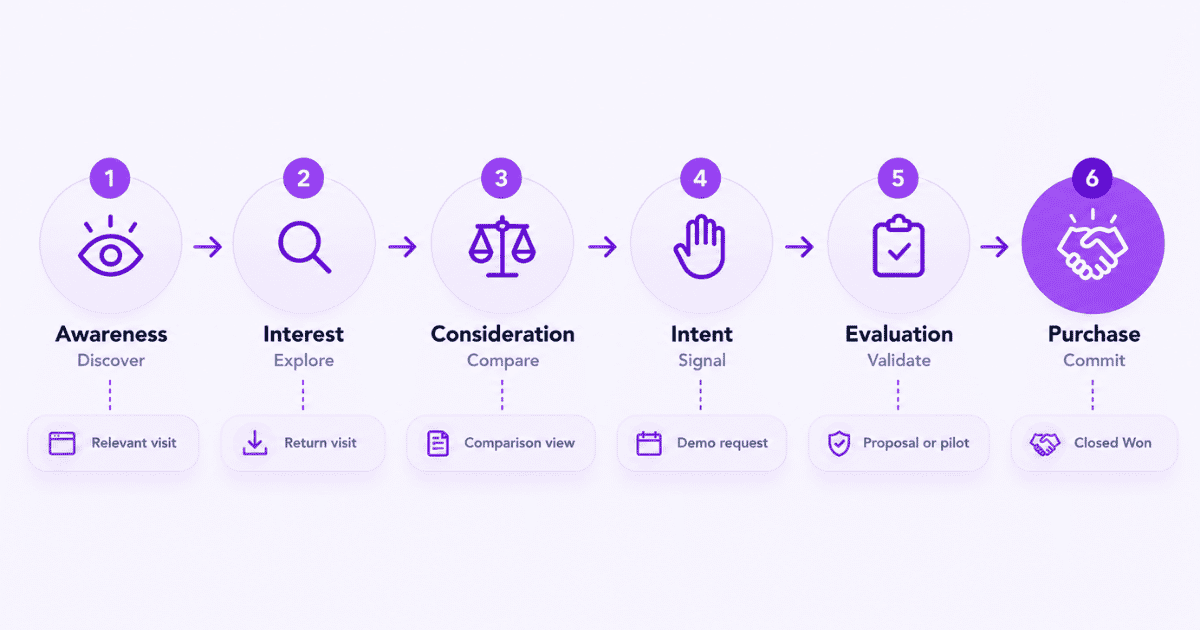
A B2B sales funnel maps how a company moves from first discovering a solution to becoming a paying customer. The six practical stages are awareness, interest, consideration, intent, evaluation, and purchase; onboarding and expansion follow the sale.
The challenge is not drawing a funnel. It is agreeing on what qualifies an account for each stage, connecting marketing touches to CRM outcomes, and spotting why good-fit opportunities stall.
This guide explains the stages, shows a worked account-based example, and provides an implementation and measurement checklist for 2026.
Key takeaways
- A B2B funnel is a buyer-journey model; a sales pipeline tracks the seller’s active opportunities. They overlap but should not be treated as identical.
- The six stages are useful labels, not a rule that every buyer moves in a straight line. Multiple people from the same account may participate at different times.
- Define stage-entry evidence, owners, and time limits before calculating conversion rates. Otherwise, funnel reports can appear precise while counting different populations.
- Judge demand generation by qualified opportunities and closed revenue, not by lead volume alone. Keep sourced and influenced pipeline separate.
- Fix tracking and CRM matching before investing in more dashboards or automated nurturing.
What is a B2B sales funnel?
A B2B sales funnel is a framework for understanding how business buyers progress from awareness to a signed agreement. It helps marketing, sales, and revenue teams identify the next useful action at each stage.
Unlike a consumer purchase, a B2B decision can involve an end user, manager, finance approver, security reviewer, and procurement team. Those stakeholders rarely arrive together or follow an identical sequence.
For measurement, choose the unit deliberately. Website activity may be visitor-based, qualification may be lead-based, and enterprise sales may require account- or opportunity-based reporting.
B2B sales funnel vs. sales pipeline
| Dimension | B2B sales funnel | Sales pipeline |
|---|---|---|
| Main question | How do buyers progress toward purchase? | Which deals are sales working, and what happens next? |
| Typical starting point | First meaningful awareness or engagement | Sales-accepted lead or created opportunity |
| Primary unit | Visitors, contacts, accounts, or cohorts—defined explicitly | Opportunities or deals |
| Main owners | Marketing, SDR, sales, customer success | Sales and revenue operations |
| Typical outcome | Stage conversion, time to progress, revenue contribution | Deal movement, forecast, win rate, value |
A marketing funnel can include anonymous visits long before the CRM contains a deal. The pipeline begins when the sales organization creates and manages a qualified commercial opportunity.
For a deeper distinction in subscription businesses, the SaaS sales funnel guide covers activation and recurring-revenue outcomes after signup.
Turn visitors into paying
customers with funnel analysis
The six B2B sales funnel stages at a glance
There is no universal mandatory stage taxonomy. The six-stage model below is useful when sales and marketing need to distinguish interest, buying intent, commercial evaluation, and an actual sale.
| Stage | What the buyer is doing | Evidence to record | Best next action |
|---|---|---|---|
| Awareness | Recognizing a problem | Relevant site entry, content engagement, account discovery | Explain the problem clearly |
| Interest | Exploring possible approaches | Return visit, guide download, webinar registration | Teach and qualify lightly |
| Consideration | Comparing solution categories or vendors | Comparison content, relevant product use case, stakeholder engagement | Show credible fit and proof |
| Intent | Signaling an active buying project | Demo request, pricing discussion, product-led hand-raise | Qualify need, timing, and ownership |
| Evaluation | Testing feasibility and commercial terms | Security review, pilot, proposal, procurement review | Remove risk and align stakeholders |
| Purchase | Approving and signing a deal | Closed Won and agreed contract value in CRM | Transfer context into onboarding |
A stage label is operationally useful only when the team can show the timestamped evidence for entering it. A newsletter signup alone should not automatically become a sales-qualified lead.
1. Awareness: Make the problem easy to recognize
At awareness, the buyer may search for symptoms rather than products: inconsistent reporting, delayed projects, rising acquisition costs, or compliance bottlenecks.
Use practical blog posts, explainers, research, and educational events. A relevant first touch matters, but page views are not evidence that the visitor is a qualified opportunity.
Example: An operations manager searches for “why B2B onboarding takes so long” and reads a guide from a workflow-software company.
Measure: Engaged visits from target accounts, relevant content paths, and known campaign sources. Do not interpret an anonymous page view as purchase intent.
2. Interest: Turn curiosity into a useful relationship
An interested buyer returns, subscribes, registers for an event, or investigates the vendor’s specific approach. The job is to deepen understanding, not force a demo prematurely.
Offer benchmarks, practical templates, focused webinars, and email follow-ups that answer the original question.
Example: A second stakeholder registers for a webinar about reducing approval delays. Their company is now showing broader engagement, but there may still be no budgeted project.
Measure: Repeat engagement, content-assisted inquiries, and new contacts associated with the same account. Separate content interest from actual qualification.
3. Consideration: Prove a solution fits the job
During consideration, buyers compare approaches and vendors. They need evidence of compatibility, implementation effort, costs, and the expected result.
Provide detailed use-case pages, credible case studies, feature comparisons, and demonstration assets. Product walkthrough videos can make unfamiliar workflows concrete before a live meeting.
Example: The operations manager compares three platforms and sends a recorded workflow demonstration to IT and the process owner.
Measure: Comparison-page paths, relevant product events, repeat account engagement, and meetings initiated. Interpret these signals alongside company fit.
4. Intent: Verify a real buying project
Intent is stronger than engagement. A prospect requests a demo, discusses their requirements, asks for pricing, or confirms an internal evaluation timetable.
Validate the problem, target outcome, decision process, and next step. A transparent lead qualification process should explain when a hand-raiser becomes sales accepted or sales qualified.
Example: A qualified account requests an integration demo and confirms that the team plans to select a vendor this quarter.
Measure: Demo-to-accepted-lead rate, qualification reasons, response time, and next-meeting completion. Do not optimize solely for low-cost demo requests.
5. Evaluation: Help the buying committee reduce risk
Buyers may now review security, implementation, procurement, contract terms, and internal ROI. Silence is sometimes a stalled approval rather than a lost opportunity.
Give each stakeholder the evidence they need. A technical owner wants architecture details; finance wants an agreed business case; legal needs contractual clarity.
Example: The IT lead reviews security documentation while finance tests the payback case and procurement negotiates terms. Sales can rehearse difficult objections using tools such as PitchMonster.
Measure: Proposal-to-close movement, days in stage, stakeholder coverage, reason for delay, and losses by objection category.
6. Purchase: Record the commercial outcome
The purchase stage ends when the deal meets the CRM’s agreed Closed Won definition, not when a prospect clicks a booking link or verbally expresses confidence.
Capture contract value, close date, deal owner, product or package, and a stable account identifier. Align booked annual contract value with how the business actually reports revenue.
Example: The buying committee signs a $40,000 annual contract and the opportunity moves to Closed Won. That is a real commercial outcome, distinct from the earlier demo conversion.
Measure: Opportunity win rate, booked contract value, sales cycle, and handoff completeness. Contract value must not be mislabeled recognized or collected revenue.
What happens after purchase?
Onboarding, adoption, renewals, and expansion sit beyond the acquisition funnel. They still matter because weak delivery can erase the value of an efficient acquisition motion.
Define a first-value milestone and hand off the buyer’s goals to customer success. For B2B credit businesses, specialized customer onboarding software may support a distinct account-opening workflow.
Track activation and retention separately instead of quietly adding them to the Closed Won denominator. A customer can renew, expand, or churn without starting a new acquisition journey.
How do you build a B2B sales funnel that works?
Build the tracking logic and handoffs before adding automation. The following seven steps turn a presentation diagram into a process a revenue team can operate.
Step 1: Define the ideal account and buying group
Document target industry, company size, business trigger, constraints, and likely participants. Include disqualifiers so a small volume of good-fit accounts can outperform a large volume of poor-fit leads.
Recruiting demand can sometimes be an early signal. For instance, job listing data may indicate that a company is investing in a relevant function, but hiring alone is not proof of buying intent.
Output: A one-page ideal customer profile, a buying-committee map, and three observable fit criteria.
Step 2: Give every stage an entry and exit rule
Agree on what is recorded when an account becomes interested, marketing qualified, sales accepted, sales qualified, or an opportunity. Choose a responsible owner and timestamp for each transition.
Keep MQL, SAL, and SQL as operational qualification states, not automatic synonyms for the six buyer-journey stages. A prospect can show intent before the CRM qualification sequence is complete.
Output: Stage dictionary with unit, event or CRM field, owner, and exit condition.
Step 3: Map content to the buyer’s questions
Use problem-led content for awareness, educational evidence for interest, comparisons for consideration, and security or ROI materials for evaluation.
Do not build five versions of the same generic sales pitch. A technical evaluator needs implementation details while an executive sponsor needs the business case.
| Buyer question | Suitable asset | Decision signal |
|---|---|---|
| Why is this problem happening? | Explainer, benchmark, audit checklist | Qualified return visit |
| What approaches exist? | Guide, webinar, framework | Topic-specific engagement |
| Which product fits us? | Comparison, walkthrough, use-case page | Demo request or product evaluation |
| Will it work here? | Case study, security pack, ROI model | Technical and financial approval |
| What happens after signature? | Handoff plan, implementation timeline | Closed Won and onboarding start |
Step 4: Specify handoffs and follow-up rules
Set a response-time target for high-intent inquiries, define who accepts or rejects the lead, and require a coded reason for rejection.
Use an automated follow-up tool to support timely outreach where appropriate, but retain human review for enterprise accounts and sensitive messages.
Output: An MQL-to-SAL service-level agreement, fallback owner, and closed-loop feedback from sales to marketing.
Step 5: Connect website events with CRM stages
Record meaningful events such as demo submissions and product activation, then associate identifiable contacts with the correct company or opportunity using permitted identifiers.
A conversion tracking plan should distinguish form submission, accepted lead, sales-qualified lead, created opportunity, and Closed Won as separate outcomes.
Deduplicate repeat form submissions and document what happens when several people from one account engage. Do not add contact counts directly to opportunity counts.
Step 6: Track movement with consistent denominators
Measure account cohorts or opportunity cohorts using the same entry rules over time. Show counts, conversion rates, and median time in stage together.
A low evaluation-to-purchase rate suggests a different action from a low awareness-to-interest rate. Fix the actual transition rather than sending more traffic into every stage.
Step 7: Review bottlenecks and test one change
Hold a regular joint review with marketing, sales, and revenue operations. For each weak stage, choose one plausible cause and one measurable intervention.
Examples include revising a qualification rule, updating a technical proof asset, fixing meeting routing, or clarifying procurement handoffs. Compare results by cohort, not only a before-and-after aggregate.
B2B sales funnel example: From accounts to won deals
Consider a fictional B2B software company that tracks a cohort of 200 identifiable target accounts reaching its marketing-qualified stage in a quarter. All figures below are illustrative, not industry benchmarks.
To keep denominators consistent, each account can count once per stage in this example. An account with four engaged employees remains one account; an opportunity-based forecast is a separate analysis.
| Qualified account stage | Accounts reaching stage | Conversion from previous stage |
|---|---|---|
| Marketing qualified (cohort entry) | 200 | — |
| Sales accepted | 120 | 60.0% |
| Sales qualified | 90 | 75.0% |
| Opportunity created | 60 | 66.7% |
| Proposal or evaluation | 30 | 50.0% |
| Closed Won | 9 | 30.0% |
Interpretation: The biggest proportional leakage happens immediately after marketing qualification, where 40% of accounts fail to become sales accepted.
That does not automatically mean sales is underperforming. The team should check account fit, routing delays, duplicate records, and whether the MQL rule is too broad.
Assume the nine won accounts each have $40,000 in booked annual contract value. The cohort produces $360,000 in booked ACV, not $360,000 of recognized revenue.
If the 60 created opportunities have an average proposed ACV of $40,000, the initial unweighted pipeline is $2.4 million. Pipeline value must not be described as realized revenue.
Which conversion rates and formulas matter?
| Metric | Definition or formula | Why it matters |
|---|---|---|
| Stage conversion rate | Accounts reaching next stage ÷ accounts entering current stage × 100 | Pinpoints transitions losing accounts |
| Overall qualified-to-won rate | Won accounts ÷ initial qualified account cohort × 100 | Summarizes end-to-end commercial progression |
| Opportunity win rate | Closed Won opportunities ÷ decided opportunities × 100 | Shows sales effectiveness among resolved deals |
| Median days in stage | Median time from entry timestamp to next event | Flags delays without distortion from outliers |
| Pipeline created | Sum of value at opportunity creation, using one valuation rule | Quantifies qualified potential, not revenue |
| Booked ACV | Sum of contracted annual values for won deals | Measures the annualized value of contracts won |
In the example, the cohort’s qualified-to-won rate is 9 ÷ 200 = 4.5%. That is not the same as the opportunity win rate.
The final stage’s 30% is 9 ÷ 30, using accounts reaching proposal/evaluation, whereas a standard opportunity win rate requires all decided opportunities, including losses.
A CRM opportunity created today should not be called a loss simply because it has not closed by the reporting date. Use mature cohorts or explicitly report open-stage censoring.
Should teams use published conversion benchmarks?
Only as rough context. Funnel rates depend on qualification strictness, account size, traffic mix, sales cycle, and whether the denominator is a contact, account, or opportunity.
Start with a baseline from the company’s own recent cohorts. Compare similar segments, define each stage consistently, and label any benchmarks by the population they actually measure.
Five checks before trusting a funnel dashboard
A useful funnel audit tests whether data represents real buyer movement, not merely whether a chart renders. Run these checks before reallocating ad budget or changing sales coverage.
| Check | Verification test | Typical failure |
|---|---|---|
| 1. Source capture | Submit a test lead from a tagged campaign and inspect stored source | UTM information disappears on redirect |
| 2. Event collection | Confirm one test demo creates one approved conversion event | Duplicate forms inflate conversions |
| 3. Identity matching | Match two contacts to the same authorized account | One buyer company counted as two accounts |
| 4. CRM progression | Change a sandbox lead through SAL, SQL, and opportunity | Stage timestamps or identifiers do not sync |
| 5. Revenue reconciliation | Match a sample Closed Won deal to contract value and date | Pipeline treated as booked revenue |
Key principle: A funnel report is only as trustworthy as its unit of analysis, identifiers, events, and CRM definitions.
Campaign attribution, customer matching, integration health, and conversion feedback should be checked routinely. Usermaven’s Measurement Trust Center provides diagnostics for these areas, but teams must still validate their own CRM rules.
How do you improve a weak B2B sales funnel?
Use the failure mode to choose the intervention. More leads rarely fix a bottleneck caused by poor qualification or a stalled buying committee.
| Where movement slows | Diagnose first | Better experiment |
|---|---|---|
| Awareness → Interest | Search intent and landing-page relevance | Replace broad CTA with useful stage-specific asset |
| Interest → Consideration | Problem-solution fit and content path | Add proof for one high-intent use case |
| Intent → Sales accepted | Routing speed and acceptance criteria | Tighten SLA and disqualification reasons |
| Sales qualified → Opportunity | Stakeholder access and discovery quality | Add multithreaded account plan |
| Evaluation → Purchase | Security, procurement, ROI, or implementation objections | Share decision-ready material earlier |
| Purchase → Activation | Incomplete sales-to-success handoff | Define ownership of first-value milestone |
A useful rule: Diagnose conversion and time-in-stage together. A stage can have a high conversion rate while taking so long that revenue targets become unreachable.
What changes for account-based and product-led B2B?
Account-based motions should track buying-group participation and company-level transitions. A click by one employee is not equivalent to an enterprise account approving a proposal.
Product-led sales may start with signup and activation before a formal opportunity exists. In that case, add product milestones without confusing them with sales acceptance or forecast stages.
Sales-led, product-led, and hybrid motions can use the same basic buyer framework, but need different stage-entry evidence and conversion goals.
How Usermaven connects the funnel to pipeline and revenue
A CRM shows opportunity stages. Website analytics shows visits and events. The difficult part is connecting those views to explain which recorded marketing journeys contributed to qualified pipeline and won business.
Usermaven combines funnel analysis, customer journeys, contact and company activity, and marketing attribution. The platform can connect marketing interactions with later CRM stage outcomes when the relevant data and identities are configured.
Compare lead volume with downstream quality
Usermaven supports conversion goals labeled Lead, MQL, SAL, and SQL, with stage-funnel reporting and attribution filters for those stages. That makes it easier to compare acquisition sources beyond initial form fills.
Its pipeline attribution reporting helps distinguish campaigns creating qualified opportunities from those producing many low-quality inquiries.
Inspect the path behind the stage movement
The Contact profiles view combines customer and company context with timelines. Its current release includes real-time updates and company timelines for member activity.
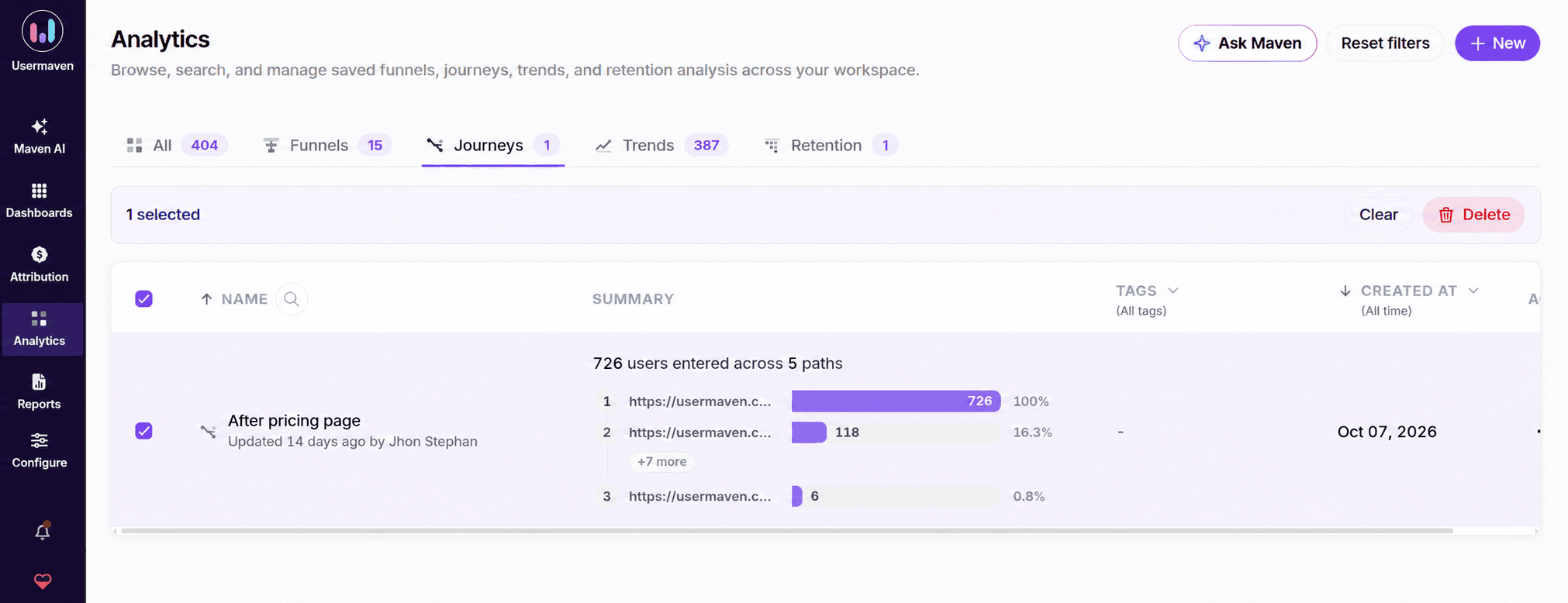
User journeys can help investigate which tracked pages and events preceded conversion, subject to the identity and tracking data available.
Use AI to investigate, not invent missing data
Maven AI supports natural-language analysis; scheduled Agents can proactively examine changes in user journeys and other product signals.
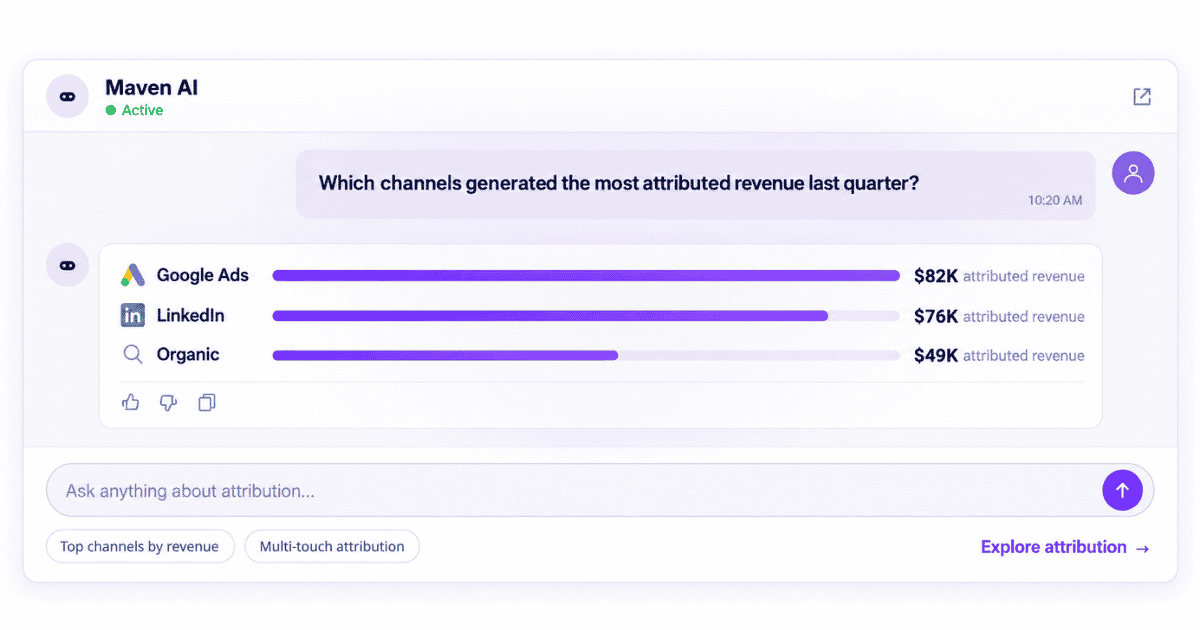
AI can highlight patterns in collected data. It cannot reconstruct untracked offline meetings, recover missing identifiers, or prove a marketing touch caused a deal to close.
A real customer application
In its published Hyperengage case study, Usermaven describes how the team used connected attribution reporting to assess qualified pipeline and shift attention away from weaker acquisition channels.
That is customer-reported evidence of a useful workflow, not a universal conversion uplift or a controlled demonstration of incremental lift.
For complex B2B journeys, B2B marketing attribution explains how touchpoint-credit models differ from the CRM’s commercial milestones.
Build a funnel that measures real buying progress
A B2B sales funnel works when everyone agrees on the stages, the evidence for movement, and the outcome that matters. Start with a clean handoff from marketing to sales and a trustworthy connection between activity, opportunities, and revenue.
If your team needs to connect website behavior, qualified stages, and CRM pipeline in one reporting workflow, book a demo to see how Usermaven supports the process.
FAQs
1. What are the six stages of a B2B sales funnel?
A practical six-stage model is awareness, interest, consideration, intent, evaluation, and purchase. Define the evidence for entering each stage and treat onboarding, retention, and expansion as post-purchase outcomes.
2. How do you create a B2B sales funnel from scratch?
Define target accounts, map the buying group, document stage-entry rules, assign handoff owners, track meaningful events and CRM stages, then review conversion and time-in-stage by cohort.
3. What is the difference between a B2B funnel and pipeline?
The funnel models buyer progression from discovery through purchase. A pipeline tracks sales-owned opportunities through commercial stages. They overlap, but the funnel may start before a deal exists.
4. What is a good B2B sales funnel conversion rate?
There is no universal good rate. Compare the same stage definitions, account or opportunity units, time periods, and sales motions. Internal cohort trends are usually more actionable than broad benchmark claims.
5. How can a company shorten its B2B sales cycle?
Measure where qualified deals wait, then address the specific delay: slow response, missing stakeholder, unclear ROI, security review, or procurement handoff. Avoid skipping necessary qualification to improve an average artificially.
6. How should multiple stakeholders be counted?
Keep contacts distinct for engagement analysis but use a stable account or opportunity ID for account-based conversion reporting. Otherwise, five employees at one company may be mistaken for five separate buying organizations.

Written by
Imrana Essa
SaaS Marketing Lead
Imrana Essa is a marketing lead and content strategist with 8+ years of experience creating and leading content for B2B and SaaS brands. She specializes in marketing analytics, attribution, content strategy, and organic growth, translating complex marketing concepts into clear, actionable insights. Her work focuses on helping marketers understand performance, make data-informed decisions, and build strategies that contribute to sustainable growth.
All articles by Imrana →