Most analytics platforms seem to promise the same thing. But once you look closer, the differences start to matter.
Some are built around product experience and in-app guidance. Others are better at showing user behavior, session insights, or marketing attribution in a more actionable way.
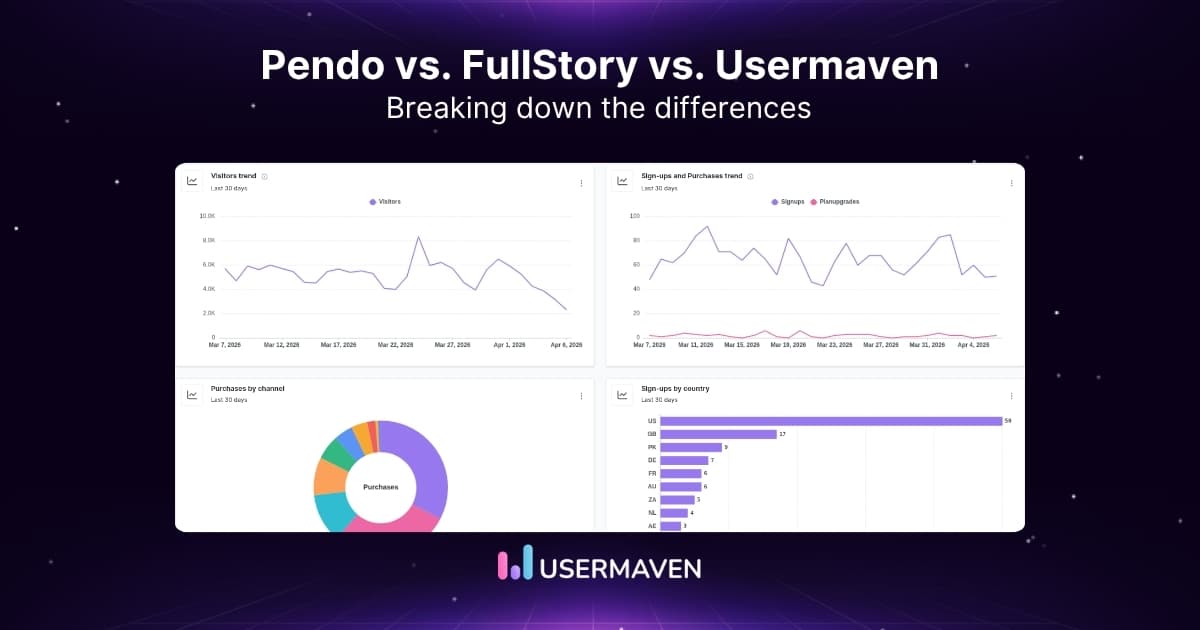
In this blog, we’ll compare Pendo vs. FullStory vs. Usermaven, break down where each platform stands out, and help you decide which one makes the most sense for your business.
Brief overview: Pendo vs. FullStory vs. Usermaven
Pendo is a product experience platform focused on helping teams understand product usage and improve in-app engagement. It combines product analytics with guides, onboarding flows, and user feedback tools, making it useful for driving feature adoption and helping users get more value from the product. That makes it a strong fit for product-led teams that want more visibility into user behavior inside the app.
FullStory is a digital experience analytics platform built to help teams see how users actually interact with a site or product. It is widely known for session replay, which makes it easier to spot friction, hesitation, and broken flows. That level of visibility is useful for investigating drop-offs, troubleshooting experience issues, and understanding where users struggle.
Usermaven is a powerful attribution tool built to show which channels, campaigns, and touchpoints actually drive conversions. It goes beyond attribution by combining website analytics, product analytics, funnel analysis, and user journey tracking in one place. That gives teams a clearer view of both where users come from and what they do next. Its no-code setup also makes it easier to get started without heavy technical involvement. For businesses that want multi-touch attribution with broader behavioral visibility, Usermaven offers a more complete picture.
See Usermaven in action
Book a free demo and discover how powerful analytics can grow your business.
A closer look at what each tool offers
Here’s a quick side-by-side look at how these tools compare at a glance.
| Feature | Usermaven | Pendo | FullStory |
| Primary focus | Attribution, web analytics, and product analytics in one platform | Product analytics, in-app guidance, and adoption | Replay, behavioral visibility, and friction analysis |
| Best fit | Teams that want acquisition, behavior, conversion, and revenue in one view | Teams focused on in-app engagement and adoption | Teams focused on session behavior and UX issues |
| Web and product analytics | Combines both in one view | Supports both, with a stronger product focus | Supports both, with a stronger behavioral focus |
| Attribution | Core part of the platform | More product-focused | More behavior-focused |
| Auto-capture | Automatically tracks key user actions | Captures usage and engagement data | Autocapture for sessions and behavior |
| AI capabilities | Maven AI for analytics and attribution insights | Pendo AI | StoryAI for behavioral insights |
| Funnels | Funnels across web, product, and attribution | Funnels for product and engagement analysis | Funnels tied to behavioral analysis |
| Retention analysis | Retention analysis with conversion context | Retention and engagement from a product lens | Retention viewed through behavior patterns |
| Journey visibility | Broad view across acquisition to revenue | In-app journey visibility | Session and friction visibility |
| Ease of setup | No-code and easier to unify | A broader platform can feel heavier | Easier for replay-focused use cases |
| Privacy and compliance | GDPR- and CCPA-compliant | GDPR- and CCPA-compliant | GDPR- and CCPA-compliant |
1. Ease of use and implementation
Usermaven is easier to implement if you want analytics and attribution without a complicated setup. Its no-code setup and marketer-friendly approach make it simpler to unify web, product, and attribution data in one place. That makes implementation feel more straightforward, especially for teams that do not want to rely too much on technical support teams.
Pendo offers a lot once it is in place, but implementation can feel more involved because the platform is built around a broader layer of analytics, guidance, and user feedback tools. It offers a strong set of capabilities, but getting everything configured can take more effort, especially for teams that want to use the platform beyond basic analytics.
FullStory is relatively easy to start with for replay and behavioral analysis, especially if the goal is to quickly surface user friction. But as the use case expands into deeper analytics and broader workflow integration, it can feel more specialized than all-in-one. That makes setup easier for focused experience analysis, though less naturally aligned with teams looking for one unified reporting layer.
2. Privacy & compliance
Usermaven takes a privacy-conscious approach that aligns well with teams looking for both insight and control. It supports GDPR and CCPA compliance, offers privacy-friendly tracking, and gives businesses more flexibility in how data is handled. That makes it a practical choice for teams that want analytics without creating unnecessary compliance friction.
Pendo supports GDPR and CCPA compliance and includes the controls most teams would expect around privacy and data governance. Its approach is well-suited to organizations that need product analytics within a structured compliance framework. For teams already evaluating Pendo for product experience, its privacy support is part of a broader enterprise-ready offering.
FullStory also supports GDPR and CCPA compliance and provides controls to help teams manage data responsibly. Its privacy features are designed to support organizations that need visibility into user behavior while staying aligned with compliance requirements. For teams using FullStory for experience analysis, those controls help support a more responsible setup.
Also read: Top privacy-first analytics tools
3. Web and product analytics in one view
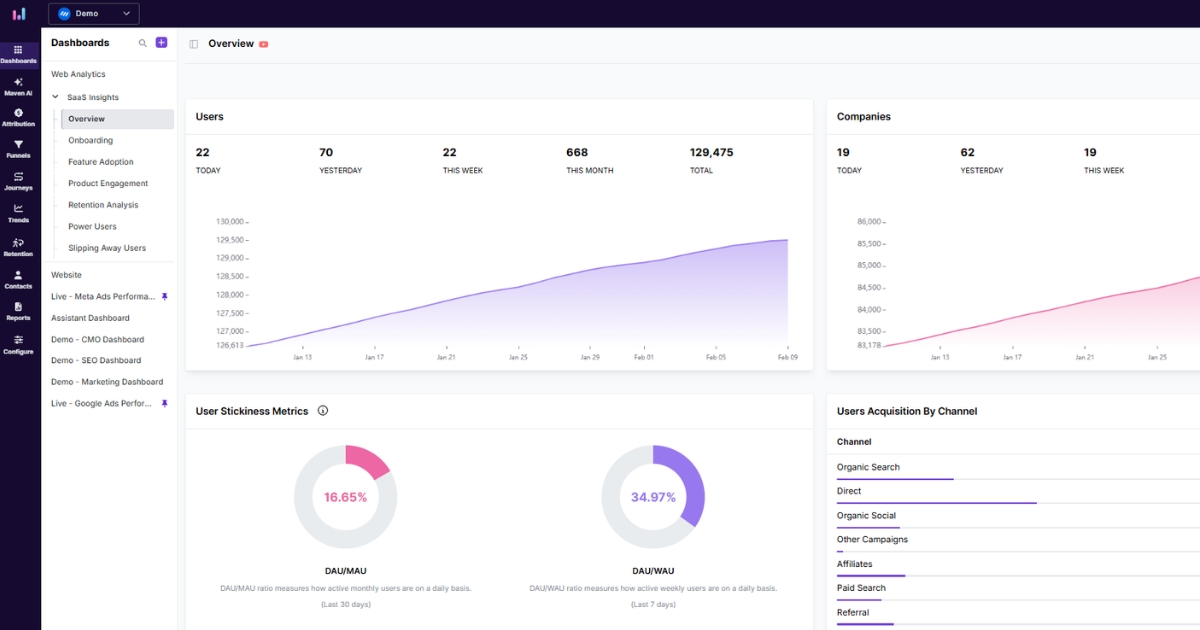
Usermaven brings website analytics and product analytics together in a way that feels more unified. You can track how users arrive, what they do across the site and product, and how those actions connect to conversion. That makes it easier to move from traffic analysis to product behavior without switching contexts. For teams that want a fuller picture, that combined view is a strong advantage.
Pendo supports both web and product analytics, but the experience still leans more heavily toward feature engagement and guided experiences inside the product. It works well for feature adoption and guided flows, though the broader view can feel less central. For teams looking beyond the product itself, that split is worth noting.
FullStory also spans web and product analytics, but its strengths remain more tied to behavioral detail and session-level visibility. It is useful for understanding interactions and friction, though the broader analytics picture does not feel as unified. That makes it more specialized in practice.
💡Want to see how Usermaven stacks up against more analytics tools? Check out our blog on Heap vs. Mixpanel vs. Usermaven for a side-by-side comparison.
4. Event tracking and auto-capture
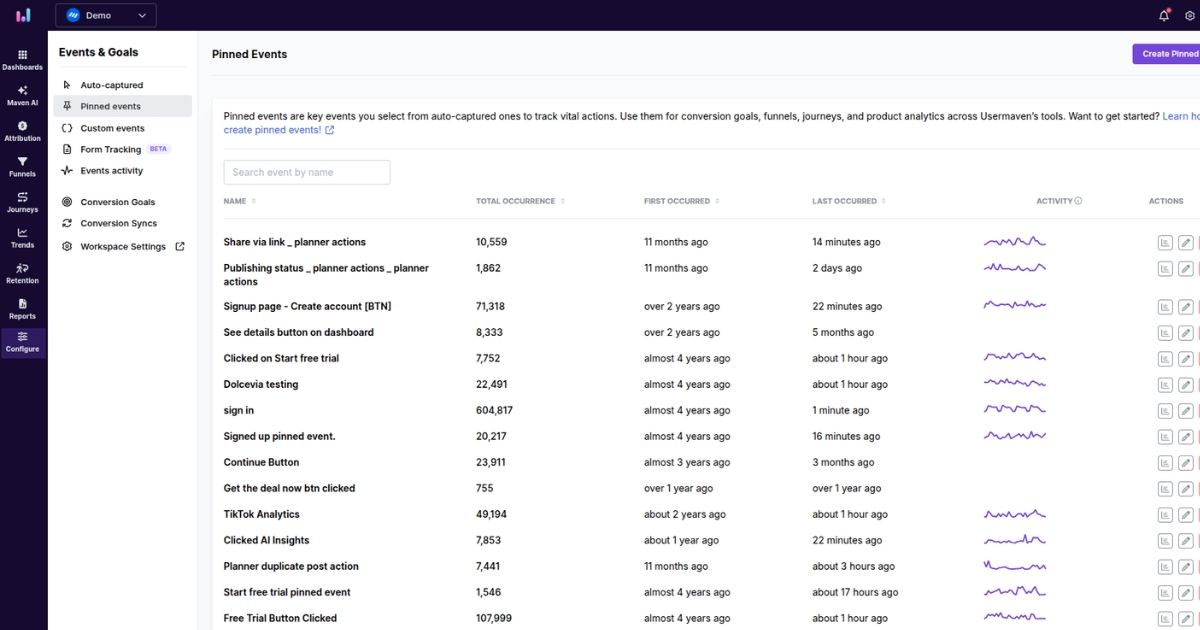
Usermaven makes event tracking feel more streamlined by automatically capturing key actions like clicks, form submissions, purchases, and page visits without heavy setup. It also gives teams the option to refine that data with pinned or custom events when needed. That makes it easier to get useful tracking in place quickly, while still keeping enough control for more specific use cases.
Pendo captures event data from the moment it is installed, with Pages, Features, and Track Events forming the core of its analytics. It is effective for understanding how people interact with the product, though teams often need to define or configure more of the tracking structure around it.
FullStory is especially strong at automatically capturing behavioral data in real time, which is why it stands out for replay and interaction analysis. Its event visibility is rich and detailed, but it is often most useful when the goal is to understand behavior deeply rather than build a broader event reporting layer around the business.
5. User behavior tracking
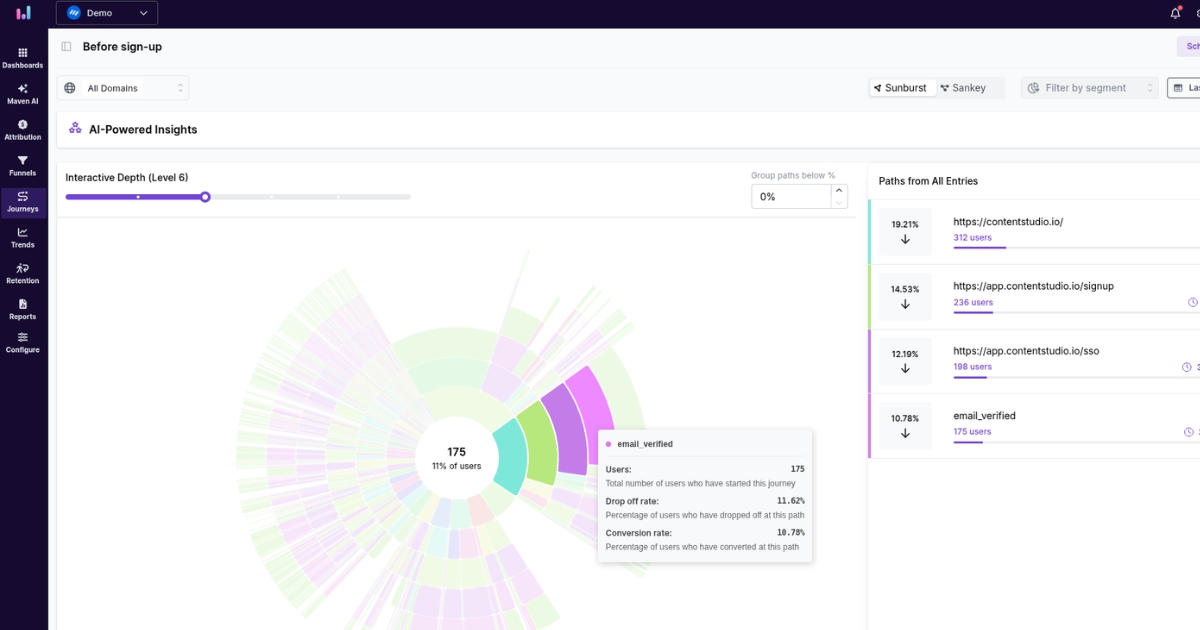
Usermaven’s user journey feature gives teams a broader view of user behavior by connecting website activity, product interactions, and attribution data in one place. You can see what users do, where they came from, and which actions lead to conversion. That makes the behavior data easier to interpret in context, not just as isolated events. For teams that want both visibility and clarity, that added layer is useful.
Pendo approaches user behavior tracking mainly through the lens of product usage and in-app engagement. It is useful for understanding feature usage, in-app flows, and how users engage with guides or onboarding elements. This works well for product teams, though the behavior view is more centered on in-app engagement.
FullStory focuses more on behavioral detail at the session level. It shows clicks, scrolls, movement, and replay data, which makes it helpful for spotting friction and investigating experience issues. It is especially useful for behavioral visibility, though the picture tends to stay more experience-focused than performance-focused.
Recommended: Mixpanel vs. FullStory vs. Usermaven
6. Multi-touch attribution
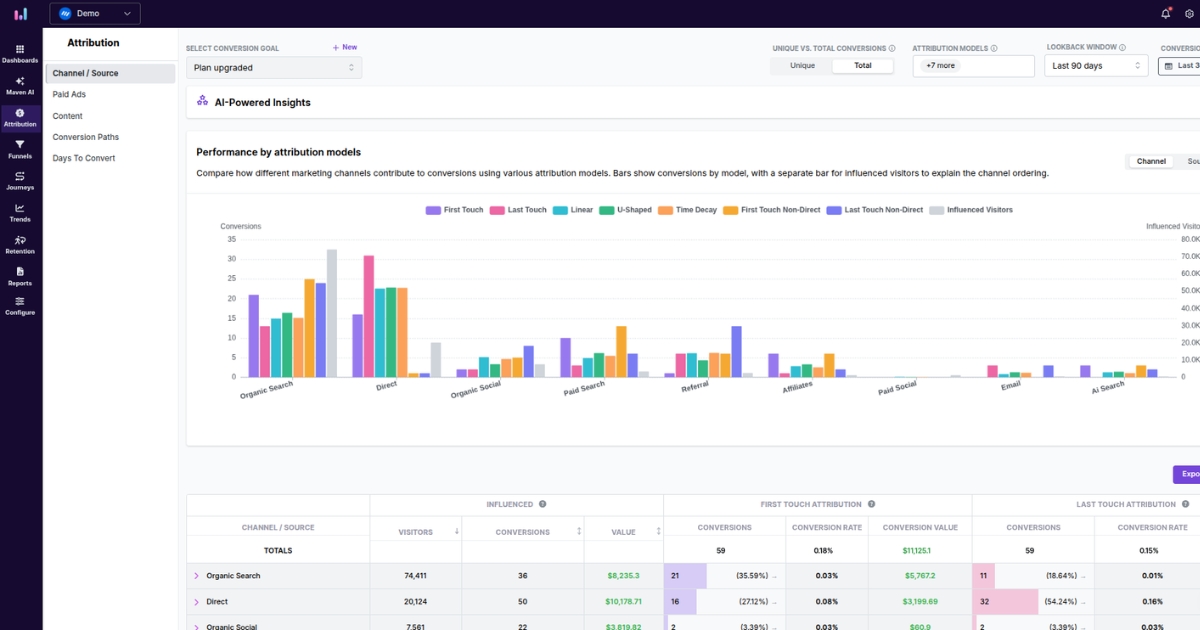
Usermaven stands out here as advanced attribution software built to connect touchpoints to conversions and revenue. It supports multiple attribution models and helps teams see how channels, campaigns, content, and product actions contribute across the full path to conversion. That makes attribution feel like a core part of the platform rather than an added layer.
Pendo does not position itself as a multi-touch attribution platform. Its focus stays on product analytics, in-app engagement, and user interactions rather than attribution across marketing touchpoints.
FullStory is also not built for multi-touch attribution. It is better known for behavioral analysis and session-level visibility than for attribution reporting across channels and campaigns.
7. Funnel analysis
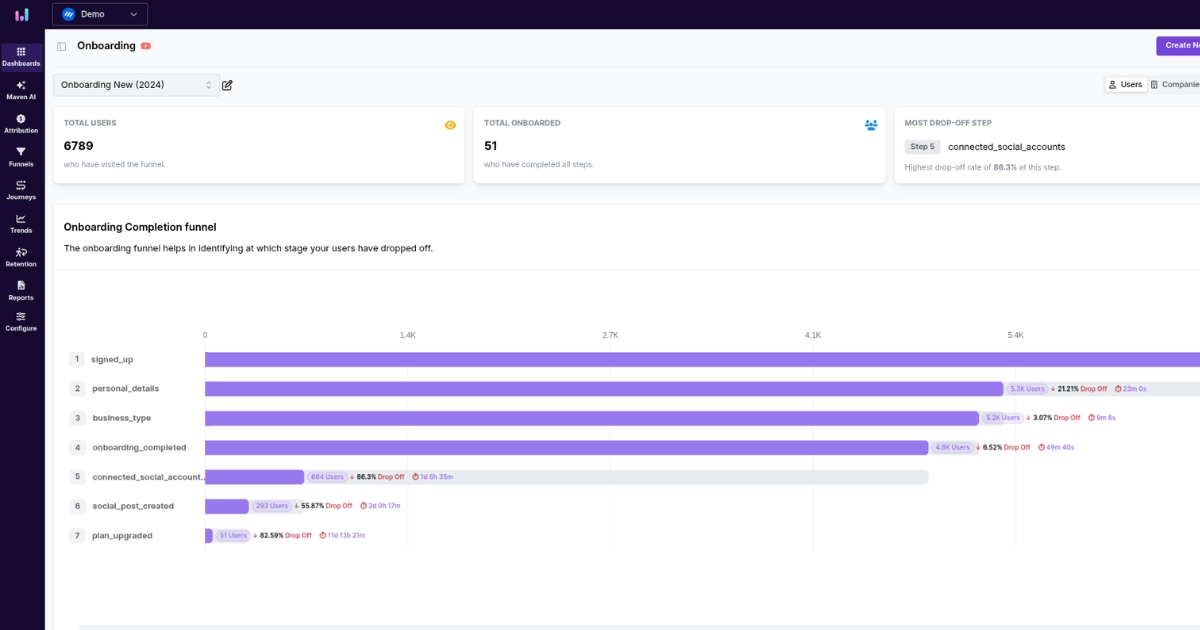
Usermaven’s funnels give teams a broader view by connecting website funnels, product funnels, and attribution in one place. That makes it easier to see where users drop off, which steps drive conversion, and how funnel performance connects back to channels and revenue. For teams that want funnel reporting with more business context, it feels more complete.
Pendo supports funnel analysis well, especially for feature engagement and onboarding flows. It helps teams measure step-by-step progress and spot where users drop off, but the lens stays more tied to product engagement. That makes it strongest for in-app optimization rather than a broader conversion view.
FullStory also offers funnel analysis and is particularly useful for seeing where users get lost in a flow. Its strength is the behavioral layer around the funnel, which helps explain friction in more detail. The tradeoff is that it feels more experience-focused than funnel reporting built around wider performance analysis.
8. Retention analysis
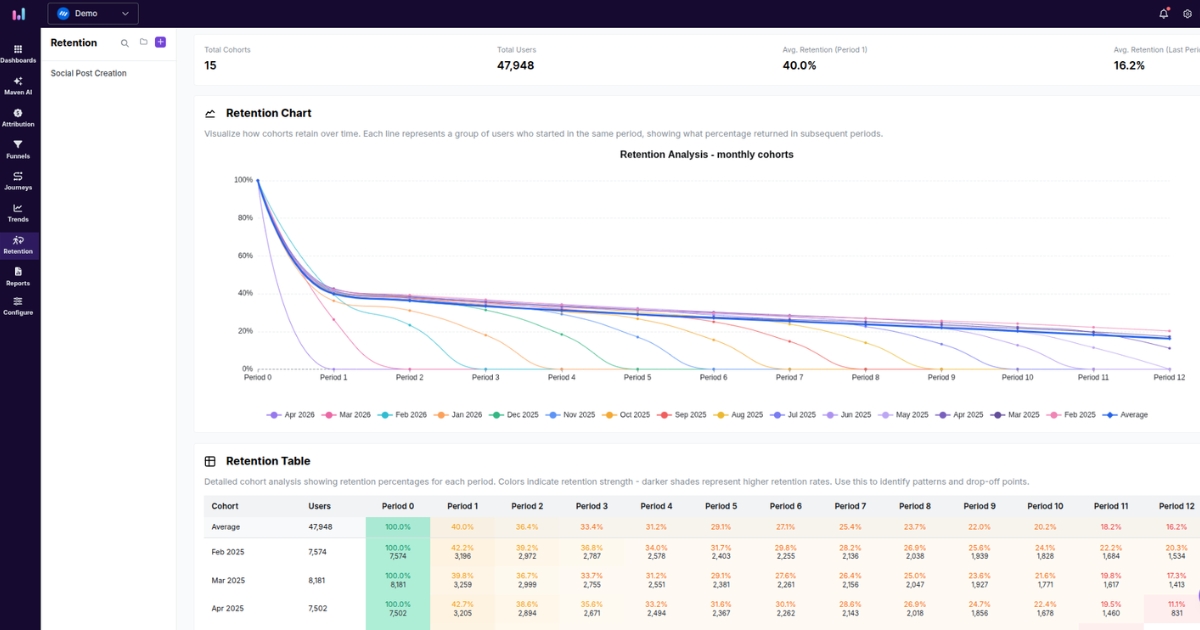
Usermaven gives retention analysis more business context by connecting returning usage patterns with product activity, conversion behavior, and revenue analytics. Its retention reporting and cohort analysis make it easier to see not just who comes back, but which actions and segments are linked to stronger long-term value.
Pendo handles retention well from a feature adoption perspective. It helps teams track returning users, engagement patterns, and adoption over time. The analysis is useful, though it stays more centered on in-app behavior.
FullStory supports retention reporting through behavioral patterns and repeat usage over time. It can show whether users come back after key actions and how engagement changes across periods. The view is helpful, but it leans more toward behavior than broader retention context.
9. AI-powered insights
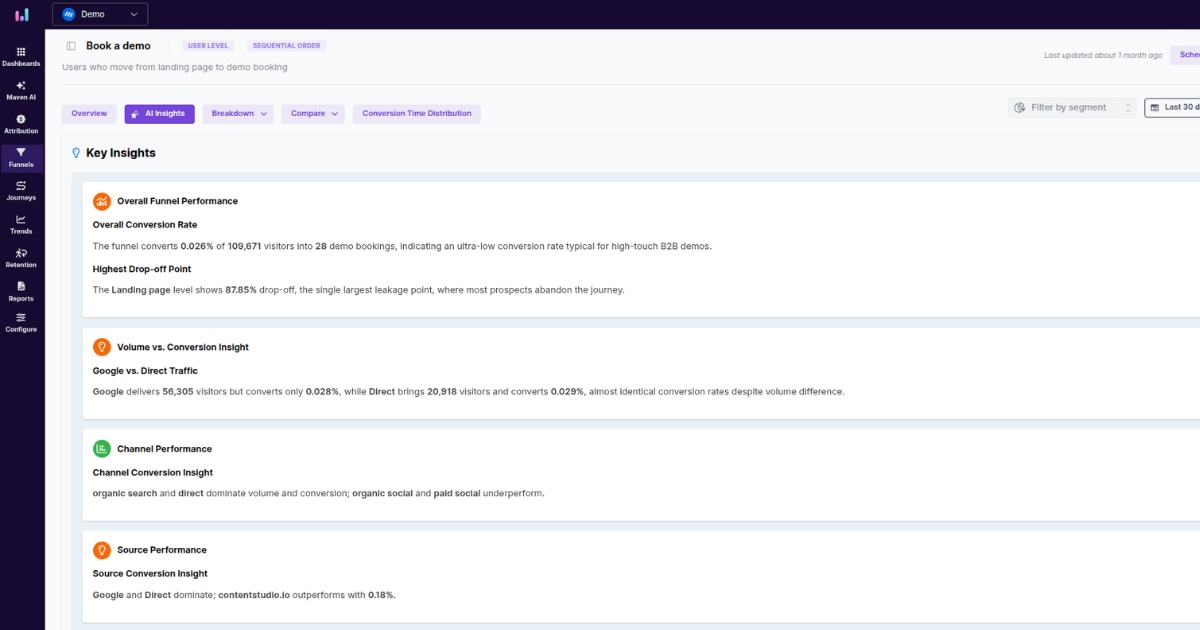
Usermaven takes a more practical approach to AI by using it to surface insights across attribution, funnels, website analytics, and product analytics in one place. Maven AI is built to help teams ask questions in plain language and get faster answers without digging through reports. Because it sits inside a broader analytics and attribution workflow, the AI feels more directly tied to day-to-day decision-making.
Pendo includes AI features across the platform to support product and analytics workflows. The capabilities are helpful, though they are spread across different parts of the product rather than centered in one main insight layer.
FullStory brings AI into the platform through StoryAI, which adds more intelligence to behavioral analysis and session data. Some of the more advanced AI functionality is available on higher plans, so the overall experience can depend on the tier.
10. Integrations and ecosystem flexibility
Usermaven offers a more balanced integration setup for teams that want analytics and attribution to connect smoothly with the rest of their stack. It works well with ad platforms, CRMs, CMS tools, and team workflows, which makes reporting feel more connected from the start. That gives teams a simpler way to bring marketing and product data together without adding too much complexity.
Pendo supports a broad range of integrations, especially across product, feedback, and enterprise workflows. Some capabilities are still tied to paid add-ons or specific modules, so the integration experience can vary depending on the setup you choose.
FullStory also integrates with a solid range of tools, particularly around behavioral analysis and digital experience workflows. It connects well to tools around analytics, support, and experience workflows, though the integration story still feels more centered on extending behavioral analysis.
Plans & pricing comparison
Usermaven keeps pricing simple and easy to assess upfront. Plans start at $84/month (yearly billing includes a 15% discount), and there is a 14-day free trial so teams can explore the platform before making a commitment. That kind of transparency is helpful when teams want to compare options without going through a sales process first.
Pendo does offer a free plan, but it is capped at 500 monthly active users, so it works more as a limited entry point than a pricing model most growing teams can rely on. Beyond that, paid pricing is not publicly available, which means you have to contact sales to understand the real cost. That lack of transparency can make comparison harder than it needs to be.
FullStory has a similar issue when it comes to pricing transparency. Its paid plans are not publicly priced, so you need to request pricing or a demo to understand the actual cost, and the free plan is positioned more as a limited starting point with 30,000 monthly sessions and 12 months of analytics retention. For teams trying to assess long-term cost early, that still leaves a lot unanswered.
Wrapping up
The value of an analytics tool shows up in the decisions it helps you make. If the insight stops at activity, it is not giving you enough to grow on.
That is where Usermaven feels like the more complete option. As a marketing attribution platform, it goes beyond showing user behavior or product activity in isolation and connects those signals to funnels, attribution, and revenue impact. The result is a clearer view of what is actually driving conversions.
Ready to see Usermaven in action? Explore the platform or book a demo for a closer look.
FAQs
1. Which tool is best for startups?
Startups often prioritize affordability and ease of use. Usermaven is a great choice due to its cost-effective pricing, intuitive interface, and ability to scale as your business grows.
2. Can these tools integrate with my existing marketing stack?
Yes, all three tools support integrations. Pendo and FullStory offer integrations with common CRMs and marketing platforms. Usermaven also integrates seamlessly with a range of tools, ensuring smooth data flow and collaboration.
3. What pricing models do these tools use?
Pendo and FullStory offer custom pricing based on usage and features, often suitable for larger enterprises. Usermaven provides a transparent and affordable starting price of $84/month, ideal for startups and growing businesses.
4. Are these tools easy to set up and use?
Pendo and FullStory are user-friendly but may require a learning curve for advanced features. Usermaven stands out for its intuitive interface and quick setup process, making it accessible even for non-technical teams.
Updated

Written by
Ryan Mitchell
Marketing Analytics Strategist
Ryan Mitchell is a marketing analytics strategist specializing in campaign measurement, customer journeys, and marketing performance. He writes about analytics, reporting, and data-driven marketing strategies, helping SaaS and B2B teams measure what matters across every stage of the customer journey.
All articles by Ryan →