Choosing an analytics platform should be straightforward. In reality, it rarely is.
Matomo, Plausible, and Usermaven are often compared side by side, but they are built with different priorities in mind. That means the best fit depends on what you actually need from your analytics.

For some teams, the priority is privacy and simplicity. For others, it is flexibility, deeper reporting, or finding an alternative that offers more room to grow.
This guide breaks down Matomo vs. Plausible vs. Usermaven in practical terms, so you can compare features, trade-offs, and use cases without getting lost in surface-level differences.
Understanding the basics: Matomo vs. Plausible vs. Usermaven
Matomo is a web analytics platform built for teams that want more control over how data is collected and managed. It is often used by businesses looking for flexible reporting, custom tracking, and greater ownership over their analytics setup.
Plausible is a website analytics tool designed for teams that want a focused approach to reporting. It highlights core traffic and performance data in a clean, easy-to-follow dashboard. Teams often use it to track website activity, referral sources, and overall trends.
Usermaven is a leading marketing attribution tool that also brings website and product analytics into one place. It helps teams measure campaign performance, understand user behavior, and connect the customer journey to actual business results. With a no-code setup and AI-powered insights, it is easier to get started, uncover what is driving growth, and make better decisions without heavy technical effort.
See Usermaven in action
Book a free demo and discover how powerful analytics can grow your business.
Now, let’s dig into the details and compare each platform.
Privacy and data accuracy
Usermaven takes a more advanced approach to privacy-friendly analytics with cookieless tracking built into the platform. It is designed to preserve data quality even when browsers, ad blockers, and privacy tools limit traditional tracking, while supporting GDPR and CCPA compliance. That gives teams a more reliable way to measure performance without giving up depth or flexibility.
Matomo takes a more traditional approach to data protection. It offers strong features for data anonymization and user consent management, but its reliance on cookies can create challenges in more privacy-conscious environments. For many teams, getting the right balance between detailed analytics and privacy often depends on a more involved setup. That is often why teams start looking for a Matomo alternative that offers strong privacy support with less setup overhead.
Plausible Analytics takes a stricter privacy-first approach to data protection. It focuses on essential metrics without collecting personal information, which helps support compliance and user trust. That also means its reporting stays more limited, making it a better fit for teams with simpler analytics needs.
| Privacy & accuracy features | Usermaven | Matomo | Plausible |
| Privacy compliance | GDPR & CCPA | GDPR & CCPA | GDPR & CCPA |
| Cookie dependency | Cookieless | Cookieless | Cookieless |
| Ad-blocker impact | 99% accuracy | Significant loss | Minimal impact |
| Data retention | Unlimited | Configurable | 36 months |
Related: Privacy-first analytics tools
Website analytics

Usermaven gives teams a more complete view of website performance through real-time tracking, automatic event capture, and deeper engagement reporting. Instead of stopping at basic traffic metrics, it helps you understand how visitors behave, where they drop off, and what actions actually move them forward.
Matomo covers the core website metrics teams usually look for, including visitor data, engagement patterns, and real-time activity. Its reporting is solid for measurement, though the experience can feel more focused on tracking data than on helping teams turn it into clear next steps.
Plausible centers its reporting on pageviews, traffic sources, and other essential website metrics. It works well for a high-level view of site activity, but offers less depth for teams that want closer visibility into behavior and engagement.
For one-on-one comparisons, check out this guide: Usermaven vs. Plausible
| Feature comparison | Usermaven | Matomo | Plausible |
| Real-time tracking | Advanced | Basic | Basic |
| Traffic sources | Comprehensive | Detailed | Basic |
| Event tracking | Automatic | Manual | Limited |
| Goal tracking | Advanced | Manual | Basic |
| Campaign monitoring | Advanced | Basic | Basic |
Product analytics
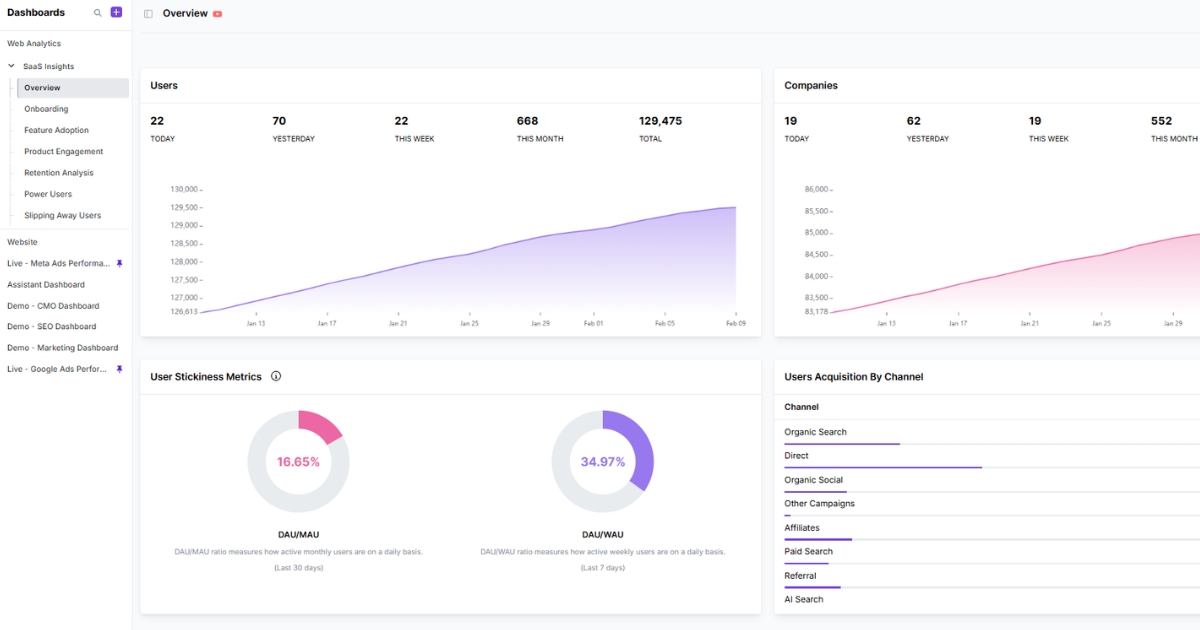
Usermaven is better suited to teams that need real product analytics, not just surface-level reporting. It helps track feature usage, user behavior, and product engagement patterns across the product, while automatic feature detection reduces the amount of manual setup needed. With AI-powered insights adding more context, teams can better understand what users are adopting, where they are engaging, and which product experiences are driving retention and growth.
Matomo takes a more traditional approach, with feature tracking and user flow analysis depending more heavily on manual setup. It can support basic product usage reporting, but the depth of insight often depends on how much time and technical effort go into configuration and maintenance. For teams that want to extract more meaningful product insights, the setup can feel more involved than the reporting itself.
Plausible is built primarily for website analytics, so its strengths remain centered on traffic reporting and visitor statistics rather than product usage analysis. It can help teams understand high-level site activity, but it does not offer dedicated product analytics capabilities such as feature adoption tracking or deeper product engagement insights. That makes it a better fit for simpler website reporting than for teams that need visibility into how users interact with a product over time.
| Product features | Usermaven | Matomo | Plausible |
| Feature tracking | Automatic | Manual | Not available |
| User flows | AI-powered | Basic | Not available |
| Retention analysis | Advanced | Basic | Not available |
| Behavior tracking | Comprehensive | Limited | Not available |
Related: PostHog alternatives
Attribution
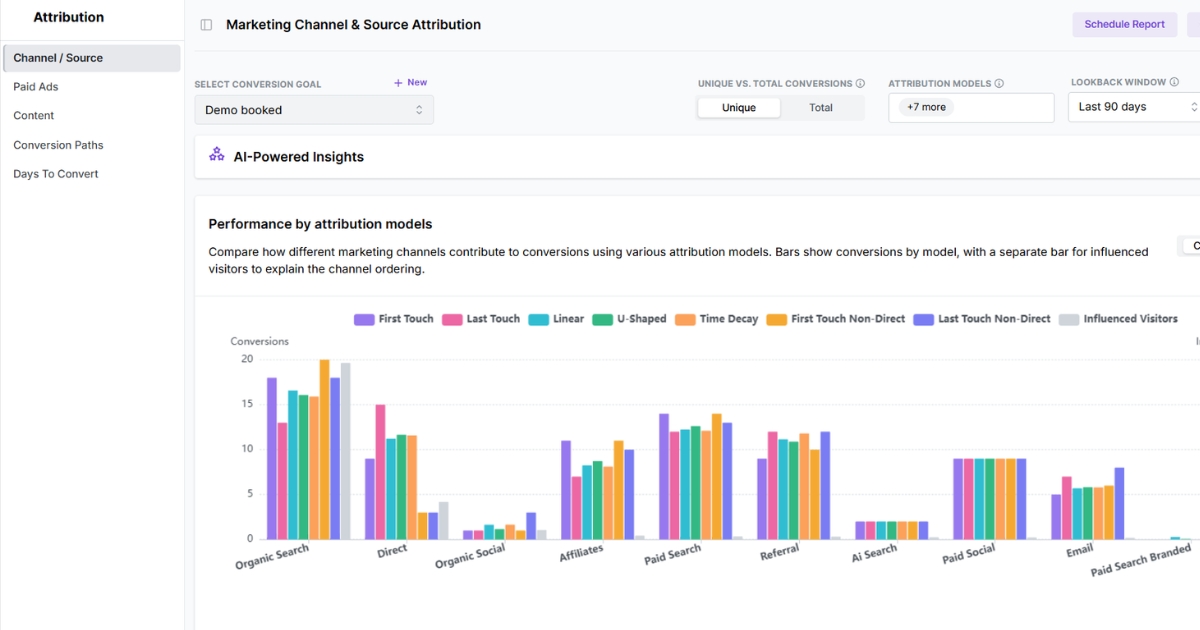
Usermaven is built for teams that want more than basic source-level attribution. Its marketing attribution supports seven attribution models and a 365-day lookback window for a fuller view of what drives conversions over time. It also includes spend-period attribution mode and a look-ahead window, helping teams connect ad spend to conversions more accurately. That makes it easier to measure what is actually influencing pipeline and revenue.
Matomo offers multi-channel attribution, but its default reporting centers on the last non-direct referrer, with broader attribution depending more on configuration and enabled features. It can help teams understand channel contribution, though the setup feels more traditional, and the attribution view is not as expansive out of the box.
Plausible keeps attribution much narrower. It supports UTM-based campaign tracking and revenue attribution, which works for seeing which tagged campaigns or sources drove conversions, but it stays much closer to lightweight campaign reporting than to full multi-touch attribution across longer customer journeys.
| Attribution features | Usermaven | Matomo | Plausible |
| Attribution models | 7 models | Limited | Not available |
| Lookback window | 365-day | Basic | Not available |
| Spend-based attribution | Available | Not available | Not available |
| Look-ahead window | Available | Not available | Not available |
| Multi-touch attribution | Yes | Basic | No |
| Revenue attribution | Advanced | Limited | Basic |
User journey analysis
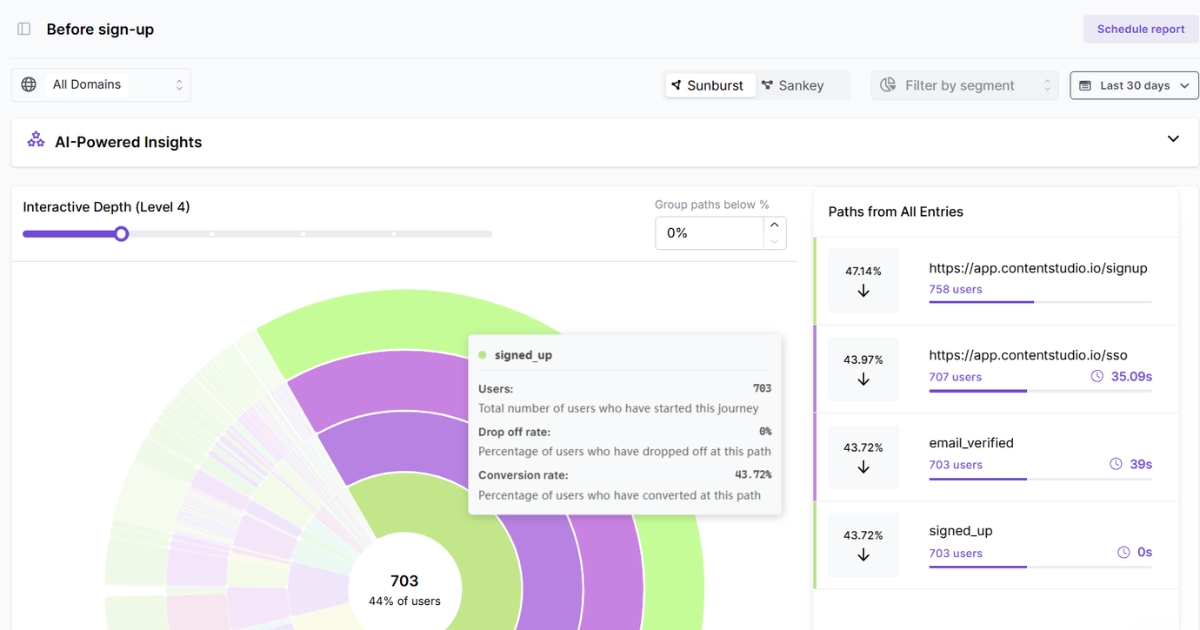
Usermaven gives teams a more advanced way to understand the customer journey. Its AI-powered user journey analysis helps surface how users move through the website or product, without relying as heavily on manual setup to map every step. That makes it easier to spot patterns, friction points, and drop-off rates as they happen. In turn, teams get clearer insight into where journeys break down and where optimization can have the biggest impact.
Matomo supports journey analysis through more traditional user flow and funnel tracking. Teams can monitor movement across pages or steps, but accurate journey mapping depends more on manual configuration and ongoing maintenance. As a result, capturing changing or less predictable paths can take more effort over time.
Plausible keeps traffic analysis at a much higher level. It can show entry points, exit pages, and general traffic patterns, but it does not offer dedicated journey mapping or deeper funnel analysis. That makes it more suitable for basic traffic visibility than for teams trying to understand how users move across multiple steps.
| Journey features | Usermaven | Matomo | Plausible |
| Drop-off analysis | Automatic | Basic | Not available |
| Path visualization | Advanced | Basic | Not available |
| Custom journeys | Unlimited | Limited | Not available |
Engagement tracking

Usermaven makes feature adoption tracking easier to manage. Its automatic event capture helps teams monitor how users interact with new and existing features without constant manual setup. That creates a clearer view of adoption patterns, engagement levels, and feature usage across different segments. As a result, teams can see more quickly what is gaining traction and what may need attention
Matomo can support tracking how users interact with different parts of a product, but it depends much more on manual event setup and ongoing configuration. Teams can monitor usage patterns, though the process often takes more time to define, maintain, and refine for each feature. As a result, getting a broader view of how usage develops across the product can require additional effort.
Plausible is not designed for deeper product usage analysis. Its reporting stays focused on basic page and traffic analytics, which makes specific in-product interactions harder to measure in a detailed way. For teams that need stronger product-level visibility, that leaves less room to understand how different features are actually being used.
| Engagement metrics | Usermaven | Matomo | Plausible |
| Event tracking | Automatic | Manual | Limited |
| Customer segments | Advanced | Basic | Not available |
| Custom metrics | Unlimited | Limited | Basic |
| Interaction analysis | AI-powered | Manual | Basic |
Also read: Usermaven vs. GA4 vs. Matomo
AI capabilities

Usermaven brings AI into analytics in a way that feels genuinely useful. With Maven AI, teams can ask questions, uncover insights faster, and get clearer answers without digging through reports by hand. It also adds AI-driven marketing attribution, funnels, and customer journey insights, making it easier to understand behavior and spot what needs attention. That helps teams move from reporting to action much faster.
Matomo does not offer the same level of built-in AI support. It relies more on manual analysis and standard automation, so teams often need to spend more time finding patterns and interpreting the data themselves. For businesses that want quicker answers and more guidance, the workflow can feel more involved.
Plausible follows a more lightweight model and does not include AI capabilities. Its reporting is clear and easy to follow, but deeper analysis still depends on the team to interpret trends on their own. That works for simpler reporting needs, though it offers less support for teams looking for more advanced insight.
| AI Features | Usermaven | Matomo | Plausible |
| AI assistant | Yes | No | No |
| AI-driven funnel insights | Yes | No | No |
| Attribution insights | Yes | No | No |
| Customer journey analysis | Yes | No | No |
Pricing plans
Usermaven feels more complete from the start. Its Growth plan starts at $84/month for 250,000 events, while Scale starts at $199/month, and annual billing gives you 15% off. There is also a 14-day free trial, plus a guided setup and tracking plan add-on for $499 one time, which can make onboarding much smoother for teams that want to get implementation right from the start instead of piecing it together later.
Matomo pricing starts at €22/month for 50,000 hits on the Cloud plan. That can look accessible at first, but the entry point is tied to a much smaller usage allowance, so growing traffic can push teams into higher tiers sooner than expected. It works best for teams that are comfortable trading a lower starting price for a more usage-sensitive pricing structure.
Plausible’s pricing is tied closely to monthly pageviews and events, so costs rise in step with traffic as usage grows. The $19/month tier covers 100,000 monthly pageviews, but the platform’s lower-cost structure also reflects a more limited feature set across reporting, team access, and deeper analysis. For teams with broader analytics needs, the pricing can feel more aligned with lightweight traffic monitoring than with a more expansive analytics setup.
Quick read: Top Plausible alternatives
| Pricing features | Usermaven | Matomo | Plausible |
| Starting price | $84/month | €22/month | $19/month |
| Events | 250K | 50K hits | Pageview based |
| Advanced features | Mostly | Add-ons | Limited |
| Support level | Full | Basic | Basic |
Making the right choice
A better way to make the decision is to weigh a few practical factors before you choose a platform.
1. Technical resources
- Usermaven: Minimal technical setup required
- Matomo: More hands-on setup and ongoing technical involvement
- Plausible: Lighter setup, but a narrower analytics scope
2. Feature requirements
- Usermaven: Broad analytics, attribution, and AI-powered insights
- Matomo: Traditional analytics with room for customization
- Plausible: Core website metrics and straightforward reporting
3. Budget considerations
- Usermaven: Strong value for the depth of features offered
- Matomo: Costs can rise with setup, maintenance, and added needs
- Plausible: Lower entry point, with a more limited feature range
For businesses that want modern analytics without added complexity, Usermaven stands out as the strongest option. It brings together depth, usability, and value in a way that is easier to grow with.
Wrapping up
Matomo and Plausible can both help you cover the basics. But when you need more than surface-level reporting, basic visibility starts to fall short.
That is where Usermaven earns its place in the conversation. As a powerful marketing attribution software, it connects campaigns, touchpoints, and conversions in one view, so you can understand what is actually driving pipeline and revenue.
Ready to see Usermaven in action? Explore the platform or book a demo for a closer look.
FAQs
1. What are the top privacy-focused website analytics platforms?
Some of the top privacy-focused website analytics platforms include Usermaven, Matomo, and Plausible. The right choice depends on whether you need simple traffic reporting, more control over data, or deeper attribution and journey insights.
3. Which analytics platform is easiest to use for privacy-conscious teams?
Plausible is often chosen for its focused reporting experience, while Usermaven is a strong option for teams that want an easier setup without giving up deeper analytics capabilities. The best fit depends on how much detail your team needs.
4. What should I look for in a privacy-focused analytics platform?
Look for a platform that matches your reporting needs, setup capacity, and growth goals. For many teams, the key factors are ease of use, data privacy, attribution, customer journey visibility, and how much manual setup is required.
Updated

Written by
Ryan Mitchell
Marketing Analytics Strategist
Ryan Mitchell is a marketing analytics strategist specializing in campaign measurement, customer journeys, and marketing performance. He writes about analytics, reporting, and data-driven marketing strategies, helping SaaS and B2B teams measure what matters across every stage of the customer journey.
All articles by Ryan →