Choosing an analytics platform often starts with features, but pricing is usually what brings the decision into focus. The way a tool is packaged can shape how easy it feels to adopt, scale, and budget over time.
Matomo is often part of that journey for teams exploring privacy-focused analytics. That makes Matomo pricing an important part of the conversation. It is not just about the number itself, but about how the platform is structured for different needs, setups, and stages of growth.
In this blog, we’ll look at how Matomo’s plans are structured and what to keep in mind as you compare your options.
What is Matomo?
Matomo is a web analytics platform used to understand website and app performance through first-party data. It is generally positioned around analytics ownership, privacy, and control, while supporting teams that want to measure performance without relying as heavily on third-party tracking models.
Key features
- Traffic analytics: Tracks visitors, sessions, channels, and page-level performance.
- Behavior reporting: Shows how users move through pages, events, and site interactions.
- Conversion measurement: Supports goals, funnels, ecommerce reporting, and attribution analysis.
- Tag management: Includes a tag manager for handling tracking setup more efficiently.
- Optimization tools: Offers features like heatmaps, session recordings, and A/B testing.
Matomo pricing: A closer look
Matomo does not package its pricing around one fixed route. The decision starts with how you want to use the platform, and that choice shapes the rest of the decision.
For most teams, that means choosing between Cloud and On-Premise. Cloud is the hosted option. On-Premise is the self-managed one. From there, the differences become less about labels and more about flexibility, ownership, and how much complexity sits behind the price.
Matomo Cloud
Matomo Cloud is the managed version of the platform. It is built for teams that want hosting, updates, and support handled as part of the service, without managing the setup themselves. That also makes Matomo Cloud pricing a key part of the decision, especially for teams trying to balance convenience with flexibility.
Within Cloud, the structure becomes more specific. Business is the standard plan with fixed allowances, while Enterprise is the custom tier for teams that need more flexibility.
Business
The Business plan is Matomo’s standard Cloud offering. It gives teams a lower entry point and includes a fairly broad set of built-in features, which makes it a more straightforward place to start.
It also comes with defined boundaries, which is where the plan starts to feel more structured for growing teams.
- Starts with public, self-serve pricing
- Includes advanced features like funnels, session recordings, and A/B testing
- Uses fixed limits for websites, users, reports, and other account allowances
- Keeps raw data for a limited period rather than indefinitely
For smaller teams, that may feel manageable. For larger setups, those limits can become part of the pricing conversation much sooner.
Enterprise
The Enterprise plan is Matomo’s custom Cloud tier. It is built for teams that need more scale, more flexibility, or a setup that goes beyond the standard plan structure.
This is where Matomo moves away from fixed allowances and into a more tailored sales-led model.
- Uses custom pricing instead of a public fixed rate
- Replaces many Business caps with custom allowances
- Adds enterprise-oriented support and admin features
- Better suited for higher traffic and more complex requirements
That added flexibility is the main advantage. The tradeoff is that the plan becomes less transparent and harder to compare quickly from the pricing page alone.
Matomo On-Premise
Matomo On-Premise is the self-hosted version, and the core product is free to use. It gives teams more control over hosting, data location, and infrastructure, which can make it appealing in the right setup.
At the same time, a lower entry price does not always mean a simpler setup. The overall cost can start to look different once technical ownership and Matomo premium features begin to factor in.
- Free core product with self-hosting
- More open-ended usage across websites, users, and retention
- Requires your own server and technical management
- Many advanced features are sold separately as paid add-ons
That makes On-Premise more flexible in some ways, but also less simple. It can look cost-effective upfront, though the full setup may take more work and more investment over time.
Also read: Top Matomo alternatives
So, is Matomo pricing really justified?
That really comes down to what your team needs and how you plan to use the platform. On the surface, the pricing can seem fairly straightforward. But the picture becomes more layered once you look at usage limits, add-ons, support, and the differences between Cloud and On-Premise.
For some teams, that structure may still make sense. For others, the real cost may feel less clear over time, especially if the setup grows more complex or requires features beyond the core plan. That does not make the platform a poor choice, but it does make the pricing more important to evaluate in context.
If that tradeoff gives you pause, looking at a Matomo alternative may help you compare what a simpler setup and a more complete analytics experience could look like.
Related: Usermaven vs. GA4 vs. Matomo
Usermaven – The budget-friendly alternative to Matomo
Usermaven is an advanced attribution platform built to help teams understand how channels, campaigns, and touchpoints contribute to conversions. It also works as a more complete analytics solution, bringing website analytics, product analytics, and customer journey visibility into one place.
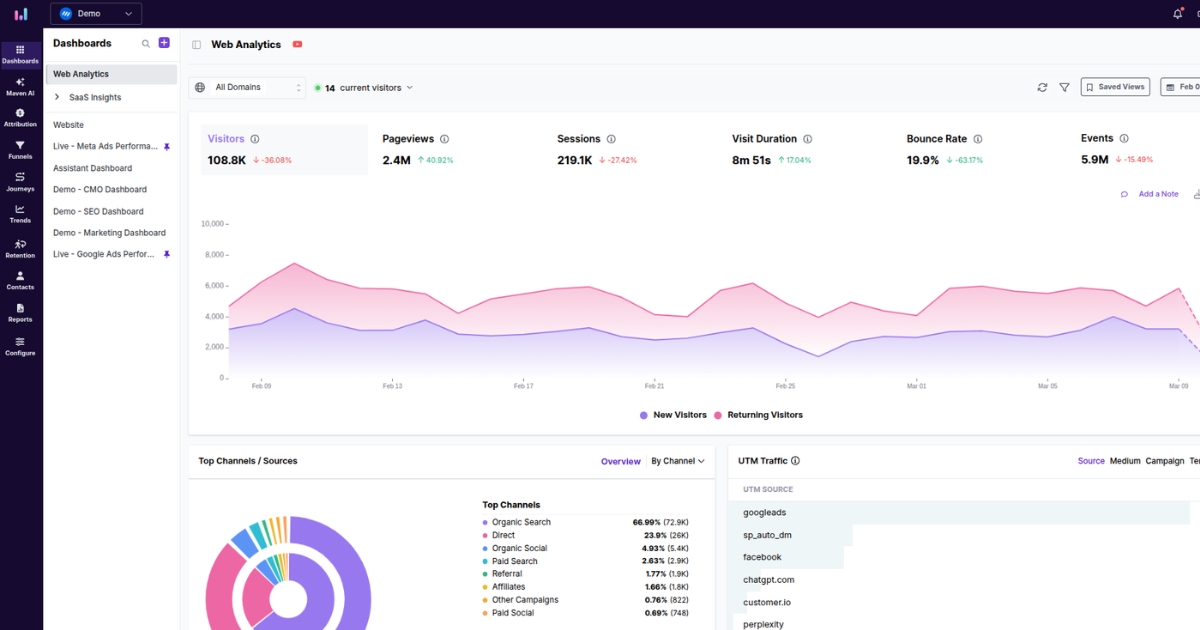
What makes it stand out in a comparison like this is how the platform is packaged for everyday use. The setup feels lighter, the reporting feels more connected, and the overall experience is easier to work with for teams that want strong analytics without adding more operational complexity.
That matters because the value of an analytics tool is not only in what it can track. It is also in how clearly it helps teams move from data to decisions, especially when marketing attribution, campaign performance, and user behavior need to be viewed together.
Drive business growth
with AI-powered analytics
Clear pricing without added complexity
Usermaven’s pricing is easier to understand upfront. The structure is clear, the starting point is public, and teams can usually see what each plan is designed for before moving deeper into the evaluation process.
That clarity makes a difference. Instead of piecing together costs across limits, add-ons, or separate layers of functionality, the pricing is presented in a way that feels more direct and easier to compare.
Usermaven also offers a 14-day free trial on its main plans, and annual billing comes with a 15% discount. For teams that want a simpler way to assess cost and value together, this makes the pricing feel more straightforward from the start.
Usermaven pricing vs. Matomo pricing
At a closer look, the difference is not just in the starting price, but in how clearly each platform structures what you get as your needs grow.
Looking at Usermaven’s plans makes that contrast easier to see.
1. Growth plan
Starting at $84/month
The Growth plan is Usermaven’s starting point for teams that want a strong analytics foundation without moving into custom pricing too early. It keeps the entry clear, and the feature set is already broad enough to feel useful from day one.
It includes:
- 3 users
- 3 workspaces
- 5 years of data history
- Website, product, and ecommerce analytics
- Funnels, journeys, dashboards, and scheduled reports
What makes this plan work well is its clarity. It gives teams a practical place to start, while still offering enough depth to make the platform valuable early on.
2. Scale plan
Starting at $199/month
The Scale plan is built for teams that need more visibility as their marketing grows more layered. It is built for teams that need stronger attribution, broader collaboration, and a more complete view of how marketing performance connects to pipeline and revenue.
It includes:
- Unlimited users
- 5 workspaces
- 7 years of data history
- Advanced attribution software offering paid ads, multi-channel, and content attribution
- CRM integration and deal attribution
- Conversion path analysis
- Maven AI and ad platform integrations
This is where Usermaven starts to feel more advanced in day-to-day use. The added depth makes it easier for teams to move from surface-level reporting to a clearer understanding of what is influencing growth.
3. Enterprise plan
Custom pricing
The Enterprise plan is designed for teams that need more flexibility in how the platform is set up and used. It is a better fit for businesses with larger volumes, more specific requirements, or a setup that needs to align more closely with internal processes.
It includes:
- Custom pricing for larger teams
- Tailored setup for more advanced requirements
- Advanced security & privacy compliance
- A more scalable path for teams that need a less limited setup
The main advantage here is flexibility. For teams with more complex needs, this plan makes it easier to build a setup that fits the business more closely.
Quick note: Usermaven also offers a guided setup and tracking plan as an add-on. For teams that want expert help with implementation, it can make the whole process feel a lot smoother from the start.
Usermaven vs. Matomo: A side-by-side comparison
The comparison table below makes the differences easier to scan. It helps show where each platform feels simpler, broader, or more specialized once you look past the headline features.
| Feature | Usermaven | Matomo |
| Ease of use | Easier to get started with auto-capture and a lighter setup | More setup-heavy, especially for custom tracking or self-hosting |
| Integration | Connects smoothly with CMS, CRM, and ad platforms | Supports many integrations, but setup can be more technical |
| Attribution | Puts multi-touch attribution at the center of the platform | Offers multi-channel attribution, but it is less central. |
| Feature adoption | Includes dedicated feature adoption reporting | Feature adoption is not a standout layer |
| Retention analysis | Includes retention reporting as part of product analytics | Offers retention analysis through the Cohorts feature |
| User journey | Gives a more detailed view of journeys across touchpoints | Shows user paths and drop-offs through Users Flow |
| Website metrics | Combines real-time web analytics with broader performance context | Offers strong web analytics, including real-time reporting |
| Product analytics | Offers a more complete product analytics experience | Supports product-style analysis, but is more web-focused |
| Privacy | Supports cookieless tracking with a privacy-first approach | Also supports cookieless tracking and strong privacy controls |
| AI features | Uses AI more directly across analysis and reporting | AI is not a major part of the core product story |
| Pricing | Pricing is clearer, with public plans and a free trial | Cloud pricing is public, but flexibility varies by setup |
To sum it up,
Pricing is only the starting point. What matters more is how much clarity the platform gives you once the data starts coming in.
That is where Usermaven makes a stronger case. As a powerful marketing attribution tool, it gives teams a more connected view of how campaigns, channels, and touchpoints influence conversions. With that level of visibility, it becomes easier to spot what is driving growth and where marketing spend is delivering real returns.
Ready to see Usermaven in action? Explore the platform or book a demo for a closer look.
FAQs about Matomo pricing
1. What is the Matomo Premium Bundle?
The Premium Bundle brings multiple premium features together in one package. It is relevant for teams that want more than the core setup without evaluating each add-on separately.
2. What is Matomo cloud pricing per month?
Matomo Cloud pricing per month starts with the public Business plan and increases as usage grows. For larger requirements, the Enterprise plan uses custom pricing, so the monthly cost depends on scale and specific needs.
3. How does Matomo Cloud vs. On-Premise compare?
The main difference is in hosting and management. Cloud is the managed option, while On-Premise gives teams more direct control over infrastructure and setup.
4. Is Matomo’s free open-source On-Premise version really free to use?
The core On-Premise version is free to download and use. Costs can still come up through hosting, maintenance, or premium add-ons.
5. When is Matomo On-Premise worth considering?
It tends to make more sense for teams that want more control over infrastructure and data. The tradeoff is that it usually asks for more hands-on management.
6. Which Matomo plan makes more sense for a small team?
That depends on how much technical ownership your team is comfortable with. Smaller teams often compare ease of setup, feature needs, and long-term cost before choosing between Cloud and On-Premise.
7. Are there better alternatives to Matomo for teams that want more than web analytics?
Updated

Written by
Ryan Mitchell
Marketing Analytics Strategist
Ryan Mitchell is a marketing analytics strategist specializing in campaign measurement, customer journeys, and marketing performance. He writes about analytics, reporting, and data-driven marketing strategies, helping SaaS and B2B teams measure what matters across every stage of the customer journey.
All articles by Ryan →