Heap vs. Mixpanel vs. Usermaven: A practical comparison
Ryan MitchellMarketing Analytics Strategist7 min read
Heap, Mixpanel, and Usermaven all explain what customers do, but they are optimized for different decisions. Choosing the wrong analytics platform can leave a team with excellent event charts and no reliable answer about revenue.
Teams comparing marketing attribution software should ask whether they mainly need retroactive event discovery, product experiments, or a clear link between acquisition channels, CRM outcomes, and customer value.
This Heap vs. Mixpanel vs. Usermaven comparison covers tracking, attribution, funnels, AI, implementation, privacy controls, and current pricing—without treating any vendor as universally better.
Key takeaways
Heap: best known for autocapture, retroactive event discovery, funnels, and behavior analysis; marketing source analysis is available, but CRM revenue attribution is not its primary operating layer.
Usermaven: strongest fit when marketers need campaign and channel attribution connected with website activity, product usage, CRM opportunities, and revenue.
AI is no longer a one-vendor differentiator: Heap Sense, Mixpanel Agent, and Maven AI answer different kinds of questions.
Compare pricing units: Heap measures sessions, Mixpanel measures events across plans, and Usermaven prices Business and Enterprise through tailored quotes.
Heap vs. Mixpanel vs. Usermaven at a glance
The most useful starting point is the primary business question each platform is designed to answer, not a list of features all three can claim.
Decision area
Heap
Mixpanel
Usermaven
Primary job
Discover user behavior from autocaptured events
Optimize product usage and experiments
Measure acquisition through product and CRM revenue
Autocapture
Core strength
Available alongside defined events
Automatic tracking for common web/product actions
Funnels and retention
Native analysis
Native and extensive
Native and connected to attribution
Marketing attribution
Referrers, UTMs, first/last touch; deeper queries
Campaign reporting and multi-touch attribution
Channel, campaign, content, ad spend, and CRM revenue
AI capability
Contentsquare Sense on eligible plans
Mixpanel Agent and MCP
Maven AI, scheduled Agents, and MCP
Session replay
Available depending on plan/add-on
Supported with plan allowances
Not its primary category
Pricing approach
Free by sessions; higher tiers vary
Free by events; usage-based Growth
Business and Enterprise; custom quote
Best-fit team
Product discovery and analytics
Product and experimentation teams
Marketing, SaaS growth, and agencies
What each platform does best
Heap: discover behavior without predicting every event
Heap automatically captures web and app interactions so teams can investigate product behavior retrospectively. Its funnels, journeys, retention, and experience analysis help reveal behavior that a fixed tracking plan might miss.
Heap is a particularly useful fit for product managers who ask new questions about historic user actions. It also captures campaign UTMs and referrers, so it should not be described as having no marketing-source visibility.
Mixpanel: deepen product analysis and experimentation
Mixpanel supports product funnels, behavioral cohorts, retention, session replay, experimentation, feature flags, and event-based reporting. Autocapture reduces setup effort, while intentional event definitions keep important metrics consistent.
Mixpanel also has campaign reporting and multi-touch attribution. Its greatest advantage often lies in optimizing product adoption, retention, and experiments rather than serving as a dedicated ad-to-CRM revenue measurement system.
Usermaven: connect acquisition with business outcomes
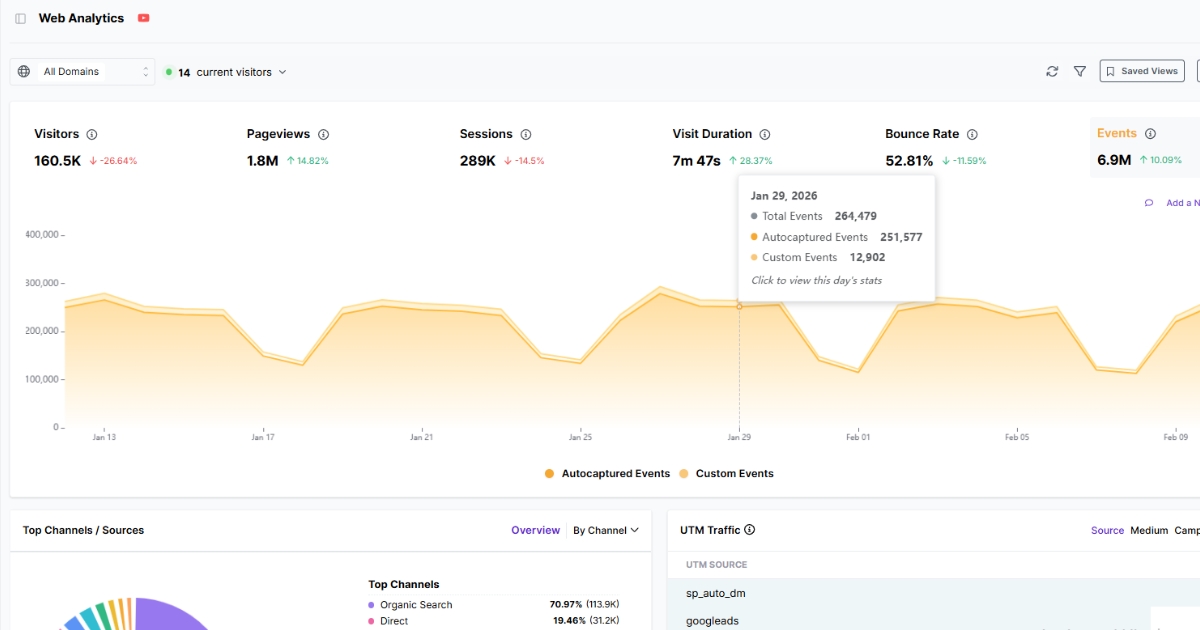
Usermaven is an AI marketing attribution platform that connects website events, product engagement, conversion paths, campaign spend, and CRM outcomes. It is designed for teams judging traffic by customers and revenue, not only by clicks or signups.
Its product analytics layer extends those questions into activation, feature adoption, and retention. This is useful when a channel that brings fewer leads actually generates better customers.
All three vendors support event collection and offer controls for implementation. No analytics product can guarantee complete coverage, bypass every blocker, or make a deployment compliant with privacy laws automatically.
Usermaven supports cookieless collection, first-party/server-side approaches, and optional pixel white-labeling. For other technical choices, the original guide to tools for server-side tracking remains a useful reference.
A cookieless tracking option changes collection mechanics, but consent and data minimization still require review. Server-side tracking may address specific browser collection gaps.
Heap uses autocapture plus definable events and historical behavioral analysis. Mixpanel supports autocapture, SDK/server-side collection, defined events, and data governance controls. Configuration and consent requirements vary by implementation.
A fair tracking comparison
Question
Heap
Mixpanel
Usermaven
Can common interactions be captured automatically?
Yes
Yes
Yes
Can teams define important business events?
Yes
Yes
Yes
Is privacy compliance automatic?
No; customer configuration matters
No; customer configuration matters
No; customer configuration matters
Can server-side or other ingestion reduce blind spots?
Integration and implementation dependent
SDK/API and server-side options
Server-side events and optional pixel white-labeling
Is unlimited history guaranteed on every plan?
No; plan-based history
Plan/contract dependent
No; Enterprise offers unlimited history
Are marketing-to-CRM validation checks the main focus?
Not primary product emphasis
Not primary product emphasis
Dedicated measurement workflow
Before comparing reporting accuracy, verify event definitions, identity stitching, UTM tagging, consent behavior, and CRM synchronization. For Usermaven workspaces, the Measurement Trust Center helps diagnose key measurement gaps.
Implementation and event tracking
Heap is optimized for exploratory autocapture. Mixpanel combines automatic collection with explicit instrumentation for analysis and experiments. Usermaven automatically captures common actions while supporting custom conversion and lifecycle events.
A documented event tracking plan is still essential, even when a platform automatically captures clicks, pageviews, and other common interactions.
None of these approaches removes the need to define what counts as a qualified lead, activated user, paying customer, or retained account. Automatic collection is a starting point; metric governance is what makes reports comparable.
Setup question
Heap
Mixpanel
Usermaven
Starting point
Autocapture plus event definitions
Autocapture, APIs, defined events
Autocapture plus goals and custom events
Historical behavioral discovery
Core strength
Depends on captured events/properties
Behavior and user journeys from tracked events
Experiments and feature flags
Not the central platform suite
Native product offering
Not a primary offering
Marketing and CRM setup
Integrations and custom workflows
Campaign and data integrations
Ad/CRM integrations and revenue goals
Typical owner
Product analyst
Product/growth team
Marketing, growth, and product
Attribution: the biggest buying distinction
Heap captures initial and session-level campaign UTMs, enabling first- and last-touch source analysis. Teams can also build multi-touch source queries from Heap data. It is inaccurate to say Heap has no attribution capabilities.
Mixpanel supports campaign analysis and multi-touch attribution. However, access and depth should be evaluated in its applicable plan, and a buyer should verify how ad cost, CRM stages, and booked revenue enter the final model.
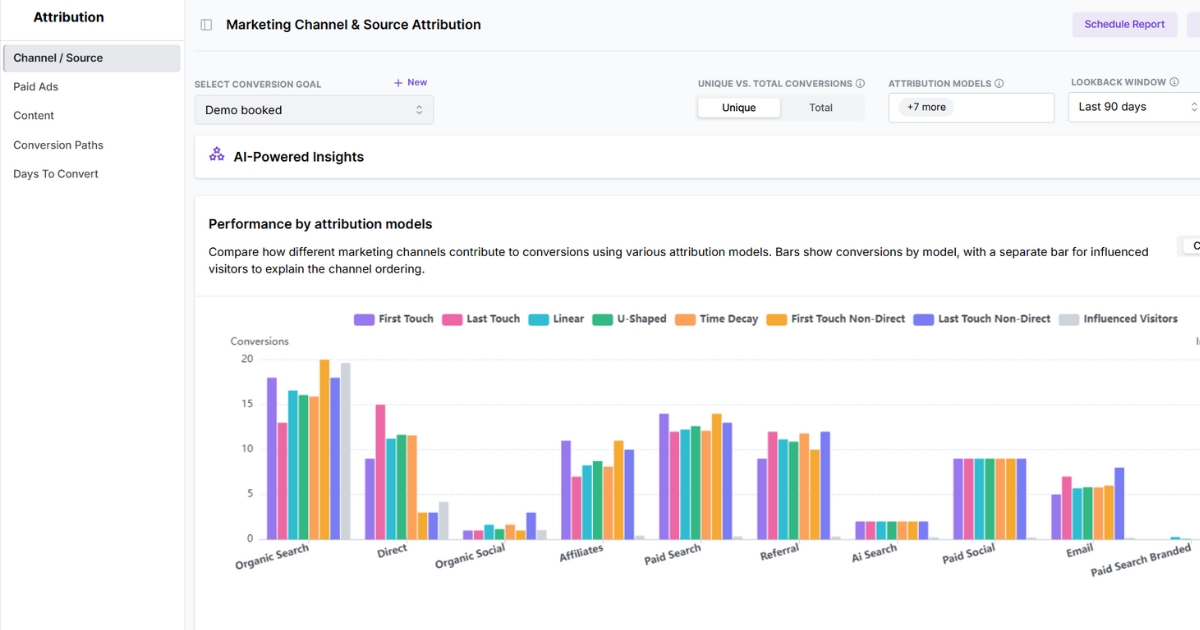
Usermaven specializes in multi-touch attribution with channel, paid-ad, source, content, journey, and CRM outcome reporting. Its Salesforce integration can connect contacts and opportunities with pre-conversion marketing activity.
Usermaven also offers Enterprise custom attribution models with weighted journey stages and channel multipliers. This is a different use case from simply reading the UTM source of a conversion session.
Attribution question
Heap
Mixpanel
Usermaven
Where did the visitor come from?
Captured UTMs/referrers
Campaign reports
Sources, channels, campaigns
Which touches deserve credit?
First/last touch; deeper queries possible
Multi-touch attribution available
Standard multi-touch models; Enterprise custom
What happened after signup?
Product events and retention
Product funnels and cohorts
Product activation and retention
Which spend produced CRM pipeline/revenue?
Usually requires connected modeling
Validate data/integration workflow
Native marketing-to-CRM attribution focus
Can alternative model totals be added?
No
No
No
For longer sales cycles, check the attribution window and whether the platform can show conversion paths across the relevant lookback period.
Avoid double-counting attribution revenue
Suppose a campaign generated $40,000 in closed revenue. A first-touch model may credit $40,000 to one channel while a linear model splits that same $40,000 across several channels.
Do not add the model totals together. They are alternative explanations of the same underlying revenue, not separate amounts earned. Compare the channel distribution and explain which model was used.
Funnels, journeys, and retention
Heap and Mixpanel both provide substantial funnel analysis, not basic or manual-only reporting. Heap combines event discovery with journeys; Mixpanel offers detailed step conversion, cohorts, retention, and experimentation.
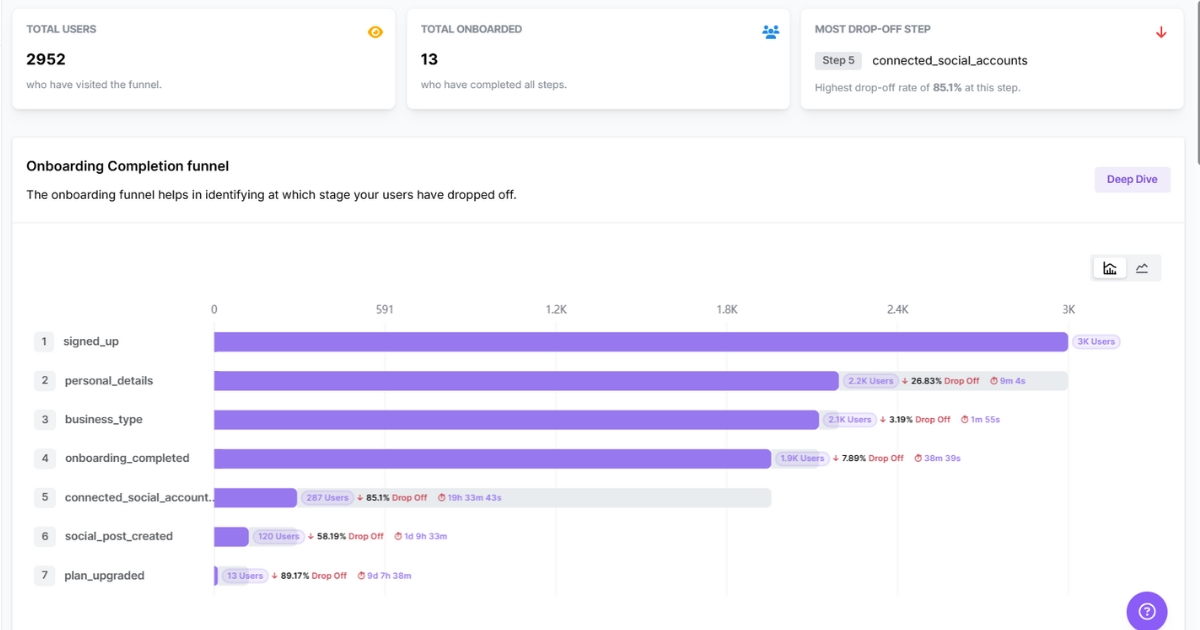
Usermaven funnels connect drop-offs with source and campaign context. Teams can investigate whether expensive paid traffic activates, converts, and retains differently from organic or partner-acquired users.
For PLG teams, a practical funnel is: ad or landing page → signup → first key action → activation → paid account. Choose an analytics tool that preserves usable identities and event definitions across those stages.
The most actionable analysis separates a drop-off rate from its cause and uses customer journey mapping to study earlier touchpoints that may have influenced it.
AI capabilities are real across all three
Heap provides Contentsquare Sense on Growth and higher plans. It helps users explore behavioral analysis with an assistant, rather than requiring every question to begin with a manually built chart.
Mixpanel Agent supports natural-language product analysis, and Mixpanel documents an MCP server. Its AI and experimentation stack should be compared on the specific questions and plan allowances a team needs.
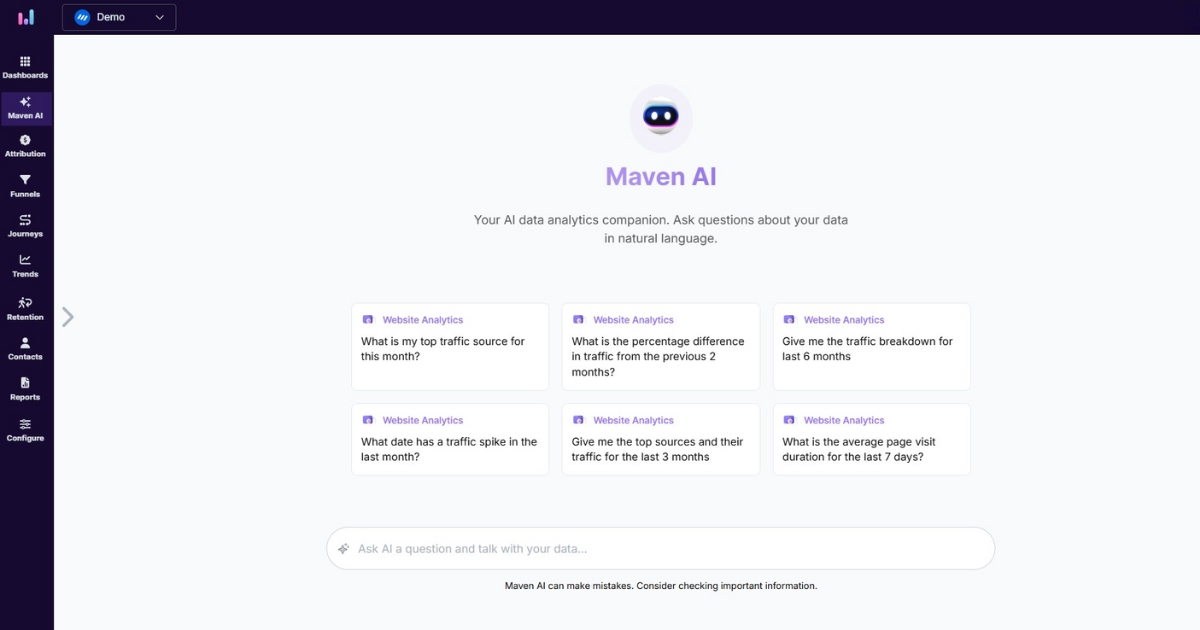
Usermaven Maven AI can answer questions across traffic, attribution, funnels, product activity, retention, and revenue. Its September 2026 Agents release adds scheduled monitoring for adoption, drop-offs, and slipping accounts.
Usermaven also offers MCP connectivity for compatible AI clients. Authorized analytics can be queried from those tools, and supported write actions require approval. These features do not mean competitors lack AI.
AI use case
Heap Sense
Mixpanel Agent
Usermaven Maven AI
Explore autocaptured product behavior
Strong fit
Supported analysis
Supported in tracked data
Investigate product metrics and experiments
Product analysis focus
Strong fit
Product metrics; no native experiment suite
Ask about paid media and CRM revenue
Depends on data setup
Depends on connected data
Core analytics and attribution focus
Run scheduled product-adoption analysis
Verify plan/workflow
Verify plan/workflow
Maven AI Agents
Connect external AI clients
Check integrations
MCP offered
MCP offered
Pricing: events vs. sessions vs. custom quotes
The three billing models are not directly comparable. An event-heavy app may fit a session-based plan differently from a high-traffic website, while an attribution-oriented business needs to price its CRM and ad integrations as well.
Platform
Current publicly described plans
Cost driver and caution
Heap
Free, Growth, Pro, Premier
Free up to 10,000 sessions/month; paid session pricing and entitlements vary
Mixpanel
Free, Growth, Enterprise
Free up to 1 million events/month; Growth starts at $0 and scales with use
Usermaven
Business, Enterprise
Custom quote; no fixed public starting rate for new customers
A complete purchase decision should test event-volume assumptions against Mixpanel pricing and session usage against Heap pricing, not compare a single advertised starting figure.
Heap’s free tier includes six months of data history, with longer history on higher tiers. Mixpanel bundles different limits for analytics events, session replay, experiments, and feature flags.
Usermaven’s current pricing includes Business and Enterprise. Legacy Growth pricing, blanket annual discount figures, and universal unlimited retention should not be used to describe new-customer plans.
Guided setup, white-label reporting, and additional workspaces may be quoted as Usermaven add-ons. A fair comparison includes implementation, support, integrations, data volume, retention, and administration.
Where revenue measurement changes the decision
Customer evidence: SecurityHive
SecurityHive used Usermaven to connect website activity with product engagement, so it could judge advertising quality against downstream behavior. This case is more relevant to acquisition-to-activation questions than a general software review.
The SecurityHive case study reports 17% lower wasted ad spend and 50% less analysis time. These are that customer’s reported results, not guaranteed outcomes or independently controlled estimates.
SecurityHive also illustrates why feature usage analysis matters: a paid campaign can appear efficient at signup but underperform once product adoption is measured.
A worked measurement example
Imagine paid search produces 200 signups and 30 activated users, while partner traffic produces 100 signups and 35 activated users. The signup ranking favors paid search; the activation rate tells a different story.
Illustrative channel
Signups
Activated users
Activation rate
Paid search
200
30
15%
Partners
100
35
35%
The numbers above are hypothetical. To choose a budget, continue the comparison to qualified opportunities, paying customers, revenue, and acquisition cost rather than stopping at the activation rate.
Five checks before trusting the comparison
Run the same basic measurement audit in whichever tool you test. Otherwise, a feature comparison may simply reflect inconsistent setup or missing CRM records.
1. Source definitions: standardize UTMs, channel groupings, campaign names, and treatment of direct or missing referrers.
2. Events and goals: define signup, activation, opportunity, purchase, and retention events; test the same definitions in each platform.
3. Identity continuity: confirm anonymous visits connect to known users or companies without inappropriate joins or duplicate conversions.
4. Costs and CRM joins: check ad-spend imports, Salesforce/HubSpot stages, currency, revenue timing, and data freshness.
5. Attribution validation: compare source-level totals to the system of record, then compare models without summing alternative credit allocations.
This is also a useful evaluation agenda for B2B SaaS teams whose marketing performance looks different after product activation and pipeline quality are considered.
Which platform should each team choose?
Team or requirement
Likely better fit
Why
Product team exploring unknown historical behavior
Heap
Autocapture and retroactive discovery are central
PLG team experimenting with features
Mixpanel
Rich analytics, feature flags, and experimentation
Growth team connecting campaigns with closed revenue
Usermaven
Marketing attribution plus CRM and product outcomes
Agency reporting on client acquisition and ROI
Usermaven
Cross-channel attribution and optional white-label reporting
Team whose primary need is replay
Compare Heap add-ons and Mixpanel replay
Replay is not Usermaven’s defining capability
Large enterprise with custom data requirements
Evaluate all three
Match deployment, integration, permissions, and contract
For marketing agencies, prioritize repeatable client reporting and how spend maps to revenue. For product-led companies, prioritize experimentation, retention, and event-level exploration before choosing by price.
Final verdict: match the tool to the revenue question
Heap excels when retroactive product behavior discovery is the priority. Mixpanel excels when event analysis, experiments, and feature optimization drive decisions. Both also offer analytics features older comparisons often overlook.
Usermaven is more directly aligned with marketing teams that need campaign performance, website and product behavior, CRM opportunities, and revenue in the same measurement workflow.
To assess that end-to-end setup, book a demo and review attribution, funnel definitions, CRM connections, and data-quality checks for your actual business model.
FAQs
What makes Usermaven different from Heap and Mixpanel?
Usermaven emphasizes marketing attribution connected with product behavior, CRM opportunities, and revenue. Heap centers on autocaptured product behavior; Mixpanel centers on product analytics and experimentation. All three can track events and funnels.
How do these analytics platforms handle privacy and data quality?
All three provide tracking and privacy controls, but legal compliance and data coverage depend on implementation. Usermaven offers a cookieless option, server-side events, and a Measurement Trust Center; none guarantees perfectly complete data.
Can Usermaven handle multi-touch attribution?
Yes. Usermaven supports standard multi-touch attribution across marketing channels, campaigns, and content, with CRM outcome context. Enterprise workspaces can use custom weighted attribution models and channel multipliers.
Does Mixpanel require manual event tracking?
No. Mixpanel offers autocapture alongside explicitly defined events. Teams still need a measurement plan so events, conversions, and retention metrics remain consistent.
How does current Heap, Mixpanel, and Usermaven pricing compare?
Heap has a free tier up to 10,000 monthly sessions and paid Growth, Pro, and Premier plans. Mixpanel offers a free tier up to 1 million events monthly and usage-based Growth. Usermaven offers quote-based Business and Enterprise plans.
Do all three tools provide AI-powered analysis?
Yes. Heap offers Contentsquare Sense on eligible plans, Mixpanel offers Mixpanel Agent, and Usermaven offers Maven AI, scheduled Agents, and MCP connections. Their strengths differ by the data and workflows analyzed.
Which platform is best for a product team?
Heap is attractive for retroactive event discovery, while Mixpanel is a strong choice for deep product analytics, experiments, and feature flags. Usermaven fits product teams that must connect product adoption to acquisition and revenue.
Does Heap support marketing attribution?
Heap captures referrers and UTM information and supports first- and last-touch analysis, as well as deeper queries using exported or connected data. This is different from a dedicated marketing-to-CRM revenue attribution workflow.
Can attribution model revenues be added together?
No. First-touch, last-touch, and multi-touch models provide alternative distributions of credit for the same conversions. Adding those reported revenue totals together would double-count business outcomes.