A blog post can introduce a buyer to your brand without ever being the page where they convert. A case study may move an opportunity forward weeks later, while another channel eventually receives the final click.
Content attribution closes that gap. With the right marketing attribution software, teams can connect content interactions with conversions, pipeline, and revenue instead of judging performance only by traffic or engagement.
This guide explains how content attribution works, which models to use, what to track, where attribution breaks down, and how to connect content with meaningful business outcomes.
Key takeaways
- Content attribution connects content with outcomes: It identifies which articles, landing pages, case studies, webinars, and other assets participate in journeys that convert.
- Tracking comes before modeling: Attribution cannot repair missing URLs, inconsistent campaign data, disconnected identities, or incomplete conversion events.
- Different models answer different questions: First-touch helps explain discovery, last-touch shows closing influence, while multi-touch models reveal more of the journey between them.
- Traffic is not content ROI: Strong attribution connects content engagement with signups, qualified leads, opportunities, purchases, pipeline, or revenue.
- No attribution report is absolute truth: Results depend on tracking quality, the selected conversion, attribution window, identity continuity, and model.
What is content attribution?
In marketing, content attribution is the process of identifying and assigning credit to the content assets that contribute to a conversion or other business outcome.
The measured content can include blog posts, landing pages, comparison pages, case studies, guides, webinars, videos, reports, emails, documentation, or any other trackable asset a prospect interacts with.
Imagine someone discovers your company through an educational article. They later return through organic search, read a comparison page, open a case study, and eventually request a demo.
Basic conversion tracking tells you that the demo happened. Content attribution investigates which content helped the journey reach that point.
The distinction matters because the page that generates the conversion is not always the content that created awareness, reduced uncertainty, or helped the buyer evaluate the product.
Content marketing attribution moves measurement beyond “How many people viewed this article?” toward “Which content starts valuable journeys?” and “Which assets repeatedly assist conversions?”
How does content attribution work?
Content attribution records content interactions, connects them across the customer journey, identifies a conversion, and applies an attribution rule to determine which eligible content receives credit.

The process sounds simple, but several measurement layers have to work together.
1. Record the content interaction
The measurement system first needs to know which page or asset a visitor consumed. For website content, the URL is usually the basic unit.
Useful reporting can also classify content by type, topic, campaign, author, funnel stage, or product category.
2. Preserve the journey
Buyers rarely consume every asset in one session. They can leave, return through another source, switch devices, subscribe to email, become an identified lead, and continue researching later.
Reliable attribution needs enough journey context to connect meaningful customer journey touchpoints instead of treating every visit as unrelated.
3. Define the outcome
Attribution needs something to attribute. Depending on the business, that may be a signup, booked demo, qualified lead, purchase, opportunity, customer, or revenue event.
This definition changes the analysis. Content that performs well before newsletter signups may not be the same content that appears in journeys ending in qualified pipeline.
4. Apply an attribution model
The model decides how conversion credit is distributed among eligible content interactions. First touch may credit the discovery article, while last touch may credit a comparison page read shortly before conversion.
5. Analyze the result
Once credit has been assigned, marketers can compare pages, topics, formats, campaigns, and stages of the journey.
The purpose is not merely to produce another dashboard. It is to make better decisions about what to create, update, distribute, and promote.
How content becomes attributable
| Stage | What is captured | Example |
|---|---|---|
| Content interaction | Page or asset engagement | Visitor reads an SEO guide |
| Journey data | Sessions, sources, identities, return visits | Visitor returns through email |
| Conversion | The outcome being measured | Demo request |
| Attribution model | Rule for assigning credit | First-touch, last-touch, linear |
| Attributed result | Content credited with the outcome | Guide receives conversion credit |
| Decision | How the insight changes strategy | Update, distribute, or scale the guide |
Content attribution vs. marketing attribution
Content attribution and marketing attribution overlap, but they answer different levels of the same measurement problem.
Marketing attribution usually asks which channels, sources, campaigns, or ads contributed to an outcome. Content attribution goes one level deeper and asks which individual assets within those journeys mattered.
Marketing attribution may show that organic search and email contributed to a signup. Content attribution can show that the visitor read a product article, comparison page, and case study before signing up.
This asset-level view complements content analytics, which explains pageviews, engagement, entrances, exits, and other behavior without necessarily assigning conversion credit.
Content attribution vs. marketing attribution
| Aspect | Content attribution | Marketing attribution |
|---|---|---|
| Main focus | Individual content assets | Channels, sources, campaigns, and ads |
| Typical units | Articles, pages, case studies, webinars, guides | Organic search, paid search, paid social, email, referral |
| Main question | Which content contributed to the outcome? | Which marketing source or campaign contributed? |
| Useful for | Editorial planning, content optimization, content ROI | Channel optimization and budget allocation |
| Example | Comparison page assisted the demo | Organic search assisted the demo |
Why content attribution matters
Content teams have traditionally had plenty of activity metrics but fewer reliable ways to connect those metrics with commercial results.
Traffic shows that an article attracts attention. Engagement shows that people interact with it. Rankings show that search engines surface it.
None of those metrics independently shows whether the content participated in a journey that produced a customer.
This measurement gap is one reason Content Marketing Institute’s B2B research remains relevant to content measurement.
Teams often need to reconcile performance data spread across different systems and stages of the funnel.
Content attribution adds several useful decision layers.
- Discovery: Identify content that starts converting journeys, not merely pages with the most entrances.
- Assistance: Find assets that rarely close conversions but repeatedly appear in successful journeys.
- Conversion support: See which content is consumed close to signups, demos, purchases, or other goals.
- Resource allocation: Prioritize updates and promotion around content that contributes to meaningful outcomes.
- Portfolio planning: Compare topics and formats by their role in the journey rather than pageviews alone.
The goal is not to declare one article responsible for a sale. It is to understand where content participates in measurable customer journeys and make better decisions with that evidence.
Which content attribution model should you use?
A content marketing attribution model is the rule used to decide how eligible content receives conversion credit.
There is no universally correct model. The right choice depends on the question you are trying to answer.
For a broader explanation, review the main marketing attribution models and how their credit rules differ.
Content attribution models compared
| Model | Best question | Main limitation |
|---|---|---|
| First touch | Which content starts converting journeys? | Ignores later influence |
| Last touch | Which content appears closest to conversion? | Ignores earlier discovery and nurturing |
| Second last touch | Which interaction helped immediately before the final touch? | Still focuses on one position |
| Linear | Which content participated throughout the journey? | Treats eligible touches equally |
| U-shaped | Which content helped both discovery and conversion? | Can undervalue middle touches |
| Time decay | Which content had more recent influence? | Can discount important early content |
Use first touch for discovery questions
First-click attribution is useful when the question is acquisition-oriented: which article, guide, landing page, or other asset first brought a future converter into the measurable journey?
It can be especially useful for SEO and educational content. However, first-touch credit should not be interpreted as proof that the first page alone created the conversion.
Use last touch for closing influence
Last-click attribution answers a different question. It identifies the eligible content interaction that happened nearest to the selected conversion.
This can surface pricing explainers, comparison pages, implementation guides, and proof content that help people take action.
The limitation is that it can systematically understate the content that created and nurtured demand earlier.
That weakness is not new. In one industry survey cited in the original version of this guide, only 21.5% of marketers said last-click reasonably reflected long-term platform impact.
Use multi-touch for longer journeys
When buyers consume several assets before converting, multi-touch attribution provides more context than assigning everything to one interaction.
A linear attribution model distributes credit evenly across eligible interactions, giving every participating touchpoint visibility.
A U-shaped attribution model emphasizes discovery and conversion, while still recognizing interactions that happened between them.
A time-decay attribution model gives more weight to interactions that occur closer to conversion.
These models are useful for different questions. They should not be treated as interchangeable versions of the same answer.
Match the attribution window to the journey
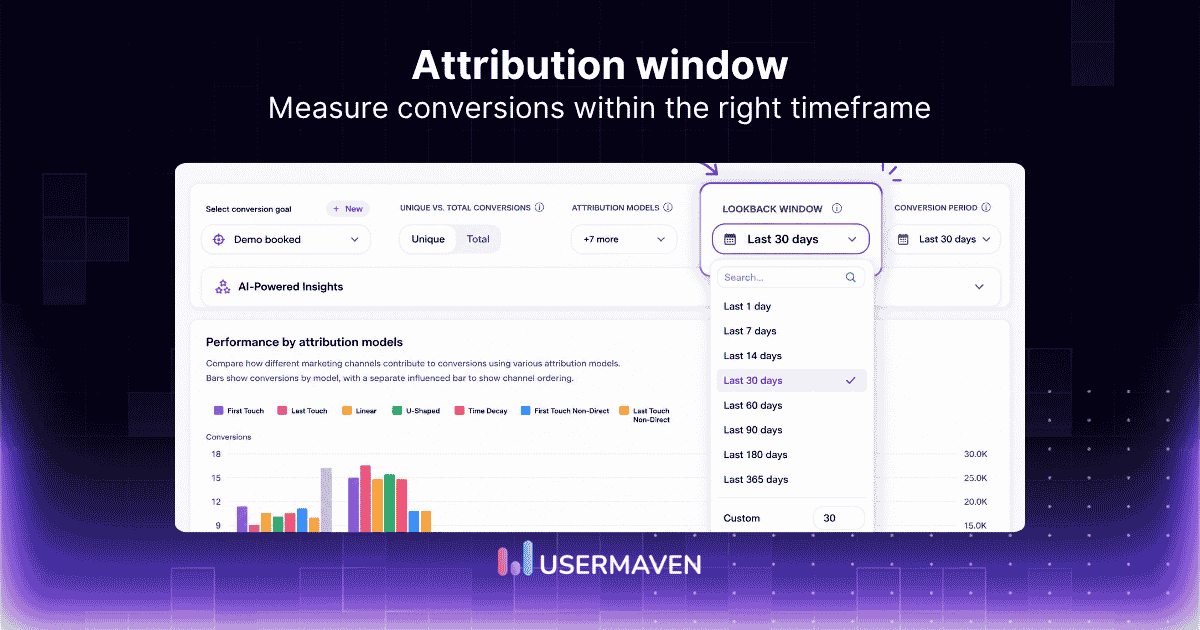
The model is only one decision. Your attribution window determines how far back an interaction can remain eligible for credit.
A short window can exclude early content from long buying cycles. An overly broad window can keep old interactions eligible long after they remain useful to the analysis.
What content should you attribute?
Content attribution becomes more useful when “content” is defined broadly enough to represent the real buying journey.
For many teams, the measurable content portfolio includes:
- Educational blog posts and search content
- Product and feature pages
- Comparison and alternative pages
- Case studies and customer stories
- Reports, ebooks, templates, and downloadable guides
- Webinar and event pages
- Documentation, tutorials, and implementation resources
- Email and campaign landing pages
The useful question is not whether an asset belongs to editorial or product marketing. It is whether the asset can materially influence the journey you are trying to understand.
Mapping assets to the content marketing funnel can also clarify whether a page primarily supports awareness, evaluation, objection handling, or conversion.
Without that context, marketers can make the wrong comparison. A high-volume educational article and a low-volume enterprise case study may play completely different roles while both being valuable.
How to measure content attribution
A reliable setup starts with measurement architecture, not with the attribution-model dropdown.

Step 1: Standardize content and campaign data
Keep URLs clean, establish consistent campaign naming, and use structured UTM parameters for distributed content and campaigns.
If the same campaign is labeled several different ways, reporting fragments before attribution begins.
Step 2: Track meaningful interactions
A pageview may establish that someone visited an article, but other content experiences need more context.
Video plays, downloads, webinar registrations, CTA clicks, form submissions, and product actions may require reliable event tracking.
Track interactions that help explain progression without turning every trivial action into a conversion.
Step 3: Preserve source and identity context
The same person may first arrive anonymously and become known only after signing up or submitting a form.
They may also return through several sources before that happens. Good lead source tracking should therefore complement journey-level attribution rather than replace it.
Step 4: Define the conversion that matters
Do not assume every report should optimize for the same outcome.
A content team may need different conversion goals for newsletter subscriptions, product signups, demo requests, qualified opportunities, purchases, and revenue.
The further the outcome sits from the initial visit, the more important journey continuity becomes.
Step 5: Compare more than one attribution view
A single model can create false certainty. Compare discovery, closing, and multi-touch perspectives before deciding that one content asset is a winner or a failure.
This is especially useful when a strategy spans both high-volume acquisition content and lower-volume decision-stage assets.
Step 6: Audit real journeys
Aggregate reporting can hide broken tracking. Select several real conversions and inspect the sequence of sources, pages, sessions, and conversion events behind them.
If the journey does not make sense at the customer level, changing the attribution model will not fix the underlying data.
Content attribution metrics that matter
The most useful content attribution report combines several metrics rather than reducing performance to one score.
- Sourced conversions: Conversions where a content asset receives discovery-stage credit.
- Assisted conversions: Conversions where content participated without being the only credited touch.
- Attributed conversions: Conversion credit assigned to a page under the selected model.
- Conversion rate: Shows how frequently visitors exposed to a content experience take the selected action when the denominator is defined consistently.
- Pipeline influenced: Useful for B2B content when the website conversion is only an early stage of the sale.
- Attributed revenue: Connects content influence with monetary outcomes instead of stopping at lead volume.
- Time to conversion: Helps show whether certain assets commonly appear early or late in longer journeys.
A conversion path analysis adds useful sequence context to these metrics.
Revenue attribution becomes especially important when the business needs to connect content influence with commercial value.
A consistent content marketing dashboard can bring these measures together without rebuilding definitions every time performance is reviewed.
Content attribution challenges in 2026
Attribution becomes harder as customer journeys become less observable. Identity gaps, private sharing, and cookieless attribution constraints can all reduce what the measurement system sees.
The model receives most of the attention, but attribution gaps usually begin much earlier.
Zero-click discovery
Prospects can encounter ideas in search summaries, social feeds, communities, newsletters, videos, and AI-generated answers without generating a trackable website visit.
If they later arrive directly or through branded search, the measurable journey may start well after the real discovery happened.
When the visit is measurable, Usermaven’s AI traffic dashboard can help separate traffic arriving from AI assistants and other AI-driven sources from broader referral activity. It cannot recover zero-click exposure that never produced a visit, but it gives teams a clearer view of the AI traffic that does reach the site.
Dark social and private sharing
A useful article can be copied into Slack, WhatsApp, Teams, email, private communities, or direct messages.
The recipient may arrive without the original sharing context, causing that influence to appear as direct or unattributed traffic.
Cross-session and cross-device journeys
A prospect might discover an article on mobile, return on a work laptop, register later, and finally convert after being identified.
Every break in continuity creates a chance for early content influence to disappear from the measurable journey.
Long sales cycles
Content can influence a buyer weeks or months before the commercial outcome.
Short attribution windows can systematically favor late-stage pages simply because earlier interactions have aged out.
Multiple stakeholders
B2B attribution becomes harder when several people from the same company research the product.
One person may discover the brand, another attends a webinar, and another submits the final demo request.
Offline influence
Sales conversations, events, calls, recommendations, and internal buyer discussions can influence the outcome without producing another trackable content interaction.
Model bias
Attribution models do not discover an objective truth hidden inside the data. They apply a rule to the interactions that were recorded.
Two legitimate models can therefore produce different rankings of the same content library without either report being technically broken.
Content attribution best practices
- Define the business outcome first. Decide whether the report should explain a signup, lead, demo, purchase, opportunity, customer, or revenue outcome.
- Separate content performance from attribution. Pageviews, engagement, and rankings explain consumption. Attribution explains participation in converting journeys.
- Keep naming consistent. URLs, content categories, campaigns, sources, and conversion definitions should not change arbitrarily between teams.
- Compare attribution models. Use first-touch, last-touch, and multi-touch views for different questions instead of treating one model as permanent truth.
- Match the window to the buying cycle. Early content needs enough time to remain visible in longer consideration periods.
- Inspect assisted content. Mid-journey assets can be valuable precisely because they help buyers progress rather than start or finish the journey.
- Audit tagging regularly. Broken tracking can create larger errors than the choice between two models. Review Common UTM mistakes to avoid when campaign data becomes difficult to reconcile.
- Use attribution as evidence, not causality. A credited interaction participated in the measurable journey. That does not prove the conversion would not have happened without it.
Most importantly, use attribution to improve your content marketing strategy, not merely to produce a leaderboard of pages.
The useful output is a better editorial, distribution, and optimization decision.
How AI helps with content attribution
AI-driven marketing attribution can make analysis faster when teams have more pages, campaigns, journeys, and conversions than they can reasonably inspect manually.
Ask attribution questions in natural language
An AI analytics layer can help marketers investigate questions without manually building a new report every time.
For example, teams can ask which articles frequently appear before conversions, which pages behave differently under first-touch and last-touch models, or which assets gained attributed conversions this month.
When an AI-generated journey, funnel, or retention view reveals something worth monitoring, Usermaven can save that preview as a reusable report so the analysis does not have to remain a one-off conversation.
Maven AI makes this type of conversational exploration more accessible without requiring every follow-up question to depend on a manually configured dashboard.
For teams that want the same analytics context inside compatible AI clients and workflows, Usermaven MCP provides a permission-aware connection to Usermaven data and analytics actions. This makes it possible to investigate attribution questions from approved AI environments without rebuilding the analysis from scratch.
Detect patterns across journeys
Pattern detection can surface repeated combinations that are difficult to notice one customer at a time.
For example, several high-value journeys may contain the same comparison page even though that page rarely receives last-touch credit.
Spot anomalies before they become conclusions
AI can also help identify sudden changes in conversion paths, unusual shifts in attributed pages, or performance patterns that deserve investigation.
An anomaly is a prompt to investigate, not an explanation. Tracking changes, campaign launches, seasonality, broken URLs, or conversion-definition changes can all produce unusual results.
Human judgment still decides what the data means
AI cannot recover interactions that were never recorded or decide which business objective should matter most.
It also should not turn correlation inside an attribution report into a causal claim.
Marketers still need to validate journeys, understand each asset’s purpose, compare models, and decide whether the evidence is strong enough to change strategy.
See Usermaven in action
Book a free demo and discover how powerful analytics can grow your business.
*No credit card required
How Usermaven tracks content impact
Usermaven brings page-level content performance into the same measurement environment as customer journeys and conversions.
This makes it easier to investigate content beyond traffic alone and see how individual pages participate in journeys that produce meaningful outcomes.
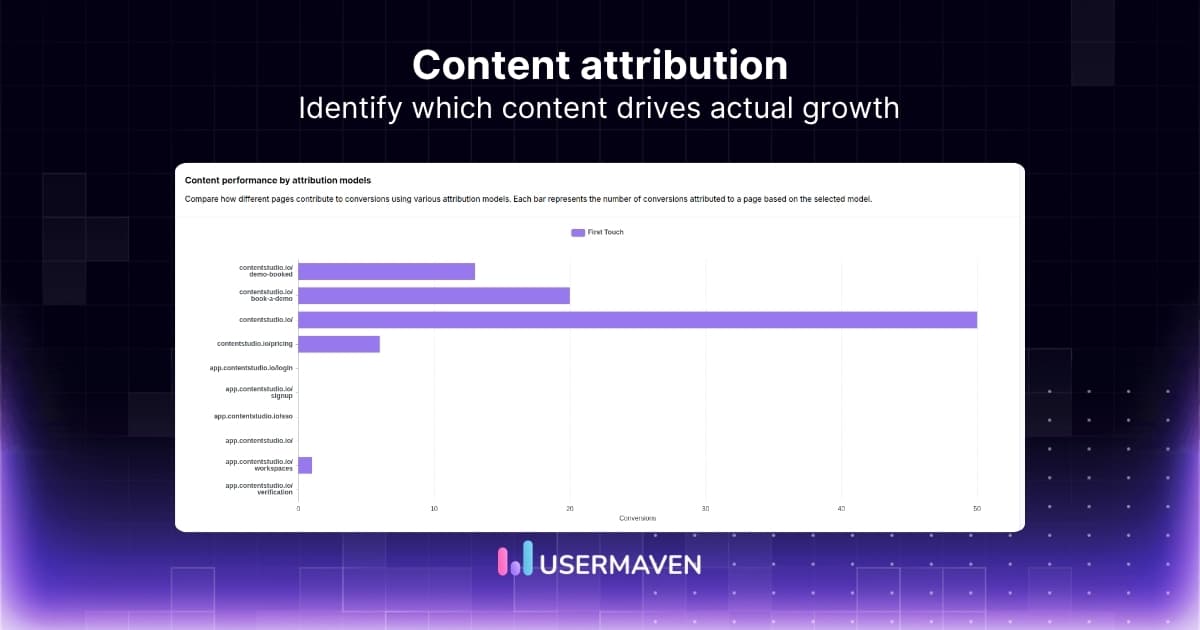
Its content attribution view lets marketers compare how different pages contribute to conversions under different attribution models.
The report can be filtered by channel and source, while the lookback window and conversion period can be adjusted to match the analysis.
The question therefore moves from “Which page had the most visits?” to “Which pages receive conversion credit when I examine discovery, closing, or multi-touch influence?”
For deeper investigation, customer journey analytics software can reveal the sequence behind the aggregate report.
Centralized analytics dashboards can then keep recurring performance views accessible to the wider team.
How content attribution works in Usermaven
The content library does not change between views, but the amount of conversion credit assigned to individual pages changes according to the selected attribution logic.
The report also includes channel and source filters, an attribution-model selector, a lookback window, and a conversion period.
This lets marketers change both the population being analyzed and the rule used to distribute conversion credit.
Compare content performance across models
The combined view places several models on the same report so differences are immediately visible.
In the example, some URLs receive much more credit under one model than another. A discovery page may appear less important under last touch, while a conversion-stage page can show the opposite pattern.

This comparison helps marketers investigate the role a page plays instead of reducing performance to one permanent attribution score.
First Touch: Find content that starts converting journeys
The First Touch view isolates pages credited with beginning the measurable journey.
In the sample report, the homepage and several other pages receive credit because they were the earliest eligible interaction for those conversions.

For content teams, this view is useful for identifying discovery assets.
If an educational article consistently receives first-touch credit, it may be doing more than generating traffic. It may be introducing future converters to the business.
Last Touch: Find content closest to conversion
The Last Touch view shifts attention to the final eligible page interaction before conversion.
In the example data, onboarding and verification-related pages receive substantially more credit than they did under First Touch.

This helps marketers identify content or pages associated with the final decision stage.
It can reveal assets that support action even when those pages generate little discovery traffic themselves.
Second Last Touch: See what influenced the final step
Second Last Touch moves one position back and surfaces the interaction immediately before the final eligible touch.
In the sample report, the registration page becomes especially prominent under this attribution view.

This perspective can expose late-stage assisting pages that disappear under pure last-touch reporting.
It is useful when comparison, proof, or educational content helps prepare a visitor for the final conversion step.
Linear: See content across the full journey
The Linear view spreads credit across eligible interactions rather than allowing one position to receive everything.

This view is useful when several assets genuinely participate in consideration and the team does not want discovery or closing to be the only important stage.
Its tradeoff is that a minor interaction can receive the same proportional treatment as a more influential one.
U-Shaped: Balance discovery and conversion influence
The U-Shaped view places greater emphasis on the beginning and end of the journey while still allowing intermediate interactions to receive some credit.
In the example report, both early and conversion-oriented pages remain visible instead of one end of the journey dominating completely.

This model can help when a team wants to give more weight to content that creates the relationship and content that helps complete the conversion.
Time Decay: Prioritize recent content interactions
The Time Decay view gives progressively more influence to interactions that occur closer to conversion.
Earlier content still participates in the journey, but recent pages carry more weight.

This perspective can be useful for longer journeys where marketers want to see which content became increasingly relevant as the customer approached conversion.
The tradeoff is that content responsible for the original discovery can appear less important because it happened much earlier.
The same content library can therefore tell different stories depending on the question being asked.
First Touch explains discovery. Last Touch explains proximity to conversion. Second Last Touch surfaces late-stage assistance, while Linear, U-Shaped, and Time Decay interpret multi-touch journeys differently.
Comparing these perspectives before reallocating resources can prevent teams from scaling or cutting content based on one narrow view of the journey.
Final thoughts
Content attribution gives marketers a stronger way to evaluate content by connecting interactions with customer journeys, meaningful conversions, and downstream outcomes.
The best analysis compares models rather than searching for one page that deserves all the credit. Discovery, assistance, and closing influence each tell a different part of the story.
Usermaven makes those differences visible across real content journeys. Start your free trial or book a demo to connect content performance with the conversions that matter to your business.
Unlock insights that drive growth
*No credit card required
FAQs
1. What is content marketing attribution?
Content marketing attribution connects content interactions with conversions or other measurable outcomes. It helps marketers understand which articles, pages, case studies, webinars, guides, and other assets participate in journeys that lead to signups, leads, purchases, customers, or revenue.
2. How does content attribution work?
Content attribution records content interactions, preserves eligible touchpoints across the customer journey, defines a conversion, and applies an attribution model. The model then determines whether the first touch, last touch, or several interactions receive conversion credit.
3. What is a content marketing attribution model?
A content marketing attribution model is the rule used to distribute conversion credit among eligible content interactions. First-touch credits discovery, last-touch focuses on the final eligible interaction, while linear, U-shaped, and time-decay models distribute credit across several touches in different ways.
4. How do you automate content source attribution?
Use consistent campaign naming, structured UTMs, reliable page and event tracking, preserved source information, clear conversion definitions, and enough identity continuity to connect return visits. Attribution software can then apply consistent credit rules to the recorded journey automatically.
5. What metrics should you use for content attribution?
Useful metrics include sourced conversions, assisted conversions, attributed conversions, conversion rate, pipeline influenced, attributed revenue, and time to conversion. The right metric depends on the business outcome the content program is expected to influence.
6. Can Usermaven track content attribution?
Yes. Usermaven can compare how individual pages contribute to conversions under different attribution models. Teams can filter by channel and source, adjust the lookback window and conversion period, and compare First Touch, Last Touch, Second Last Touch, Linear, U-Shaped, and Time Decay views.
Updated

Written by
Ryan Mitchell
Marketing Analytics Strategist
Ryan Mitchell is a marketing analytics strategist specializing in campaign measurement, customer journeys, and marketing performance. He writes about analytics, reporting, and data-driven marketing strategies, helping SaaS and B2B teams measure what matters across every stage of the customer journey.
All articles by Ryan →