Have you ever wondered how your favorite apps or websites manage to attract so many users?
The secret lies in a powerful marketing framework called the user acquisition funnel.
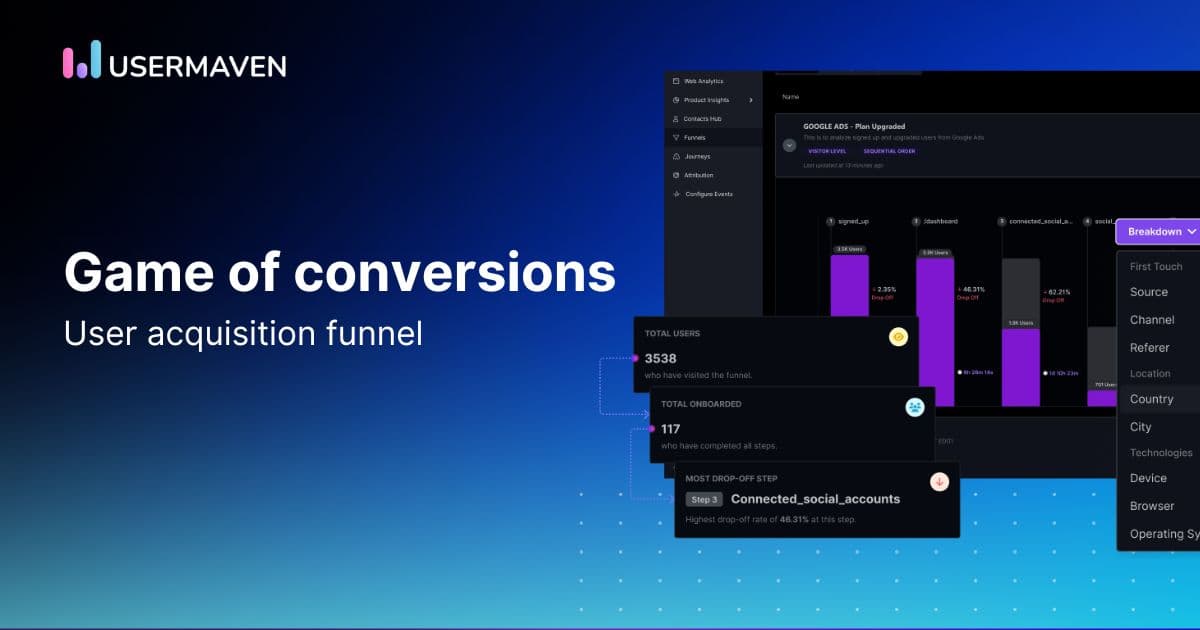
Whether you’re a seasoned marketer or just starting out, understanding the user acquisition funnel is crucial. It’s a framework that helps you visualize and optimize the path potential customers take from initial awareness to becoming loyal fans.
But wait, there’s more!
This journey isn’t a straight shot. It’s a dynamic process with four distinct phases, each requiring unique strategies and approaches.
So, get ready to dive into it;
Defining the user acquisition funnel
Are you looking to increase your app’s user base?
If so, then you’ll need to create a user acquisition funnel.
A user acquisition funnel is a process that helps you attract and convert new users. The process starts with awareness, where you make potential users aware of your app. Then, you move them through interest and consideration until they finally take action and download your app.
Related: A Guide to User & Customer Acquisition Funnel with Usermaven
Let’s figure out what the phases of the user acquisition funnel are.
4 phases of the user acquisition funnel
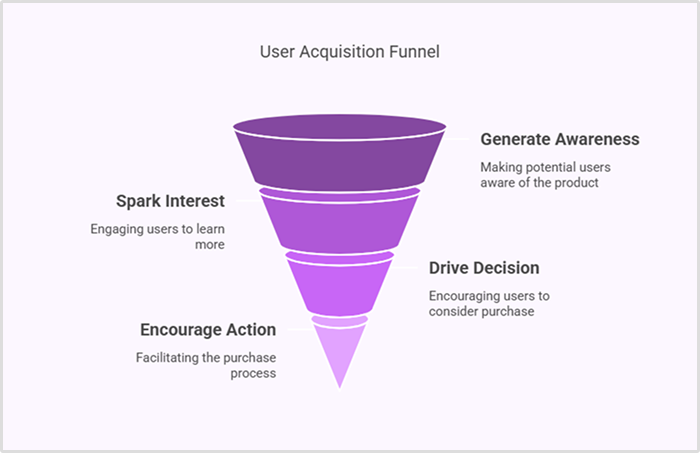
The user acquisition funnel is a marketing framework that describes the journey potential customers take from initial awareness of your product or service to becoming a paying customer. It’s typically divided into four main phases.
1. Awareness
This is where potential customers first learn about your brand and offering. This can happen through various channels like advertising, social media, content marketing, or public relations. The goal in this phase is to generate interest and get people curious about what you have to offer.
2. Interest
In this phase, potential customers who are aware of your brand start to learn more about it. They might visit your website, read your blog posts, watch your videos, or engage with your social media content. The goal here is to capture their attention and convince them that your product or service is worth considering.
This is also the point where content performance analytics can reveal which formats keep potential users engaged and which ones lose attention too early.
Also read: 12 Strategies to Increase Your Customer Engagement
3. Decision
Once potential customers are interested, they start to evaluate their options and compare different brands. They might research your competitors, read reviews, or compare features and prices. The goal in this phase is to position your offering smartly and address any concerns they might have.
4. Action
This is the final stage, where potential customers decide whether or not to purchase your product or service. The goal here is to make it easy for them to convert and provide a smooth buying experience.
By understanding these four phases, you can develop targeted marketing campaigns that address the specific needs and concerns of potential customers at each stage of the funnel. This can help you optimize your marketing efforts and increase your chances of converting leads into paying customers.
Here are some additional things to keep in mind about the user acquisition funnel:
- It’s not always a linear process. Customers may move back and forth between stages depending on their individual needs and circumstances.
- The length of each stage can vary depending on the product or service you’re offering and your target audience.
- As marketing attribution software, Usermaven helps teams track each stage of the funnel, understand what is working, and identify where acquisition efforts need improvement.
Turn visitors into paying
customers with funnel analysis
Strategies of user acquisition funnel
Here are a few user acquisition strategies to help your team get started with your sales funnels.
1. Make sure your app is visible to potential users
The first step in the customer acquisition process is getting your app out there. This may seem like a no-brainer, but it’s important to make sure your app is easy to find. Optimize your app store listing with keyword-rich descriptions and screenshots that show off your app’s best features.
2. Use targeted marketing campaigns
Once you’ve made your app visible, your sales reps need to start targeting potential users with marketing campaigns. Use social media, affiliate marketing, paid advertising, and other channels to reach your target audience. Leveraging PPC statistics can help fine-tune your paid advertising campaigns, enabling you to identify the most effective keywords, target demographics, and bidding strategies for optimal ROI.
3. Create a landing page
A landing page is a great way to capture leads and convert them into users. Include a strong call to action and make it easy for visitors to download your app.
4. Offer incentives
Incentives are an important part of the customer journey. They can be a great way to encourage users to download your app. Offer discounts, free trials, or other rewards to entice users to take action.
5. Provide excellent customer service
Once users have downloaded your app, it’s important to provide them with excellent customer service. As part of the customer journey, good CSM ensures that your customer base has a positive experience and continues using your app.
Creating a user acquisition funnel can be a complex process, but it’s essential if you want to increase your app’s customer base. By following these customer acquisition strategies, you can get started on the right track.
Now, let’s discuss some of the stages of the user acquisition funnel.
Also read: 12 Tips to Reduce Your Customer Churn Rate
Stages of the user acquisition funnel
The user acquisition funnel consists of several stages, including awareness, interest, decision-making, and post-purchase.
The stages of the user acquisition funnel can be summarized as follows:
- Top of the funnel (Awareness and Interest): Focuses on creating brand awareness and generating interest in the product or service through various marketing strategies such as advertising, SEO, social media, and content marketing.
- Middle of the funnel (Evaluation and Decision-Making): Involves the evaluation of customer pain points and the decision-making process to find the right product-market fit. It’s essential to understand the customer’s goals, pain points, budget constraints, target users, and ideal marketing channels during this stage.
- Bottom of the funnel (Purchase or Conversion): The final stage where the goal is to convert users into paying customers through a strong value proposition, strategic product positioning, and other conversion optimization strategies.
Post-purchase activities, including order confirmation, follow-up emails, and customer satisfaction, are essential for retaining customers and turning them into brand advocates. It’s important to provide a great post-purchase experience to increase customer satisfaction and encourage repeat purchases.
Related: 15 Customer Retention Metrics and 7 Ways To Boost Customer Retention
Understanding and optimizing the user acquisition funnel, including post-purchase activities, is crucial for businesses to effectively acquire and retain customers. By analyzing funnel metrics and customer behavior at each stage, businesses can improve their sales and marketing efforts and foster long-term customer relationships.
Essential elements of an effective customer acquisition strategy
As the world of online business has become more and more competitive, the importance of having an effective customer acquisition strategy has become more and more important.
There are a lot of different elements that go into acquisition tactics, but I believe that there are five essential elements that are absolutely necessary if you want to be successful.
1. Clear understanding of your target customer
If you don’t know who your target customer is, it will be very difficult to craft an effective customer acquisition strategy. You need to have a clear understanding of who your ideal customer is and what they are looking for. Once you have a good understanding of your target customer, you can start to craft a strategy that will appeal to them.
2. Solid value proposition
Your value proposition is what is going to convince your target customer to do business with you instead of your competitor. It’s important to have a strong value proposition that is clear and concise. You need to be able to communicate your value proposition in a way that will make your target customer want to do business with you.
3. Well-defined user acquisition funnel
Your user acquisition funnel is the process that you use to take a potential customer from being unaware of your product or service to becoming a paying customer. It’s important to have a well-defined user acquisition funnel so that you can track your progress and make necessary changes along the way.
4. Strong call to action
Your call to action is what is going to prompt your target customer to take the next step in your user acquisition funnel. It’s important to have a strong call to action that is clear and concise. You need to be able to communicate your call to action in a way that will make your target customer want to take action.
5. Robust test and measurement plan
It’s important to have a robust test and measurement plan in place so that you can track your progress and make necessary changes along the way. You need to be able to track your progress so that you can see what is working and what isn’t. Without a robust test and measurement plan, it will be difficult to make necessary changes to your customer acquisition strategy.
These are just a few of the essential elements of an effective customer acquisition strategy.
If you want to be successful in today’s competitive online world, it’s important to have a strong customer acquisition strategy in place.
Building and optimizing funnels in Usermaven
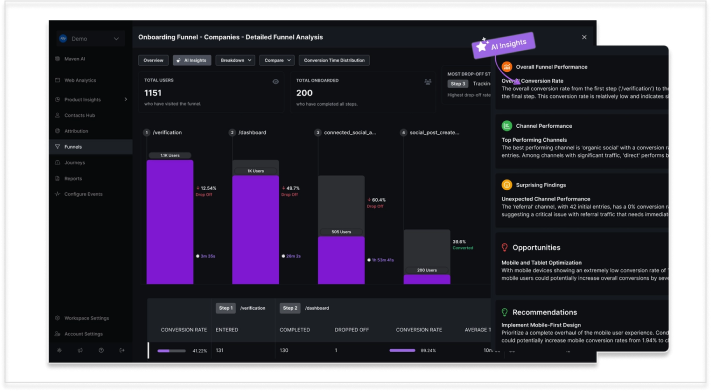
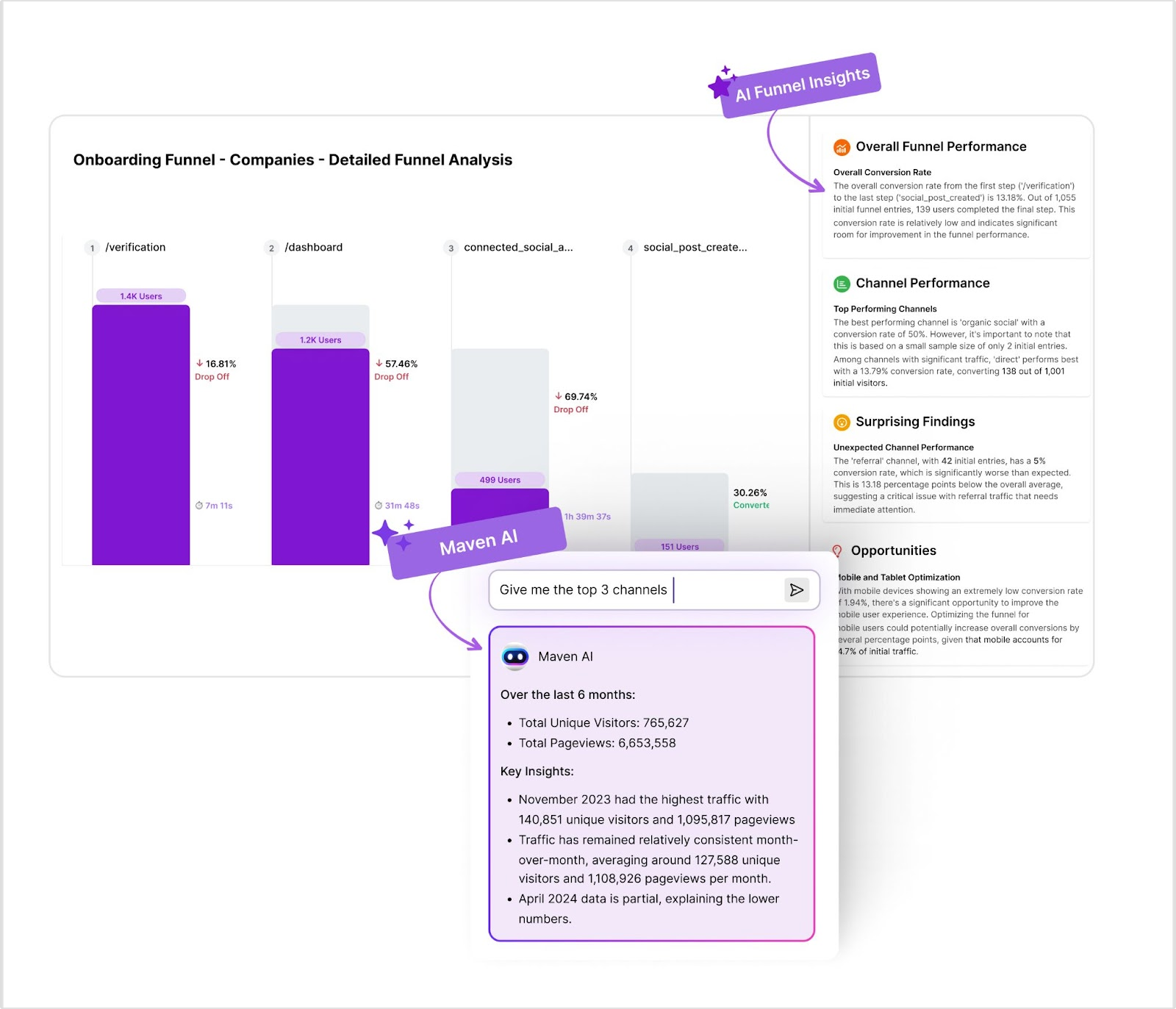
Start by accessing the “Analyze” section in Usermaven. Click on “Funnels” and create one by specifying a descriptive name and selecting your target audience – be it visitors, users, or companies.
Define your conversion goals, like sign-ups or purchases, and choose specific events as funnel steps. Set the order of these steps and the timeframe for completion.
Usermaven offers actionable insights:
- Understand where users drop off (absolute and relative).
- Dive deep into detailed views, analyzing time spent and traffic sources.
- Break down data by location, technology, and first touchpoint.
- Compare funnel performance over time or against campaigns.
- Utilize conversion time distribution for efficiency insights.
Related: How to Locate Users Based on Device Type in Usermaven
Easily share and collaborate on funnel analytics, rearrange steps, and apply filters for fine-tuning. This data-driven approach ensures optimized user acquisition and conversion strategies.
Turn visitors into paying
customers with funnel analysis
Conclusion
A user acquisition funnel is a powerful tool for understanding and optimizing how users discover, engage with, and ultimately convert into loyal customers for your app or website.
By understanding the distinct phases (awareness, interest, decision, action) and tailoring your strategies to each stage, you can significantly improve your acquisition efforts and achieve sustainable growth.
Usermaven further supports this process by providing funnel insights and optimization capabilities that help teams refine acquisition strategies and build long-term customer relationships.
Frequently asked questions
1. What is a user acquisition funnel?
A user acquisition funnel is a process that businesses use to identify and target potential customers. The funnel typically starts with awareness, moves on to interest and consideration, and ends with a purchase.
2. What is a user acquisition model?
A user acquisition model is a framework that businesses use to identify and track the various stages that a customer goes through when becoming aware of and then eventually adopting their product or service. The model helps businesses to understand better how customers interact with their brand and where they are in the journey from awareness to adoption.
3. What is a customer acquisition strategy?
A plan that businesses use to attract and gain new customers involves tactics to convert leads into paying customers.
4. What is acquisition marketing?
A subset of marketing focused on acquiring new customers through channels like digital advertising, content marketing, and social media campaigns.
Updated

Written by
Lauren Brooks
Lifecycle Marketing Strategist
Lauren Brooks is a lifecycle marketing strategist with 4+ years of experience helping SaaS businesses create meaningful customer experiences. She specializes in user engagement, retention, and conversion optimization, helping brands build stronger customer relationships beyond acquisition.
All articles by Lauren →