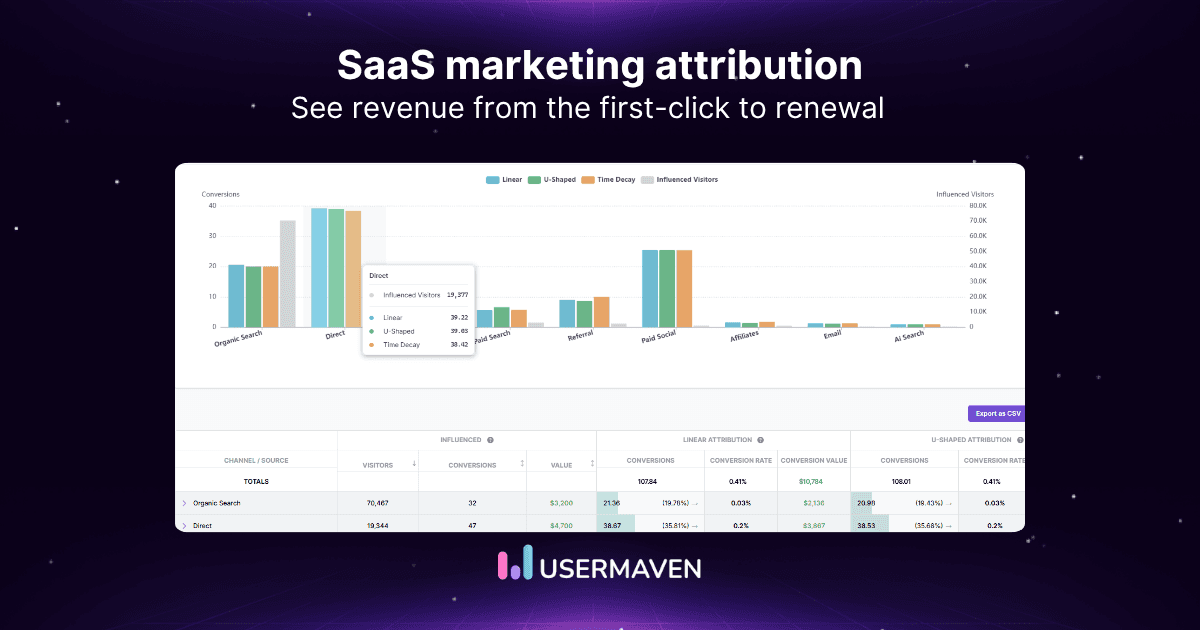
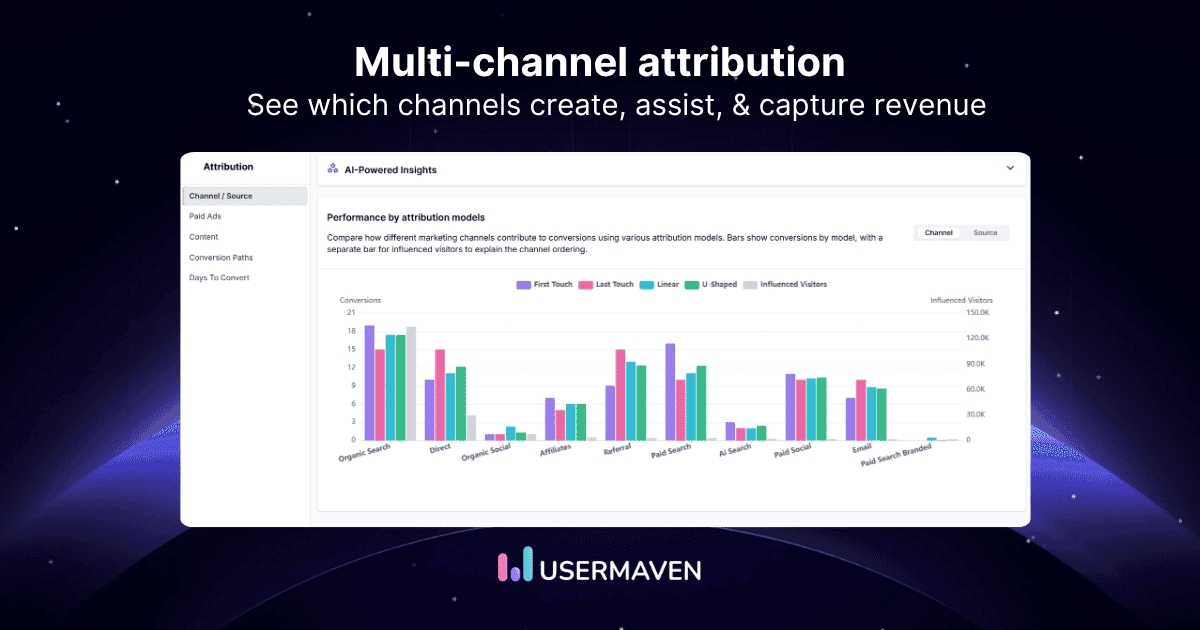
Google says Campaign A drove 40 conversions. Meta says Campaign B drove 35. LinkedIn claims another 20, yet the backend records only 80 customers. Different platforms can be internally consistent while still claiming overlapping credit.
Marketing campaign attribution solves a narrower problem than broad marketing attribution. It connects named campaigns with customer journeys and business outcomes, then applies one model and window so campaign contribution can be compared consistently.
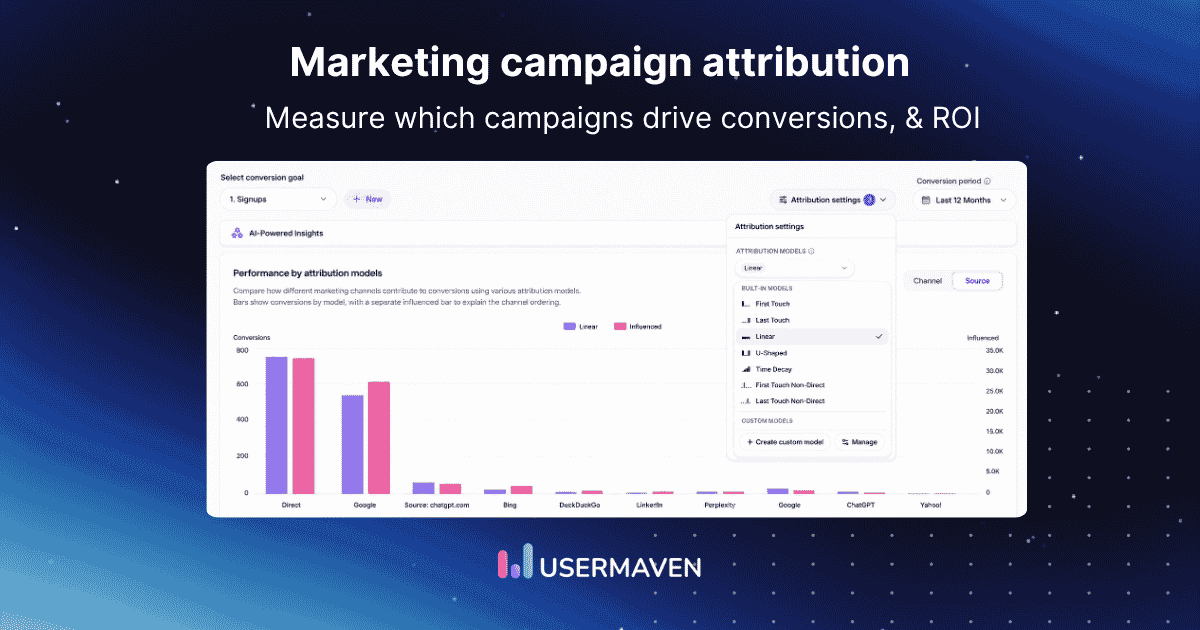
This guide shows how to structure campaign data, choose models and windows, connect campaign credit to pipeline and revenue, and reconcile platform claims. It also shows what a marketing attribution platform should make visible before budget moves.
Marketing campaign attribution at a glance
Marketing campaign attribution assigns conversion, pipeline, or revenue credit to individual marketing campaigns based on their contribution to a customer journey.
Reliable attribution requires clean campaign tracking, a defined model and window, and a trusted outcome source outside individual ad-platform dashboards.
Campaign attribution quick answers
| Question | Short answer | Why it matters |
| What is campaign attribution? | Assigning conversion or revenue credit to specific campaigns | Makes campaign performance comparable |
| Is campaign tracking the same as attribution? | No | Tracking records activity; attribution assigns credit |
| What unit receives credit? | Usually a named campaign | Avoids mixing channel, ad, and creative performance |
| Which model is best? | Depends on the decision | Different models answer different questions |
| Does the attribution window matter? | Yes | A touch outside the window receives no credit |
| Should platform conversions be added together? | No | The same conversion can be claimed by multiple platforms |
| What should campaign attribution optimize toward? | Business outcomes | Lead volume alone can hide poor revenue quality |
Key takeaways
- Campaign attribution is narrower than marketing attribution: The campaign is the primary reporting object receiving credit.
- Tracking and attribution are different: Clean campaign evidence must exist before a model can allocate credit.
- Models change credit, not the underlying conversion: The same journey can produce different campaign rankings under different models.
- Windows control eligibility: A relevant campaign receives no credit if the interaction falls outside the selected lookback period.
- Platform dashboards are not a shared source of truth: Google, Meta, and LinkedIn can claim overlapping conversions under different rules.
- Campaign revenue matters more than lead volume: Pipeline, revenue, CAC, and ROAS support stronger budget decisions.
- Trust comes before optimization: Taxonomy, identity, conversions, and revenue reconciliation should be healthy before spend changes.
What is marketing campaign attribution?
Marketing campaign attribution is the process of assigning conversion, pipeline, or revenue credit to individual marketing campaigns based on their role in a customer journey.

The word campaign matters. “Paid search” is a channel. “Google Ads / US non-brand / demo intent” is a campaign. The reporting object should be explicit enough that two teams would group the same traffic the same way.
Campaign attribution vs other attribution views
| Measurement type | Primary unit | Main question |
| Marketing attribution | All marketing | What marketing contributed |
| Channel attribution | Channel or source | Which channels contributed |
| Campaign attribution | Named campaign | Which campaigns contributed |
| Multi-touch attribution | Individual interactions | Which touches deserve credit |
| Revenue attribution | Commercial outcome | What created pipeline or revenue |
The boundaries matter because campaign reporting should not duplicate the jobs of multi-channel attribution or multi-touch attribution. Campaign attribution uses those ideas when needed, but keeps the named campaign as the decision unit.
Unlock insights that drive growth
Campaign tracking vs. campaign attribution
Campaign tracking and campaign attribution are often used interchangeably, but they answer different questions. Tracking records what happened after an interaction. Attribution decides how much credit a campaign deserves when the customer journey includes other interactions too.
Campaign tracking
Campaign tracking answers: what happened after someone interacted with this campaign? Typical outputs include clicks, visits, signups, leads, purchases, and other conversion events tied to campaign metadata.
Campaign attribution
Campaign attribution answers: how much credit should this campaign receive when other campaigns, channels, or touchpoints also influenced the same customer? The answer depends on the chosen attribution model and eligibility window.
Campaign revenue attribution
Campaign revenue attribution extends the same logic into pipeline or revenue. Instead of stopping at a lead, the system connects campaign evidence with downstream business outcomes and then allocates revenue credit according to the selected model.
| Campaign tracking -> conversion evidence -> attribution -> revenue credit |
A campaign can be tracked correctly and still be attributed incorrectly. Strong conversion tracking confirms that an outcome happened. Attribution still has to decide which campaign interactions are eligible and how credit should be distributed.
Define the campaign hierarchy before assigning credit
Campaign attribution becomes unreliable when a report mixes channels, campaigns, ad groups, and creatives as if they were the same unit. Define the hierarchy before calculating contribution.

| Channel -> source / medium -> campaign -> ad group / ad set -> ad / creative -> landing page |
Channel
A channel is a broad traffic class such as paid search, paid social, email, organic search, referral, or partner. Channel performance answers a different question from campaign performance.
Source and medium
Source and medium identify where traffic came from and the marketing method used. Examples include google / cpc, linkedin / paid-social, and newsletter / email.
Campaign
The campaign is the named initiative being evaluated, such as Q4-enterprise-demo or US-nonbrand-attribution. Campaign names should be stable enough to remain useful after data is joined across advertising, analytics, CRM, and revenue systems.
Ad group, ad set, and creative
Lower-level delivery objects answer more granular questions. A creative can underperform inside a strong campaign, while one strong ad can sit inside a weak campaign. Do not silently turn a creative-level result into a campaign-level conclusion.
Why taxonomy matters
Inconsistent naming produces duplicate campaigns, fragmented reports, and misleading “Other” or “Direct” buckets. Standardized UTM parameters should be paired with platform campaign and ad identifiers when those IDs are available.
How campaign attribution data should flow
The attribution model is only one layer in the measurement chain. Campaign metadata must survive the journey from the first interaction to the business outcome the team actually cares about.
| Campaign -> visitor -> event -> identity -> journey -> conversion -> CRM / revenue -> attribution |
Campaign identifiers
Capture source, medium, campaign, content, and relevant platform IDs. These fields make it possible to distinguish one campaign from another when several campaigns share a channel or landing page.
Behavioral events
Track what happens between the campaign click and the outcome. Events such as form submissions, demo requests, product actions, purchases, and revenue milestones show whether campaign traffic progressed through the journey.
Identity
Anonymous sessions need to connect to known users or accounts when possible. Otherwise, the campaign that introduced the customer can disappear when the person returns later, changes devices, or enters a CRM workflow.
Conversion and revenue
Define the outcome that owns the business decision. First-party data from the website or product can support behavioral evidence, while CRM, billing, or backend systems should remain authoritative for pipeline and revenue where appropriate.
Which campaign attribution model fits which decision?
There is no universally best model for campaign attribution. The useful question is which campaign decision the team is trying to make and what bias each model introduces.
| Campaign question | Useful model | Main risk |
| Which campaign introduced the customer? | First touch | Ignores later influence |
| Which campaign captured the conversion? | Last touch / last non-direct | Overcredits closers |
| Which campaigns participated? | Linear | Treats every campaign equally |
| Which recent campaigns mattered more? | Time decay | Undervalues earlier demand creation |
| Which discovery and closing campaigns matter most? | U-shaped | Simplifies middle influence |
| Which campaigns statistically influenced conversion? | Data-driven | Needs sufficient clean data |
The mechanics are covered in the dedicated marketing attribution models guide. For campaign analysis, the important principle is that changing the model changes campaign credit, not the underlying conversion or revenue.
A data-driven attribution approach can be useful when there is enough clean historical data to estimate contribution patterns. It should not be treated as a shortcut around inconsistent campaign taxonomy or incomplete outcomes.
Attribution model vs attribution window
The attribution model answers who receives credit. The attribution window answers which campaign interactions are eligible to receive credit at all. Confusing the two can make a model comparison look more important than the underlying lookback rule.
A simple window example
Suppose a LinkedIn campaign touched a buyer 45 days before conversion. A 30-day window excludes that interaction. A 60-day window makes it eligible, after which the selected model decides how much credit it receives.
Click-through and view-through eligibility
Paid-media platforms may also treat clicks and ad views differently. A view-through window can make a campaign eligible even when the buyer never clicked, which is useful context when reconciling platform reports with independent attribution.
Amazon’s current Attribution methodology uses a 14-day, last-touch model for qualifying clicks. It is a clear example of why campaign comparisons should state both the attribution model and the window.
For broader implementation guidance, the attribution window guide explains how lookback periods change which interactions remain visible in the conversion path.
See Usermaven in action
Book a free demo and discover how powerful analytics can grow your business.
A worked campaign attribution example
Consider a $20,000 B2B conversion. The buyer first clicked a LinkedIn demand-generation campaign, later attended a webinar campaign, and finally returned through a Google Search campaign before booking the demo that became revenue.

How credit changes by model
| Model | Webinar | Google Search | |
| First touch | 100% | 0% | 0% |
| Last touch | 0% | 0% | 100% |
| Linear | 33% | 33% | 33% |
| U-shaped | 40% | 20% | 40% |
Under U-shaped attribution, the $20,000 becomes $8,000 of credit to LinkedIn, $4,000 to the webinar campaign, and $8,000 to Google Search. The credit changed, but the customer and revenue did not.
That distinction is central to campaign attribution. Models are decision lenses. They help explain contribution, but they do not create new revenue or prove that a campaign caused the conversion.
Cross-channel campaign attribution
Campaign attribution becomes more useful as journeys span multiple channels. A team may need to compare campaigns inside one platform, across platforms, and across the complete customer path without collapsing all three questions into one report.
Within-channel comparison
Within-channel attribution compares campaigns that share a channel, such as Google Campaign A versus Google Campaign B. This is useful for budget allocation inside a paid-search or paid-social program.
Cross-channel comparison
Cross-channel attribution compares campaigns across environments such as LinkedIn demand generation, Google Search capture, and email nurture. Consistent cross-platform ad tracking helps preserve campaign evidence before a shared model compares contribution.
Journey-level campaign roles
A campaign can create demand, assist consideration, re-engage a prospect, capture existing demand, or close the journey. Customer journey analytics helps show those roles without judging every campaign only by last-touch credit.
| Create demand -> assist -> re-engage -> capture demand -> convert |
Campaign revenue attribution
Campaign attribution becomes more valuable when the outcome changes from a lead to pipeline or revenue. Lead volume can identify activity, but revenue outcomes reveal whether a campaign created commercially useful demand.
| Campaign -> lead / contact -> account -> opportunity -> Closed Won -> revenue |
Attributed pipeline
Attributed pipeline is the opportunity value associated with campaign contribution under the selected model. It is useful for B2B teams where a campaign can influence revenue long before a deal closes.
Attributed revenue
Attributed revenue applies the same logic to Closed Won or purchase revenue. The dedicated revenue attribution guide goes deeper into the revenue layer; this article keeps the campaign as the unit being compared.
Campaign ROAS
| Campaign ROAS = attributed revenue / campaign spend |
ROAS becomes more defensible when the numerator comes from a shared revenue source rather than each ad platform using its own conversion value and attribution rules.
Campaign CAC
| Campaign CAC = campaign spend / new customers attributed to the campaign |
CAC should use customers, not raw leads, when the business decision concerns acquisition efficiency. The attribution model still affects which campaign receives customer credit.
Campaign revenue share
| Campaign revenue share = campaign-attributed revenue / total attributed revenue |
The broader set of formulas belongs in the marketing attribution metrics guide. Metrics used in a campaign report should match the business outcome being optimized rather than defaulting to every metric available in the ad platform.
What a campaign attribution report should include
For marketing teams, a useful campaign attribution report should connect campaign metadata with investment, customer outcomes, and the rules used to assign credit. That makes budget decisions auditable instead of presenting conversion totals without the context behind them.
| Field | What it answers |
| Campaign | What is being evaluated? |
| Source / channel | Where did it run? |
| Spend | What was invested? |
| Visits / clicks | What traffic did it produce? |
| Conversions | What outcomes occurred? |
| Attributed conversions | What credit does the model assign? |
| Pipeline | What B2B value was created? |
| Attributed revenue | What revenue receives credit? |
| CAC | What did acquisition cost? |
| ROAS | What revenue came back per dollar? |
| Model | How was credit assigned? |
| Window | Which interactions were eligible? |
Campaign report vs ad-platform dashboard
Ad-platform dashboards are useful for delivery and optimization inside each network. Cross-channel campaign attribution should answer a different question: how do campaigns compare when they are evaluated against the same business outcomes and the same credit rules?
A shared analytics dashboard can combine campaign, conversion, pipeline, and revenue views, but the underlying measurement rules still need to be documented.
Why ad-platform campaign totals disagree
Ad platforms are designed to explain the value of their own advertising. That creates a predictable problem when several platforms can claim the same conversion under different identity, timing, and eligibility rules.
| System | Claimed conversions |
| Google Ads | 55 |
| Meta Ads | 45 |
| LinkedIn Ads | 20 |
| Backend customers | 100 |
The three ad platforms claim 120 conversions in total, even though the backend records 100 customers. The extra 20 are not necessarily fake conversions. They can be duplicate claims for customers who interacted with more than one platform.
Why the numbers diverge
- Different attribution windows: One platform may allow a longer lookback period than another.
- View-through credit: A platform can count an impression that an independent click-based report does not.
- Different identity rules: Networks use their own logged-in and modeled identity signals.
- Different reporting dates: Platforms can assign the same conversion to different dates.
- Self-attribution: Each network evaluates whether its own campaign deserves credit.
These ad platform discrepancies are why campaign attribution should reconcile platform claims against a trusted backend, CRM, or billing outcome instead of adding platform conversion totals together.
How to know if campaign attribution can be trusted
A sophisticated model cannot compensate for broken campaign tags, incomplete conversions, weak identity, or incorrect revenue. Measurement health should be checked before the team reallocates budget.
| Tracking -> identity -> outcome -> revenue -> reconciliation -> confidence |
Campaign taxonomy health
Check whether source, medium, campaign names, and platform IDs arrive consistently. A campaign split across several naming variants will understate its contribution even when every later step works correctly.
Event completeness
Make sure the outcomes that matter actually arrive. Leads, demos, purchases, subscriptions, upgrades, or Closed Won events cannot be attributed if the system never receives them.
Identity quality
Check whether repeated sessions and known customer records connect reliably enough for the journey being analyzed. Identity gaps often erase early campaign evidence and over-credit later direct or branded visits.
CRM and revenue completeness
For B2B campaign revenue attribution, opportunity stages, amounts, account associations, and Closed Won outcomes need to be complete. Otherwise, marketing can look weak simply because downstream records are missing.
Conversion feedback and reconciliation
Review whether conversion syncs are missing, duplicated, or stale. Then compare attributed outcomes against the system that owns the business result. The goal is explainable variance, not artificial agreement between every dashboard.
Measurement Trust Center
Usermaven’s Measurement Trust Center checks campaign tracking, customer matching, connected platforms, conversion feedback, and data confidence. It combines those checks into a Trust Score and surfaces high-impact fixes before attribution results drive budget decisions.
Campaign attribution by business model
For B2B SaaS, the useful outcomes are usually qualified pipeline, Closed Won revenue, CAC, and sales-cycle quality. B2B marketing attribution adds account-level context when several people and campaigns influence the same opportunity.
B2B SaaS
| Campaign -> lead / account -> opportunity -> pipeline -> revenue |
The useful outcomes are usually qualified pipeline, Closed Won revenue, CAC, and sales-cycle quality. B2B marketing attribution adds account-level context when several people and campaigns influence the same opportunity.
PLG SaaS
| Campaign -> signup -> activation -> upgrade -> retention |
For PLG teams, campaign quality is often clearer after activation. Connecting acquisition with product analytics makes it possible to compare campaigns by activated users, upgrades, and retention instead of signup volume alone.
Ecommerce
| Campaign -> product / session -> checkout -> order -> revenue -> repeat customer |
For ecommerce brands, campaign attribution should continue from acquisition through checkout, purchase revenue, and repeat-customer behavior. This helps distinguish campaigns that generate cheap first orders from those that create more valuable customers.
The broader ecommerce attribution workflow goes deeper into assigning credit across the complete purchase journey.
Agencies
For marketing agencies, campaign attribution needs to survive client scrutiny. Reporting should show how campaign spend connects to conversions and revenue while documenting the model, window, and source of truth behind the result.
This makes campaign reporting easier to defend across clients because performance is tied to consistent measurement rules rather than whichever ad platform claims the most conversions.
For multi-client teams, marketing attribution for agencies also needs consistent account structure and reporting so campaign evidence can be defended rather than presented as a black box.
Attribution does not prove campaign incrementality
A campaign can receive a large share of attribution credit without proving that the campaign created incremental demand. Attribution describes observed contribution. Incrementality asks what would have happened without the campaign.
| Method | Main question |
| Attribution | Which campaigns receive observed credit? |
| Incrementality | Did the campaign cause additional conversions? |
| Marketing mix modeling | How much did aggregate channel investment contribute overall? |
Google Ads describes Conversion Lift as an incrementality approach that compares treatment and control groups to estimate conversions caused by advertising. That is a causal question, not simply another attribution model.
The comparison between user-level attribution and aggregate measurement is covered in more depth in Marketing mix modeling versus multi-touch attribution. A highly attributed campaign is not automatically an incremental campaign.
How to build marketing campaign attribution
Do not begin by choosing first touch, linear, or data-driven attribution. Begin by defining the campaign object, business outcome, data sources, and trust checks that will feed every model.

1. Define the business outcome
Choose the result that matters: lead, qualified opportunity, activation, purchase, subscription, Closed Won revenue, or another business event. Campaign attribution is only as useful as the outcome it is trying to explain.
2. Define the campaign hierarchy
Document which level receives credit and how channel, source, campaign, ad set or ad group, creative, and landing page relate to one another. This prevents teams from comparing different reporting objects accidentally.
3. Standardize campaign taxonomy
Create naming rules for source, medium, campaign, content, and platform identifiers. Apply them consistently across paid, email, partner, and other measurable campaign types.
4. Capture first-party events
Track the events that connect the campaign with meaningful behavior and outcomes. Server-side tracking can strengthen measurement when important events happen outside the browser or when browser-only collection is incomplete.
5. Resolve visitor and customer identity
Connect anonymous activity to known users or accounts when the use case requires it. Preserve campaign context through return visits and later conversions instead of restarting the journey after identification.
6. Connect CRM or billing outcomes
For B2B revenue attribution, a marketing attribution CRM integration should bring leads, contacts, companies, opportunities, stage history, and revenue into the same measurement chain. Ecommerce and subscription businesses may rely more heavily on billing or backend revenue.
7. Select the attribution window
Choose a lookback period that matches the buying cycle and channel behavior. State the window in campaign reports so readers know which interactions were eligible for credit.
8. Compare attribution models
Apply several models to the same conversion goal when the decision is sensitive to credit logic. Differences between first touch, last touch, linear, time decay, or position-based views can reveal which campaigns create versus capture demand.
9. Reconcile platform claims
Compare campaign claims against backend, CRM, or billing outcomes. Investigate large differences before reallocating spend, especially when platforms use different windows or view-through rules.
10. Build campaign reporting
Combine campaign name, spend, attributed conversions, pipeline, revenue, CAC, ROAS, model, and window. Keep the report compact enough that the budget decision remains obvious.
11. Review contribution before reallocating budget
Ask whether the campaign creates, assists, re-engages, captures, or converts demand. A campaign that rarely closes may still be valuable if removing it would starve the rest of the journey.
12. Audit measurement health
Run campaign, identity, conversion, revenue, and platform-connection checks before major optimization decisions. Fix measurement problems before debating which model produces the preferred answer.
Common campaign attribution mistakes
Mixing channel and campaign attribution
Paid search, paid social, and email are channels. Campaigns are named initiatives inside or across those channels. Mixing the two produces vague conclusions and weakens budget decisions.
Inconsistent UTM naming
One campaign can split into several rows when naming varies by capitalization, spelling, or ownership. Normalization should happen before attribution reporting, not after budget has already moved.
Choosing the model before defining the outcome
A sophisticated model cannot rescue a vague conversion goal. Decide whether the report is about leads, customers, pipeline, revenue, activation, or another outcome first.
Treating last click as the only truth
Last click is useful for demand capture, but it can over-credit branded search, direct, retargeting, or closing campaigns while hiding the programs that created demand earlier.
Ignoring the attribution window
An earlier campaign can disappear from every model if its interaction sits outside the lookback period. Model comparisons should therefore state the window alongside the model.
Adding platform conversions together
Cross-platform totals can double-count customers because several networks claim the same conversion. Use a shared backend outcome for reconciliation rather than summing self-attributed platform numbers.
Optimizing for conversions instead of revenue quality
Cheap leads can be commercially weak. Campaign reporting becomes more useful when conversions are connected to pipeline, revenue, customer quality, or retention where those outcomes matter.
How AI can improve campaign attribution analysis
AI is useful after campaign tracking and outcome data are connected. It can reduce the time required to compare campaigns, investigate anomalies, analyze journeys, and turn recurring questions into reusable reports.
- Which campaigns created the most pipeline this month?
- Which campaigns create revenue rather than just leads?
- Which campaigns assist conversions but rarely close them?
- Why did campaign ROAS fall?
- Which campaigns produce higher-LTV customers?
- Which platform is over-reporting conversions relative to backend data?
- Which campaigns deserve investigation before budget is reduced?
AI cannot repair bad campaign taxonomy, missing conversions, broken identity, or incorrect revenue. It can accelerate analysis, but it cannot turn incomplete campaign evidence into trustworthy attribution.
How Usermaven supports campaign attribution

Usermaven is an AI marketing attribution platform that helps teams trace named campaigns through customer journeys, conversions, pipeline, and revenue, then compare campaign contribution using consistent models, windows, and measurement-health checks.
Compare channel and source credit

Usermaven’s multi-touch attribution software compares channel and source contribution across seven models and lookback windows up to 365 days. This gives campaign analysis a consistent attribution context before teams drill into paid campaigns and ads.
Follow campaign roles across conversion paths

Conversion Paths show where touchpoints appear early, in the middle, and late in the journey. That helps teams distinguish campaigns that create, assist, re-engage, or capture demand instead of judging every campaign by the final visit.
Connect paid campaign spend to revenue

Paid attribution connects campaign spend with conversions and attributed revenue so teams can evaluate CAC and ROAS against shared business outcomes instead of relying only on each ad platform’s conversion claims.
Connect campaign evidence to CRM outcomes
For B2B campaigns, customer activity can continue into contact, company, opportunity, and Closed Won context. Contacts Hub helps keep known people and companies connected to the campaign journey without replacing the CRM.
Measurement trust
The Measurement Trust Center provides a diagnostic layer for campaign tracking, customer matching, platform connections, conversion feedback, and data confidence. It is designed to surface measurement problems before attribution drives spend decisions.
Maven AI
Maven AI can analyze which channels, campaigns, and touchpoints contribute to conversions and revenue, compare conversion paths, and surface underperforming campaigns. The practical value is faster investigation across the same connected dataset.
MCP for external AI workflows
Usermaven MCP connects authorized Usermaven analytics with MCP-compatible tools such as ChatGPT, Claude, Cursor, and Codex. Teams can query campaign attribution, revenue, funnels, journeys, dashboards, and related analytics from those AI clients.
Read and write permissions remain separate. Approval-gated write actions can create or update supported objects such as funnels, segments, dashboards, reports, conversion goals, and attribution views.
Campaign attribution in practice: ContentStudio
ContentStudio is a useful campaign-attribution example because its problem was not missing clicks. The team already had campaign and cost data from Google Ads and Meta Ads.
What the platform reports did not reliably show was which campaigns produced paying customers, plan upgrades, or revenue.
The measurement problem
ContentStudio needed one attribution view connecting paid campaigns with signups, demo bookings, subscription upgrades, and revenue. That would let the team compare campaigns using actual customer outcomes instead of platform-reported conversion counts.
What changed
After implementing Usermaven, the ContentStudio case study reports 128% growth in signups, 92% more plan upgrades, 242% more demo bookings, and a 30% increase in ROAS. These are vendor-published customer results, not guaranteed benchmarks for every team.
Why the case matters
The most relevant lesson is campaign-level visibility connected to revenue. ContentStudio could identify which campaigns produced paying users and compare cost per paying customer.
That made it possible to shift spend toward campaigns where attribution confirmed revenue rather than relying on clicks or assumed ROAS.
Marketing campaign attribution checklist
- Define the campaign: Know exactly which reporting object receives credit.
- Define the outcome: Choose lead, activation, opportunity, revenue, or another business result.
- Standardize tracking: Keep UTMs and platform IDs consistent across campaigns.
- Capture first-party events: Do not rely only on ad-platform reporting.
- Resolve identity: Preserve the customer journey across sessions and systems where possible.
- Connect CRM or revenue: Tie campaign evidence to real business outcomes.
- Choose the window: Match eligibility to the customer journey.
- Choose the model: Align credit logic with the decision being made.
- Reconcile platforms: Compare claims against backend, CRM, or billing truth.
- Audit trust: Fix measurement gaps before reallocating spend.
Final verdict
Marketing campaign attribution is not simply counting conversions by UTM. It is a credit system applied to a trusted campaign measurement chain so named campaigns can be compared against the same customer and business outcomes.
Reliable campaign attribution combines campaign taxonomy, events, identity, conversions, revenue, an explicit attribution model, a stated window, and reconciliation. Removing any of those layers makes the final campaign ranking harder to trust.
The strongest campaign report connects credit with pipeline, revenue, CAC, and ROAS, then uses incrementality alongside attribution when the decision depends on causality rather than observed contribution alone.
Ready to see Usermaven in action? Explore the platform or book a demo for a closer look.
FAQs
1. What is marketing campaign attribution?
Marketing campaign attribution assigns conversion, pipeline, or revenue credit to individual marketing campaigns based on their role in a customer journey. It helps teams compare campaign contribution using a defined attribution model and window.
2. What is the difference between campaign tracking and campaign attribution?
Campaign tracking records what happened after a campaign interaction, such as visits, leads, or purchases. Campaign attribution decides how much credit that campaign deserves when other campaigns or touchpoints also influenced the same customer.
3. What is the best marketing campaign attribution model?
There is no single best model. First touch is useful for campaign discovery, last touch for demand capture, linear for shared participation, time decay for recent influence, and U-shaped for emphasizing discovery and closing. The right model depends on the decision.
4. How do you attribute revenue to a marketing campaign?
Capture campaign metadata, connect the visitor or account to a conversion, import the trusted CRM, billing, or backend revenue outcome, and then apply a defined attribution model and window to allocate revenue credit across eligible campaign interactions.
5. What is a campaign attribution window?
A campaign attribution window is the lookback period during which a campaign interaction remains eligible for conversion credit. An interaction outside the window receives no credit even if the chosen attribution model would otherwise include it.
6. Why do Google, Meta, and LinkedIn report different campaign conversions?
They can use different identity signals, reporting dates, click and view-through windows, and attribution rules. The same customer may therefore be claimed by several platforms. Cross-channel reporting should reconcile those claims against a shared backend outcome.
Updated

Written by
Adeel Khan
Growth Marketing Expert
Adeel Khan is a full-stack SaaS marketer with 10+ years of experience in content marketing, paid advertising, analytics, and conversion rate optimization. He shares practical insights and strategies drawn from hands-on experience, helping B2B SaaS marketers improve performance and make better marketing decisions.
All articles by Adeel →